
Artist
Titian
1488–1576
Works (27)
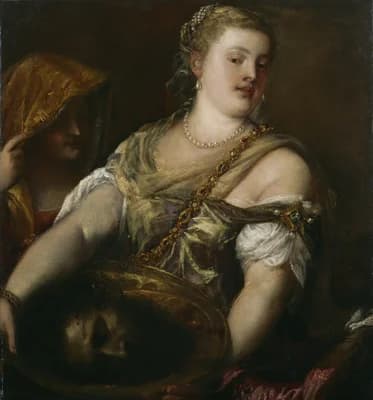
洗礼者聖ヨハネの首を持つサロメ
1560
The Rape of Europa
1560
Tarquin and Lucretia
1571

Equestrian Portrait of Charles V
1548
Portrait of Isabella d'Este
1535
Portrait of Laura Dianti
1520
Allegory of Marriage
1530

The Death of Actaeon
1567
Venus of Urbino
1538
Portrait of Gerolamo (?) Barbarigo
1510

Crucifixion
1558

Pietà
1575

Sacred and Profane Love
1514

Jupiter and Antiope
1551

Diana and Callisto
1557
Salome with the Head of John the Baptist
1515

Perseus and Andromeda
1554

Bacchus and Ariadne
1520

Assumption of the Virgin
1517

Venus and Music
1550

Pope Paul III and His Grandsons
1546
Altarpiece of San Nicolò della Lattuga
1520

The Flaying of Marsyas
1573

Diana and Actaeon
1557

Alfonso d'Este (1486–1534), Duke of Ferrara

Doge Andrea Gritti (1455–1538)

Venus and the Lute Player
ca. 1565–70
Timeline
Titian was born around 1488 in Pieve di Cadore near Venice. Coming from an established family, he was sent to Venice at age nine with his brother to apprentice as a painter.1
In Venice, he studied under Gentile Bellini and his brother Giovanni Bellini. Training in these major workshops allowed him to develop the talent that would later define the Venetian school's golden age.1
In his youth, he rivaled Giorgione, collaborating on the Fondaco dei Tedeschi frescoes in 1508. Their styles were so similar that many masterpieces once attributed to Giorgione are now recognized as Titian's.1
His early work 'A Man with a Quilted Sleeve' (c. 1509) deeply impressed Rembrandt. The Dutch master sketched it at an auction and used it as a key inspiration for his own self-portraits.1
In 1511, he painted frescoes of the life of St. Anthony in Padua. Works like 'The Miracle of the Jealous Husband' demonstrate his early mastery of dramatic expression and spatial arrangement.1
In 1513, Titian petitioned to paint a battle scene for the Doge's Palace and requested a 'sansaria' (broker's patent), showing his strong ambition to establish his financial and professional status.1
Titian lived an exceptionally long life, painting until his death in 1576. Although he claimed to be nearly 100 in letters to the King of Spain, modern scholars believe he was in his late 80s.1