Artist
Francisco Goya
Spain, 1746–1828
Works (22)
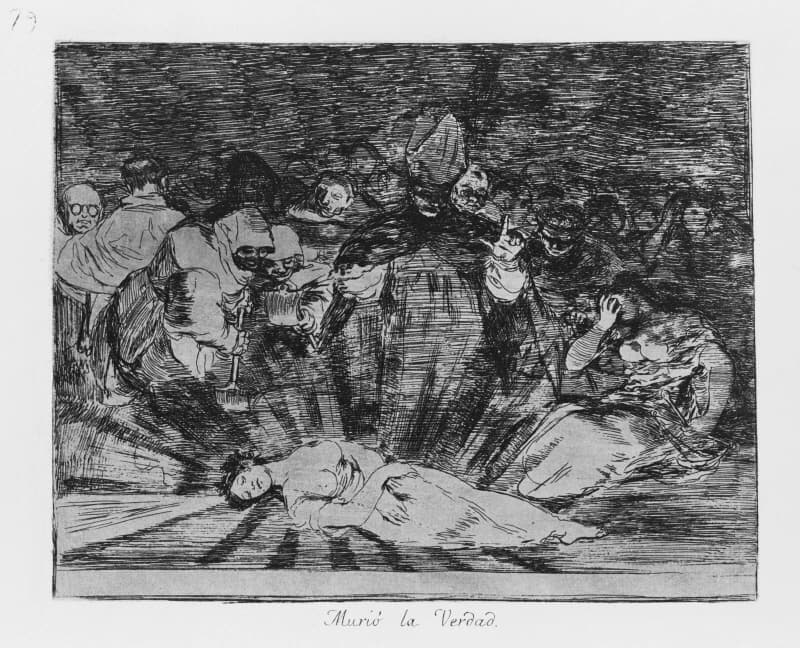
『戦争の惨禍』:真理は死んだ
1810
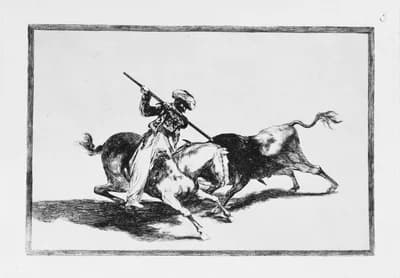
『ラ・タウロマキア』:勇壮なモーロ人ガスールは、規則に従って牡牛を槍で突いた最初の男
1816
Charles IV of Spain and His Family
1800
Truth, Time and History
1797

Portrait of the Duke of Wellington
1812

the bullfight
1780
The Dog
1819

La maja desnuda
1795

El albañil borracho (boceto)
1786
Two Old Men
1819
Self-portrait with Dr Arrieta
1820

Saturn Devouring His Son
1820

Josefa Bayeu
1814

Don Juan and the Commendatore

the witches kitchen

The incantation

A Village Bullfight
1815

Witches' Sabbath
1820

Self-Portrait
1815

The Victorious Hannibal Seeing Italy from the Alps for the First Time
1770
The Colossus
1818
The Third of May 1808
1814
Timeline
At age 14, Goya studied under José Luzán and later with Anton Raphael Mengs in Madrid. However, he clashed with Mengs and was twice denied entry to the Royal Academy, marking a difficult start to his career.1
His brother-in-law, Francisco Bayeu, played a key role in Goya's early career; his recommendation for the Royal Tapestry Factory was a major stepping stone to becoming a court painter.1
Appointed as a court painter in 1786, Goya's early career was marked by portraits of the aristocracy and Rococo-style tapestry cartoons for royal palaces, achieving success in high society.1
In 1793, a severe illness left Goya completely deaf. This tragedy transformed his style from bright colors to dark, pessimistic expressions reflecting inner darkness and social irony.1
In 1799, he became the Prime Court Painter. Commissioned by Godoy, his 'La maja desnuda' shocked art history as a daring nude that challenged the taboos of the time.1
Heavily influenced by Velázquez, as seen in 'Charles IV and His Family' (1800), Goya opened the door to modern painting by adding unique psychological depth to traditional techniques.1
Witnessing the horrors of the Peninsular War, Goya captured the shock in works like 'The Third of May 1808,' vividly denouncing the madness of war and the suffering of the people.1
The 'Black Paintings' series, painted directly onto the walls of his home 'Quinta del Sordo,' represents the peak of his despair, using oil on plaster to depict primal human fears.1
Exiling himself to Bordeaux at 78 to escape political turmoil, Goya remained creative despite paralysis, experimenting with lithography until his death at age 82.1