Artist
Raphael
Italy, 1483–1520
Works (15)

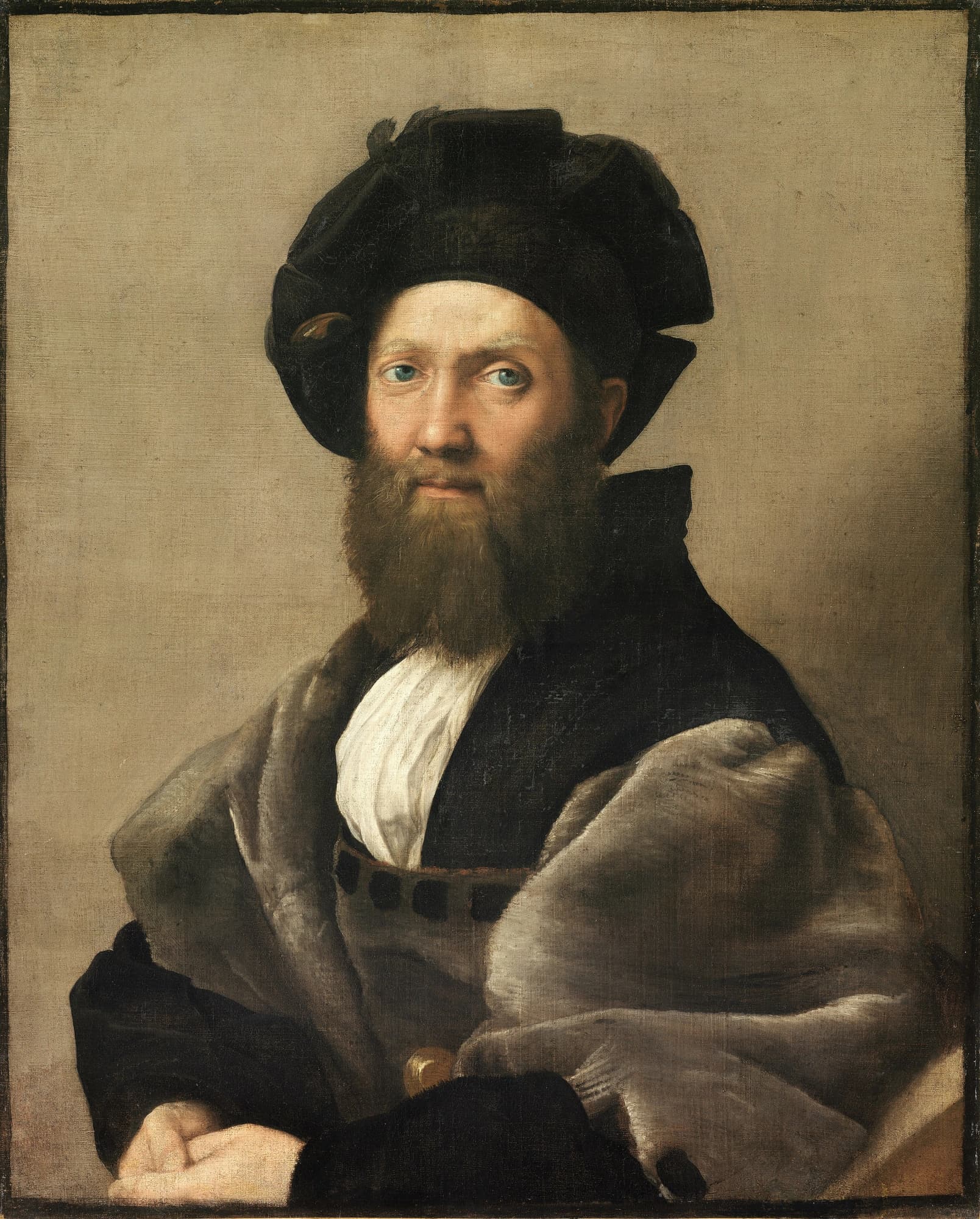
Portrait of Baldassare Castiglione
1515

Portrait of Doña Isabel de Requesens y Enríquez de Cardona-Anglesola
1518

Ansidei Madonna
1505
The Deposition
1507
The Ecstasy of Saint Cecilia
1514

St. Michael Vanquishing Satan
1518

Garvagh Madonna
1500

Madonna della Seggiola
1513

La fornarina
1519
Madonna of Loreto
1509

Portrait of a Young Man
1513

Sistine Madonna
1512

The School of Athens
1512
Transfiguration
1518

Giuliano de' Medici (1479–1516), Duke of Nemours
Timeline
Born in 1483 in the cultured city of Urbino. Influenced by his father, a court painter, he acquired excellent manners and social skills from childhood, which later contributed to his success with high-ranking patrons.1
Raphael was recognized as an independent master around 1500 and created the Baronci Altarpiece between 1500 and 1501.2
Around 1500, he worked as an apprentice or assistant to Perugino. His early style was so similar to his master's that they were hard to distinguish, absorbing techniques like oil varnish and specific paint application.1
During his four years in Florence (1504–1508), he absorbed the artistic traditions of Leonardo and others, evolving from his early traditional style into a more dynamic and sophisticated personal approach.1
Raphael moved to Rome at the age of 25 in 1508 and resided there for the rest of his life.3
In 1508, invited by Pope Julius II, he moved to Rome to work on the Vatican Palace. He gained the trust of popes and cardinals, achieving great success and even beginning work as an architect.1
In 1508, Raphael was invited to Rome by Pope Julius II and received the important commission to fresco the Vatican Palace.2
The School of Athens, a fresco in the Raphael Rooms of the Vatican Palace, is his most famous work. It is considered a perfect embodiment of the intellectual ideals of the High Renaissance.1
He died in 1520 at the young age of 37 at the height of his powers. Despite his early death, his harmonious and balanced classical style remained the standard of beauty in Western art for centuries.1
In the 18th and 19th centuries, his serene style heavily influenced Neoclassical painting. Conversely, groups like the Pre-Raphaelite Brotherhood later explicitly rejected his techniques as artificial.1