Artist
Dante Gabriel Rossetti
Works (9)


Timeline
Born in London to an Italian émigré scholar, he grew up in an intellectual household alongside his sister Christina, immersed in the works of Dante and Shakespeare.1
In 1848, he founded the Pre-Raphaelite Brotherhood with Hunt and Millais, rejecting post-Raphael Mannerism in favor of the detailed compositions and intense colors of the Quattrocento.1
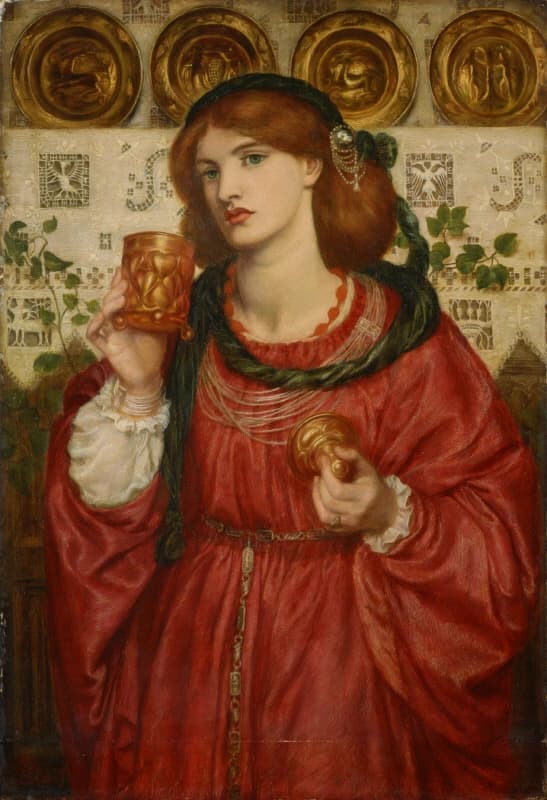
In his early oils, he used watercolor brushes to apply thin layers on white-primed canvases, achieving a smooth surface and transparent, luminous tints.1
Elizabeth Siddal, met in 1850, became his primary muse, pupil, and wife, serving as a central source of artistic inspiration throughout much of his career.1
Deeply influenced by Dante Alighieri and Arthurian romance, he entwined poetry and image, often writing sonnets to accompany his symbolic paintings.1
Following harsh criticism in 1850, he turned to watercolors for private sale and rarely exhibited publicly, later gaining the influential support of John Ruskin.1
His only major modern-life subject, 'Found' (begun 1853), remained unfinished as he increasingly preferred symbolic and mythological images over realism.1
He developed a watercolor method using thick pigments mixed with gum to create rich effects similar to medieval illuminated manuscripts.1
He inspired William Morris and Edward Burne-Jones, collaborating with them on the Oxford Union murals and paving the way for the Aesthetic movement.1
Rossetti's sensual and medievalist style was a major precursor to European Symbolism and significantly influenced the late 19th-century Aesthetic movement.1