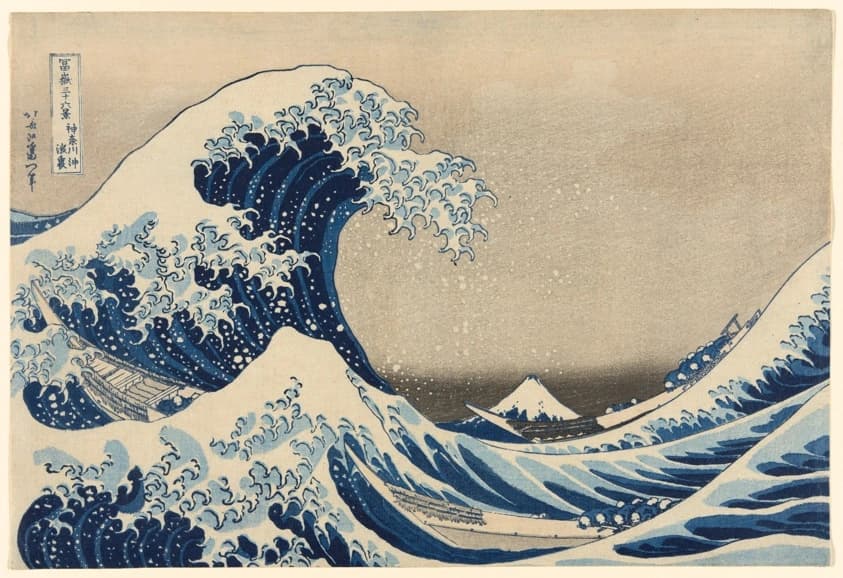
When you hear "a Hokusai print," the first thing that comes to mind is probably that great wave.
But have you ever really looked closely at that picture? Between the curling crests of the wave, far in the back of the composition, stands a surprisingly tiny Mount Fuji, all alone. Perhaps the star isn’t the wave after all.[1]
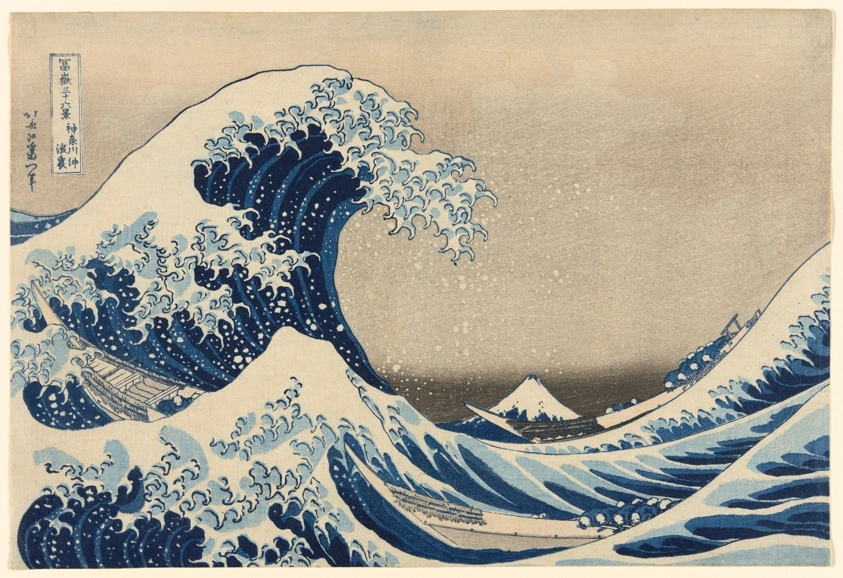
And this is no ordinary sea. The three boats being tossed about are oshiokuri-bune, fast cargo boats carrying fish from Boso to Edo, with roughly thirty people aboard in all. The waves are said to tower more than ten meters high, and recent research suggests Hokusai painted not a tsunami but a sudden "rogue wave." The scattering spray looks almost like snow falling on Fuji. Hokusai deliberately set the raging instant against the unmoving mountain.[1]
Why the people of Edo longed for Fuji
But why did Hokusai paint Fuji so many times in the first place? For the Japanese, Mount Fuji was never just a tall mountain. Ever since "The Tale of the Bamboo Cutter," said to be the oldest of tales, Fuji had been a sacred mountain linked to immortality. In the Edo period, a form of faith called Fuji-ko, worshipping Fuji as a god and making pilgrimages to it, swept the land. Fuji was everyone’s longing.
Hokusai and Hiroshige, the two masters who define the famous-view print, saw the same mountain through utterly different eyes. Let us set their two Fujis side by side and trace the difference.
Hokusai, an extraordinary artist
By the way, Hokusai was quite an eccentric. Across a life of nearly ninety years he changed his art name (his signature as a painter) more than thirty times, and in his final years called himself Gakyo Rojin Manji, "the old man mad about painting." He left behind more than thirty thousand works. And he took up that Fuji series only after he had passed the age of seventy.[8]
Hokusai’s Fuji was always "drama"
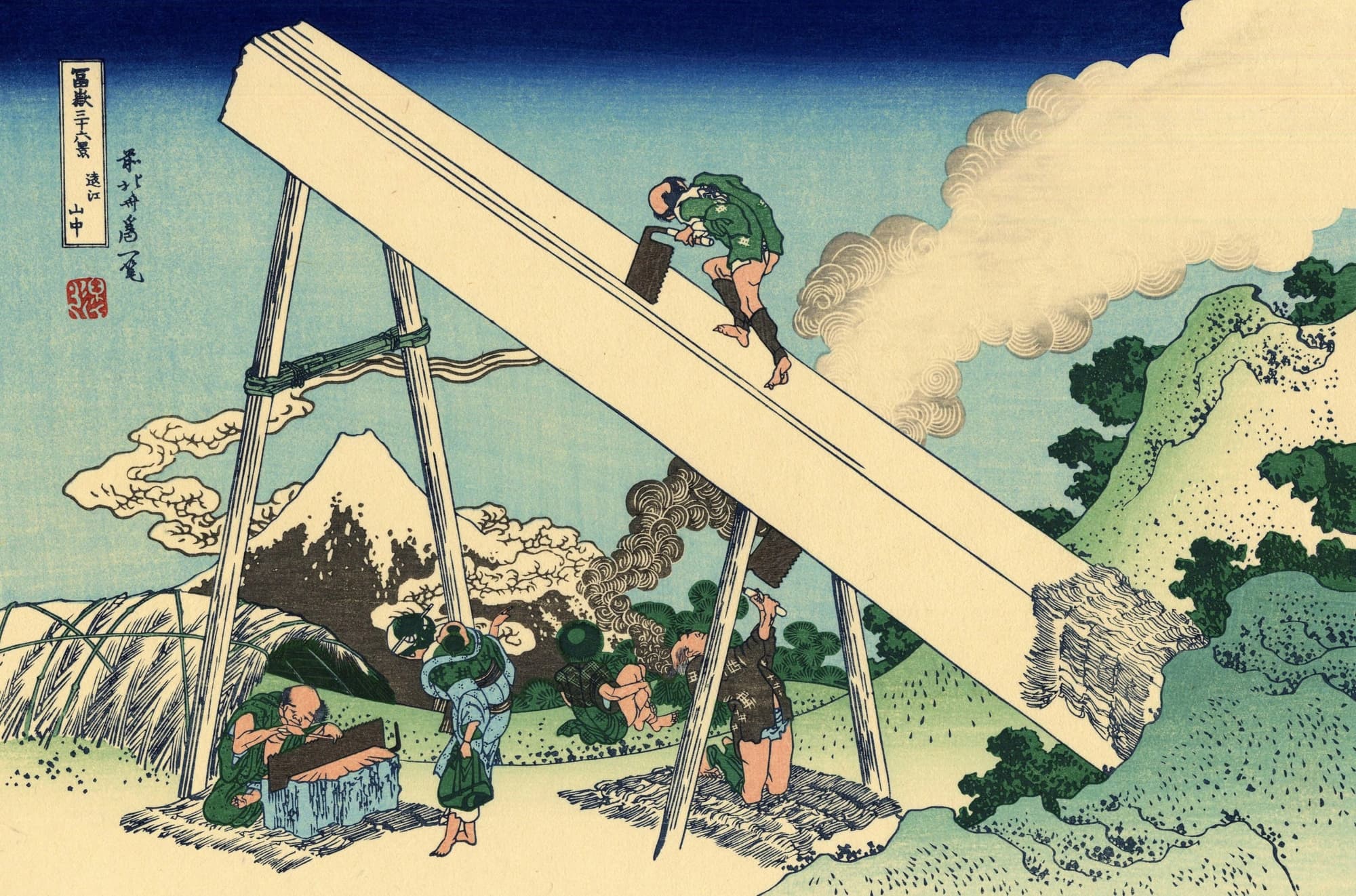
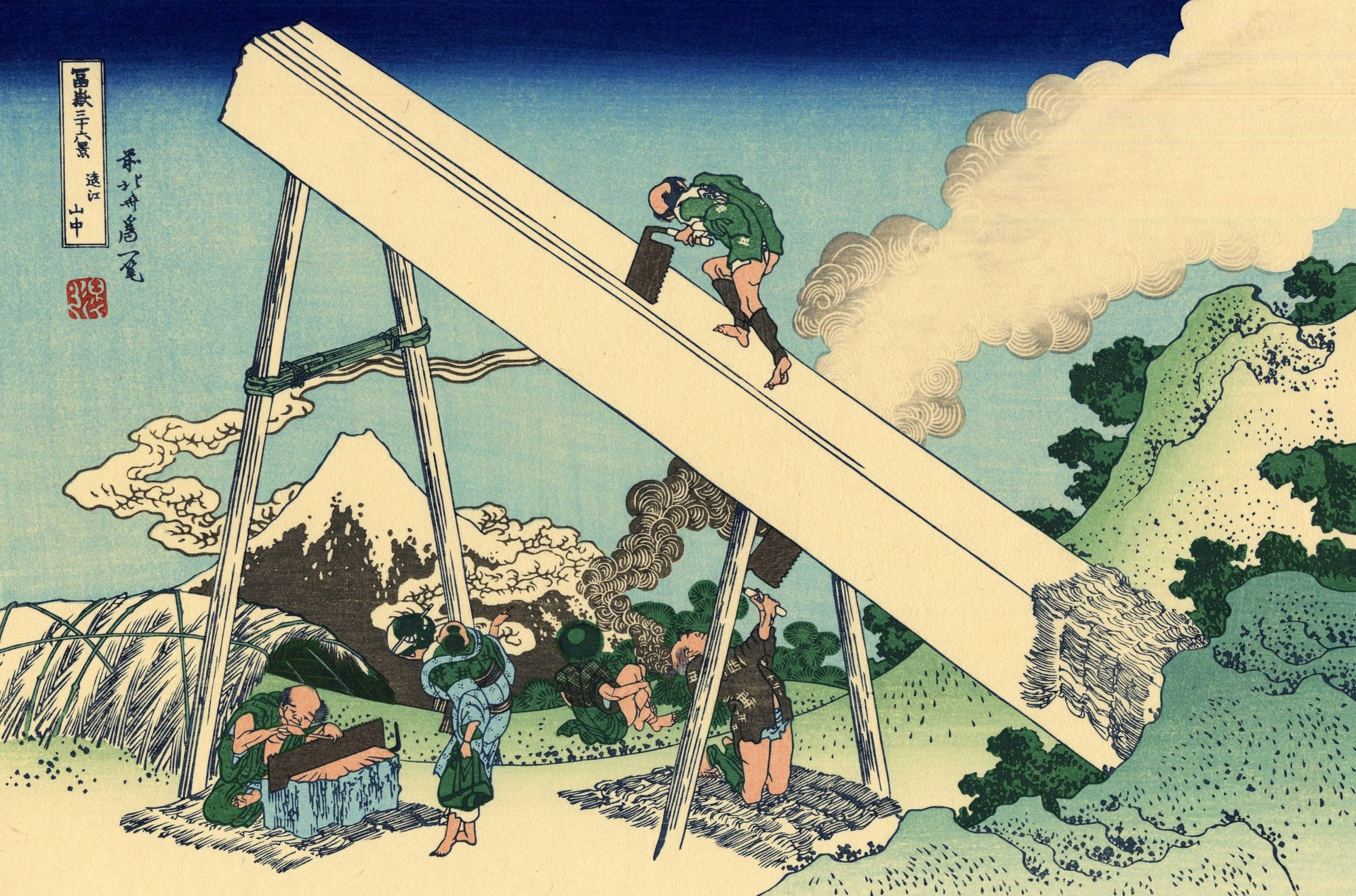
Hokusai’s Fuji was always, somehow, theatrical. Fuji is usually paired with something. With curling waves. Or, in "In the Totomi Mountains," with an enormous beam of timber slashing diagonally across the picture. Craftsmen saw the wood, a man sharpens a saw, a boy tends a fire, a mother carries a baby on her back. Beyond the bustle of this mountainside workshop, Fuji pokes its head out through the triangular gap formed by the beam. This "framing" technique beautifully contrasts the powerful movement in the foreground with the quiet Fuji far away. In the smoke of the fire he even tried Western-style shading, rare for the ukiyo-e of his day.[2]
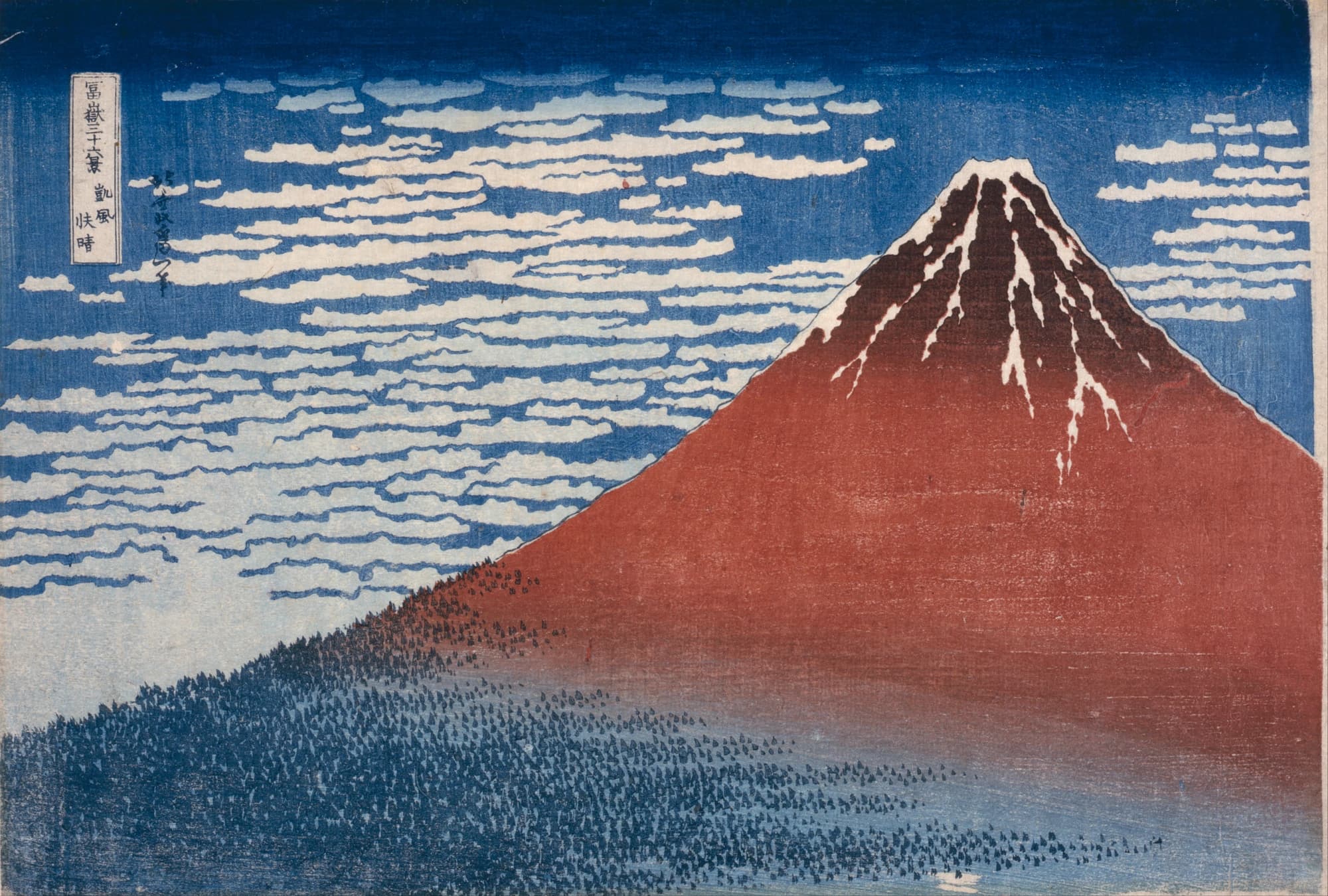
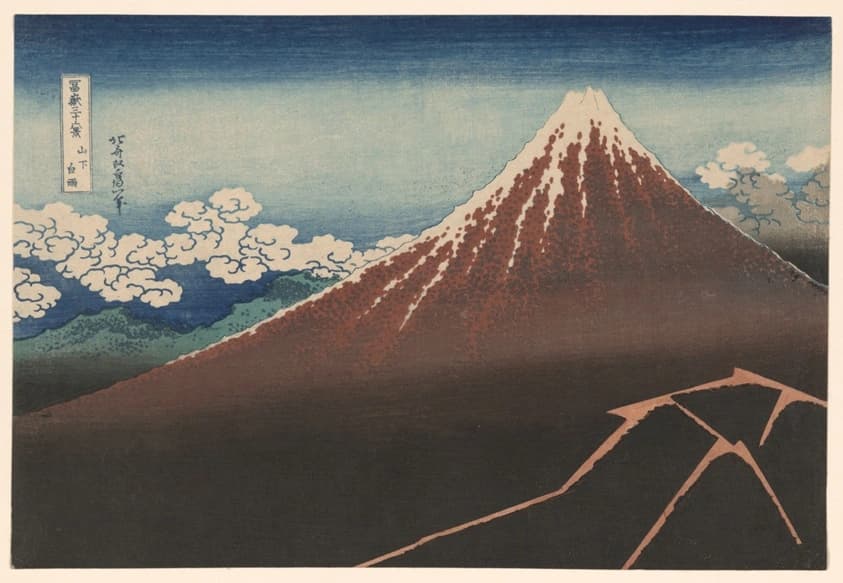
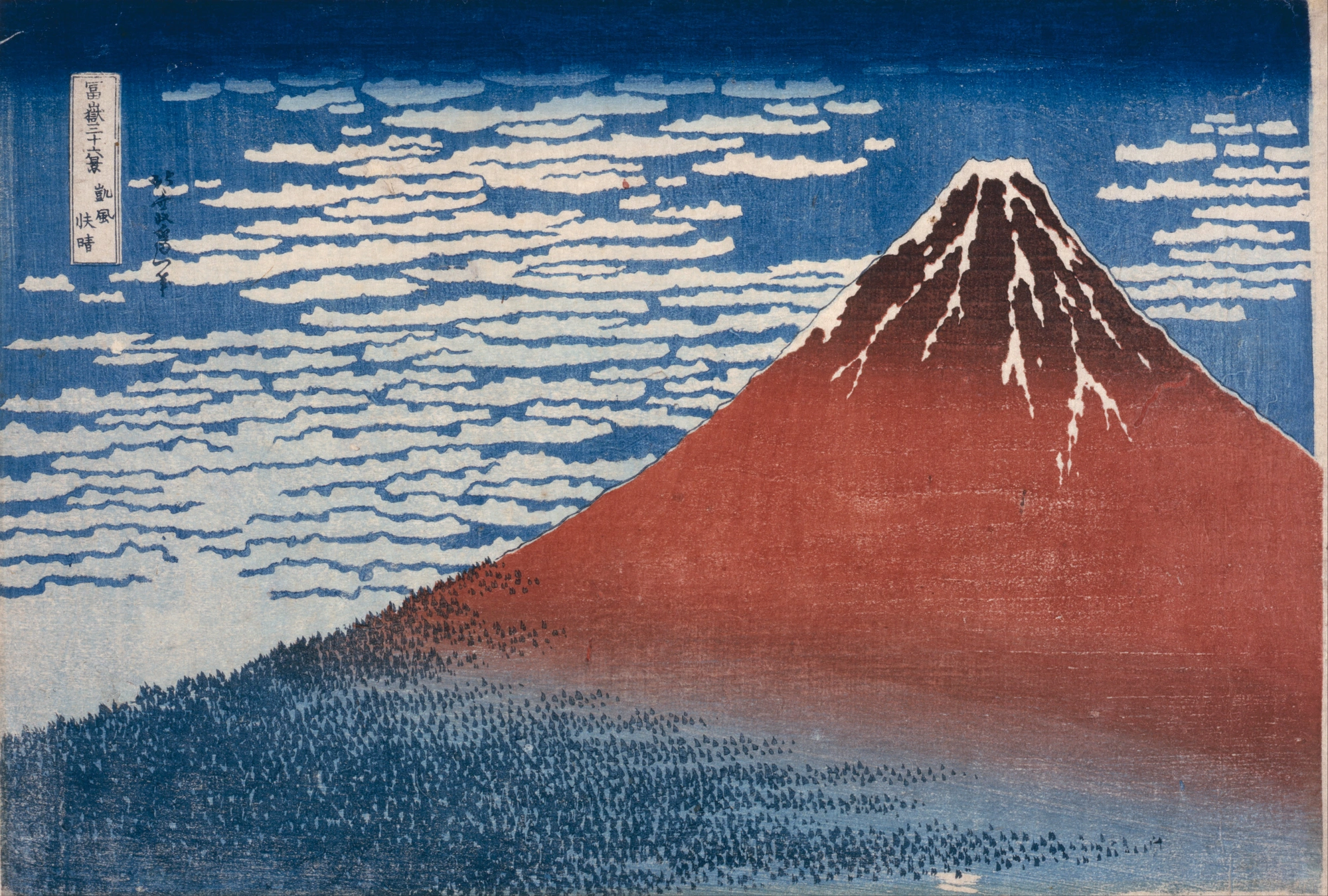
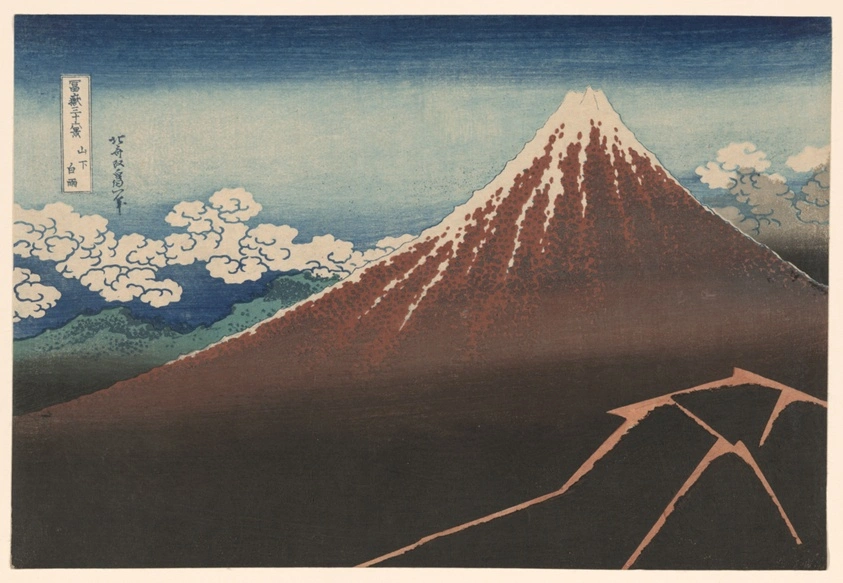
Hokusai stages his drama through weather and color too. There is the majestic Fuji filling the whole picture in "Fine Wind, Clear Morning," popularly known as the "Red Fuji." And there is "Rainstorm Beneath the Summit," where black lightning streaks below the clear peak, also called the "Black Fuji." These two, together with "The Great Wave off Kanagawa," are the series’ finest masterpieces, the "three great works" (san-dai yakumono). Incidentally, "gaifu" (the fine wind) comes from the Chinese classic the "Book of Songs" and means the gentle south wind that blows in summer. A single title carries all the freshness of early summer.[3,4]
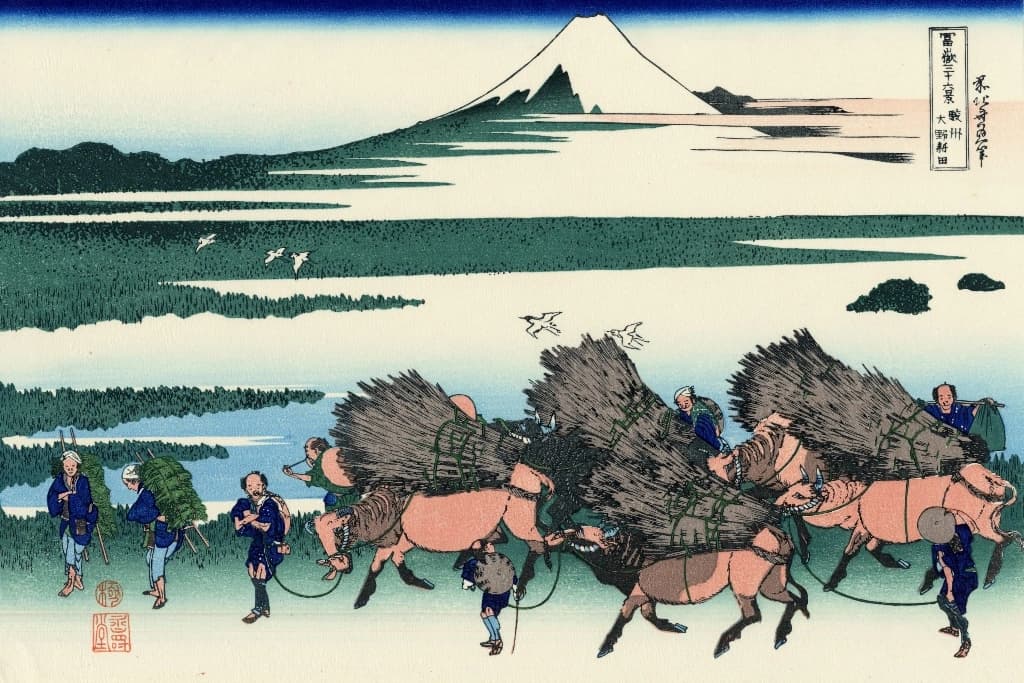
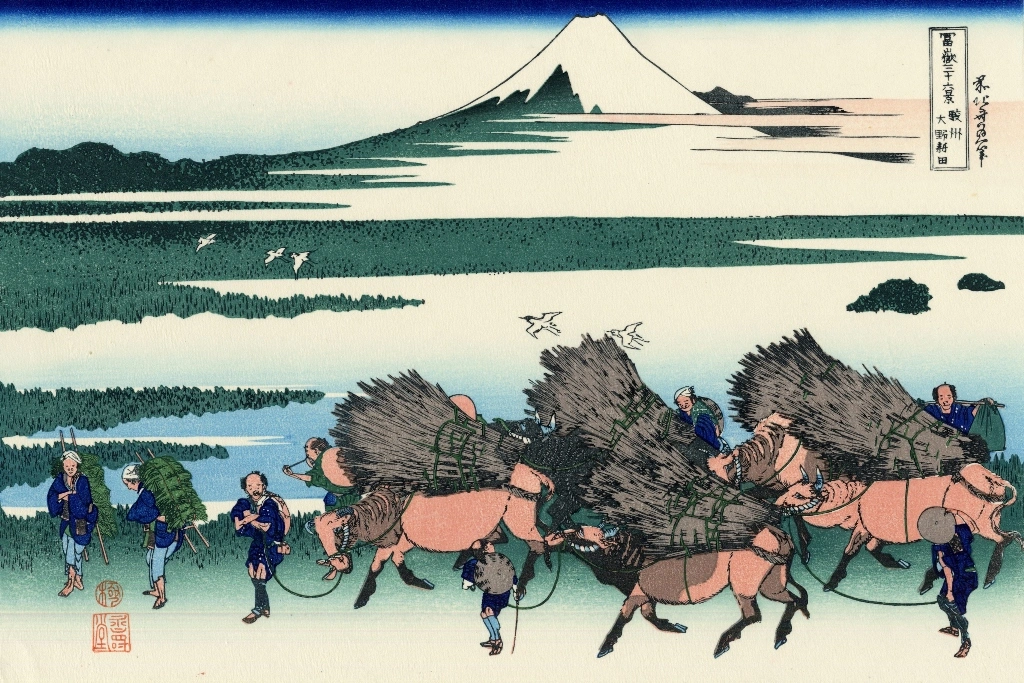
Nor does he forget a sense of play. In "Ono Shinden in Suruga Province," the bundle of brushwood carried by an ox is shaped exactly like Fuji’s ridgeline. Look, and you notice five egrets rising from a reed-choked marsh, quietly telling you this is wetland. From the ferocious to the playful — the range of Hokusai’s Fuji is truly vast.[5]
One wave that changed the world
And one more thing. The deep indigo of that wave was "Prussian blue," known in Japan as "Bero-ai," a pigment that had only just arrived. A vivid blue unlike anything in earlier prints transformed the whole impression of the image. In time Hokusai’s wave crossed to Europe and astonished the likes of van Gogh and Monet. Japanese prints shook Western art — the movement called Japonisme — and this one sheet is its very symbol.
Hiroshige’s Fuji lives inside everyday life
Now to the other: Hiroshige’s Fuji. Hiroshige, too, had a fascinating background. Born into a firefighter’s family in Edo, he entered a painter’s studio at fifteen and, after his master’s death, turned toward landscape. In time he came to be called "Hiroshige of the landscape," a master of shifting atmospheres — rain and snow, mist and dusk. The great work of his very last years is "One Hundred Famous Views of Edo."[9]
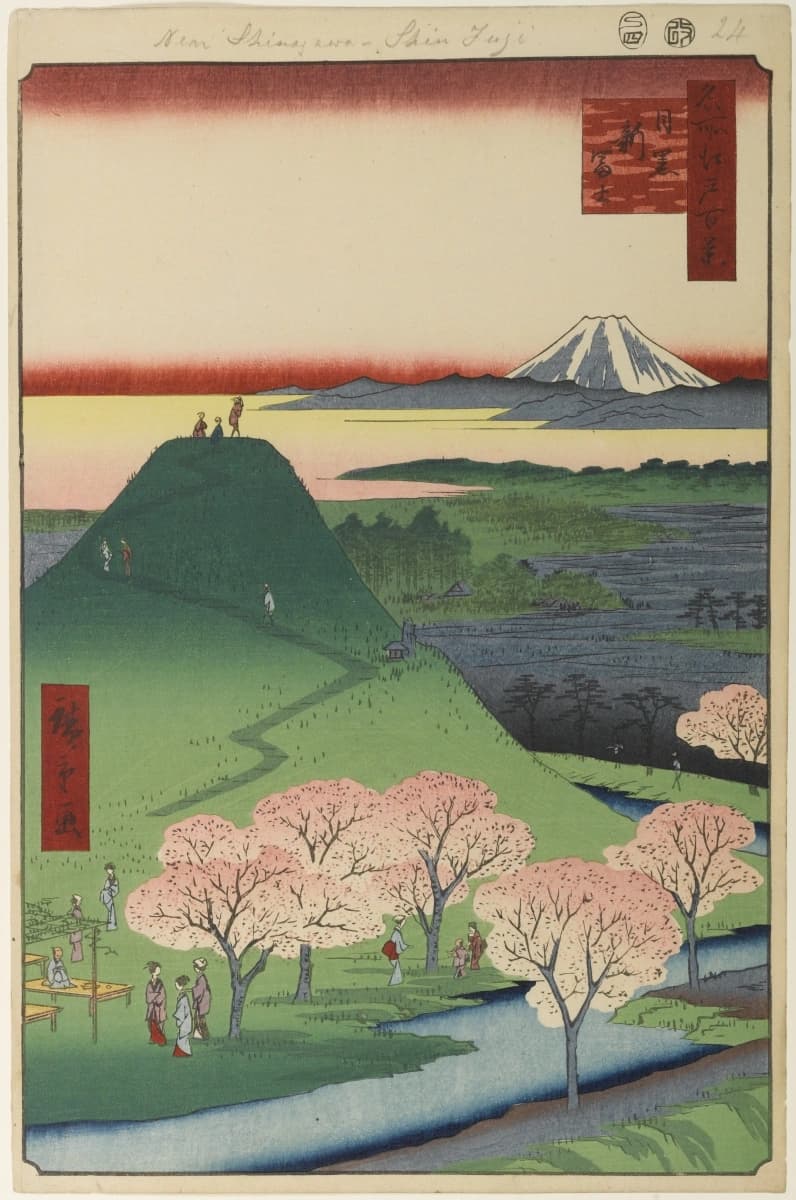
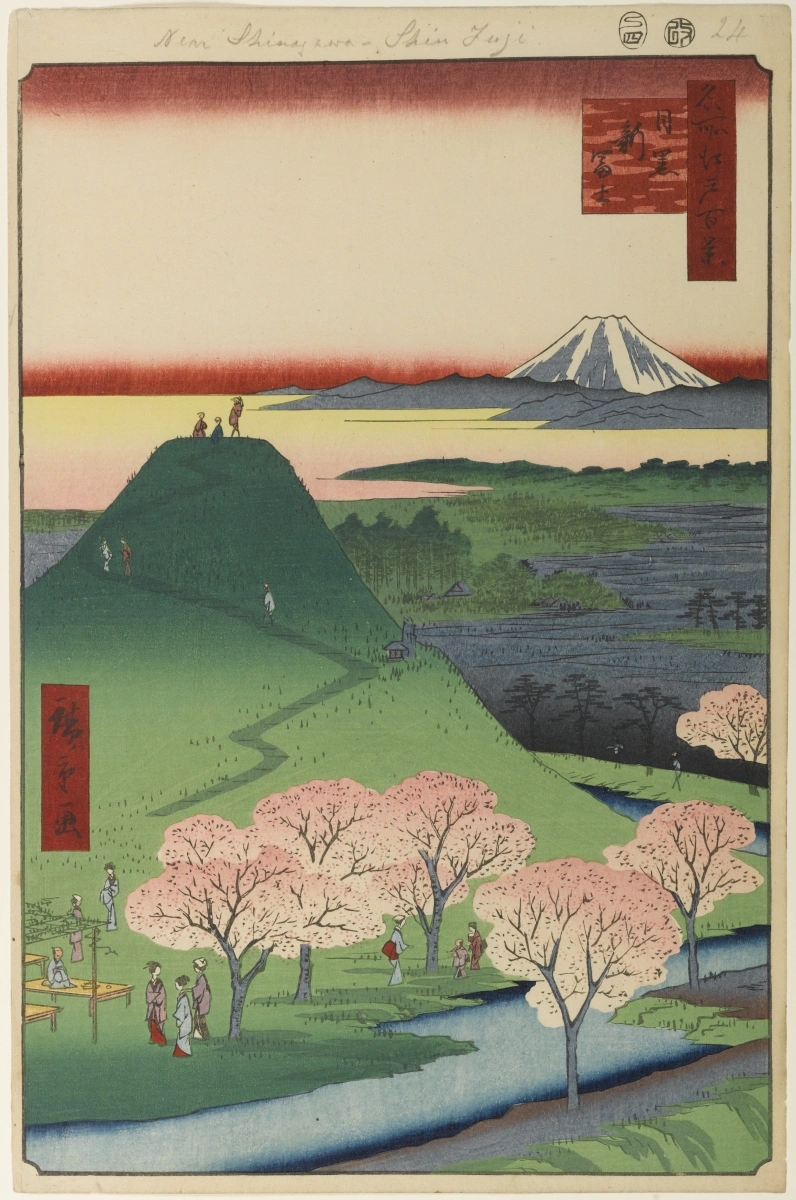
If Hokusai turns Fuji into an "event," Hiroshige’s Fuji stands quietly within everyday life. Take "New Fuji at Meguro." What is depicted here is not, in fact, the real Fuji. It is a small Fuji about the height of a person, built in Meguro in Edo — a "fujizuka," a Fuji mound. In 1819, a shogunate retainer named Kondo Juzo built it on his own estate; in the picture it bustles with Fuji-ko worshippers, and cherry trees in full bloom color a day in spring. This is the twenty-fourth view of "One Hundred Famous Views of Edo." Just as Hokusai combined Fuji with waves and timber, Hiroshige placed Fuji within the everyday life of ordinary people, alive with cherry-blossom viewing and faith.[6,7]
Meguro, where Hiroshige’s New Fuji once stood. The names “Moto-Fuji” and “Shin-Fuji” still survive in the area.
View on Google MapsThe same Fuji, through two pairs of eyes
What is delightful is that, as you compare the two artists’ Fuji, you find yourself becoming "an eye that searches for Fuji." In the next print, where will Fuji be? And what kind of face will it wear?
The depth of the printed indigo, the texture of the paper, that "too-small Fuji." The Fuji of drama and the Fuji of everyday life. Set the two ways of seeing side by side, and the same mountain looks remarkably different.