Artist
Jean-Léon Gérôme
Works (9)


Timeline
MayJean-Léon Gérôme was born on May 11, 1824, in Vesoul, France.1
In 1840, he went to Paris to study under the master of historical painting, Paul Delaroche. Traveling to Italy with his teacher to see ancient ruins became a crucial foundation for his later detailed historical and Orientalist works.2
Jean-Léon Gérôme won a third-class medal at the Paris Salon of 1847 for his painting 'The Cock Fight' (1846).1
His painting 'The Cock Fight' at the 1847 Salon was highly praised by critic Théophile Gautier, making him an overnight sensation. This success established him as a leader of the 'Neo-Grec' movement in Neoclassicism.2
In 1852, Gérôme received a commission to paint a large mural, 'The Age of Augustus, the Birth of Christ,' possibly intended to flatter Napoleon III.1
In 1852, he received a large mural commission from Napoleon III's government. The payment funded his research travels to Constantinople and Greece, marking a pivotal turn toward his later Orientalist works.2
In 1854, Gérôme undertook another important commission: decorating the Chapel of St. Jerome in the church of St. Séverin in Paris.1
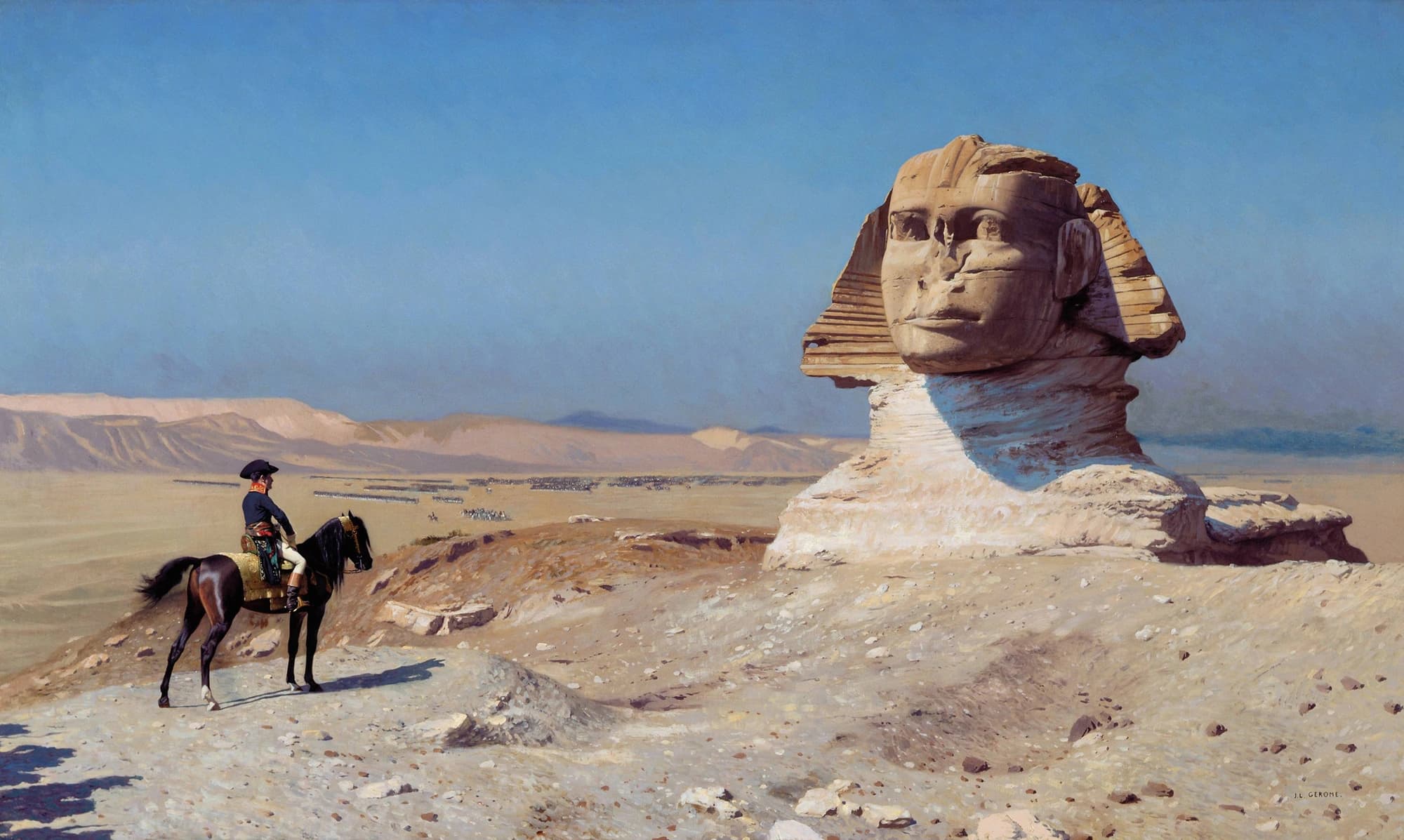
Starting with his 1856 trip to Egypt, he created many Orientalist masterpieces. He used a unique method of combining accurately observed Middle Eastern architectural details with idealized nudes painted in his Paris studio.2
Gérôme's reputation significantly increased at the Paris Salon of 1857 with his display of works including 'Egyptian Recruits Crossing the Desert'.1
Works like 'Phryne Before the Areopagus' sparked intense controversy among critics due to their sensual depictions. Such scandals contributed to his fame and public recognition.2
His grand house on Rue de Bruxelles in Paris featured both painting and sculpture studios, as well as stables. He was active as both a painter and a sculptor, gaining fame as a versatile artist.2
In 1863, he married the daughter of international art dealer Adolphe Goupil. This connection allowed his work to be widely reproduced and distributed globally, securing his popular and commercial success.2
He served as a professor at the École des Beaux-Arts for 40 years starting in 1864, teaching over 2,000 students. International talents like Mary Cassatt and Thomas Eakins emerged from his competitive atelier.2
Gérôme was invited to the opening of the Suez Canal in 1869, alongside other eminent French artists.1
JanJean-Léon Gérôme died in Paris on January 10, 1904, at the age of 79.1