Artist
Hans Holbein the Younger
Switzerland, 1497–1543
Works (25)
Hermann Hillebrandt de Wedigh
1533

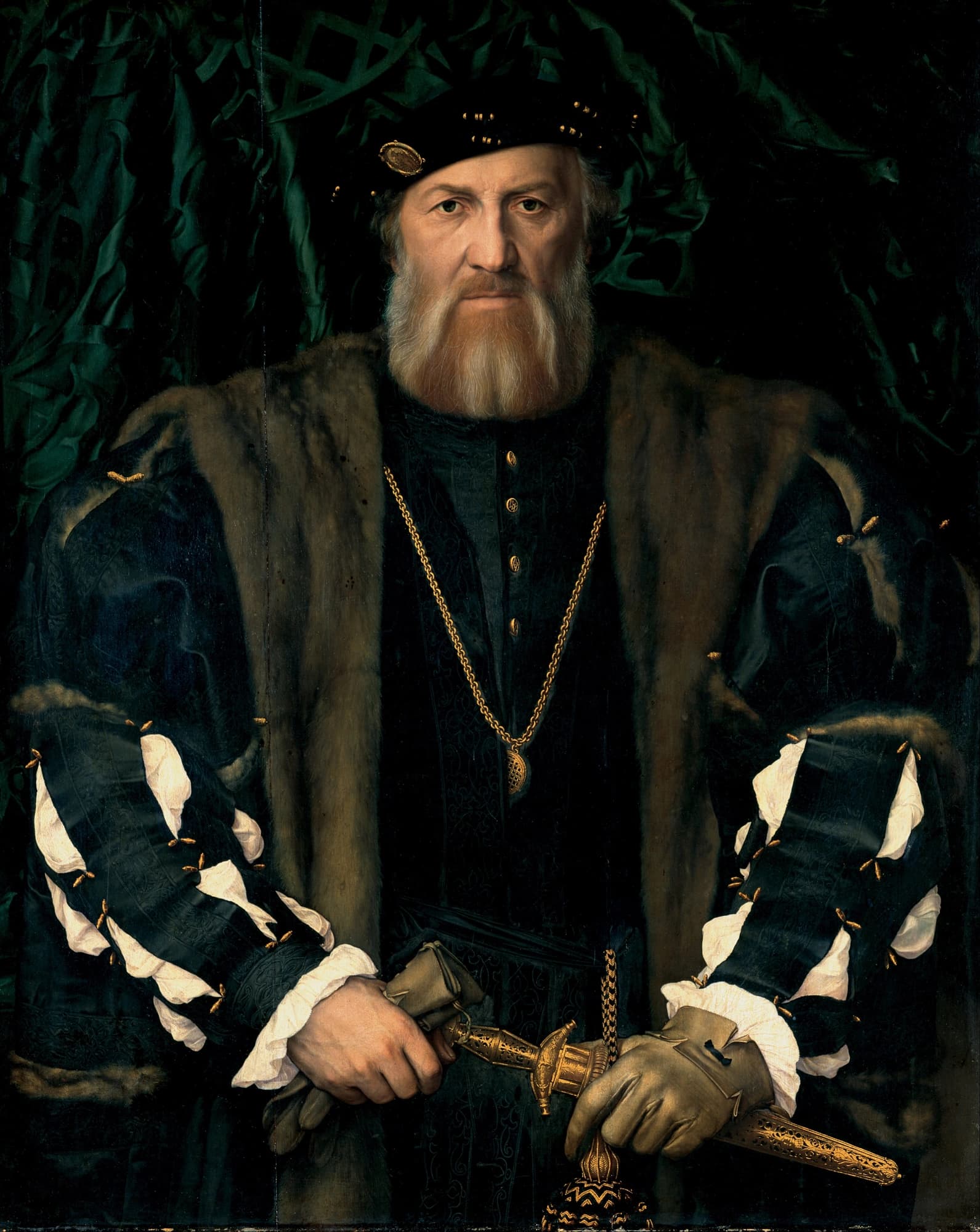
Charles de Solier, Sieur de Morette
1534

Portrait of a Young Merchant
1541

The Merchant Georg Gisze
1532

Madonna enthroned with child and two figures
1522
Thomas Cromwell
1532

Portrait of a Lady, probably a Member of the Cromwell Family
1540
Portrait Miniature of Hans Schwarzwaldt
1540

Portrait of Johann von Schwarzwaldt
1543

The Ambassadors
1533

William Roper (1493/94–1578)
1535–36

Portrait of a Man, Said to Be Arnold Franz

Portrait of a Man (Sir Ralph Sadler?)
1535

Margaret Roper (Margaret More, 1505–1544)
1535–36

Lady Guildford (Mary Wotton, 1499–1558)

Portrait of a Man in Royal Livery
1532–35

Portrait of a Young Woman
ca. 1540–45

Benedikt von Hertenstein (born about 1495, died 1522)
1517

Lady Lee (Margaret Wyatt, born about 1509)
early 1540s

Lady Rich (Elizabeth Jenks, died 1558)
ca. 1540

Creation of Eve, from "The Dance of Death"
ca. 1526, published 1538

Thomas Wriothesley (1505–1550), First Earl of Southampton
ca. 1535

Derick Berck of Cologne
1536

Edward VI (1537–1553), When Duke of Cornwall
ca. 1545; reworked 1547 or later

Hermann von Wedigh III (died 1560)
1532
Timeline
Born around 1497 in Augsburg, Germany, as the son of the painter Hans Holbein the Elder. He trained in his father's workshop and began his career alongside his brother Ambrosius.1
In 1517, a record shows he was fined for a street fight with a goldsmith in Lucerne. In his youth, he possessed a fiery temperament alongside his passion for art.1
Influenced by masters like Mantegna during a trip to Northern Italy around 1517, he fused Northern realism with Italian Renaissance spatial composition and elegance to establish his own refined style.1
He gained international fame by painting portraits of the humanist Erasmus in 1523. Erasmus highly valued his talent and later helped him move to England by writing a recommendation to Thomas More.1
In 1526, as work in Basel declined due to the Reformation, he moved to England seeking new opportunities. Joining Thomas More's circle became a major turning point in his career.1
By 1535, he was appointed King's Painter to Henry VIII. He painted numerous portraits of the King, his family, and nobles, recording the turbulent court during the establishment of the Church of England.1