
Artist
El Greco
1541–1614
Works (8)
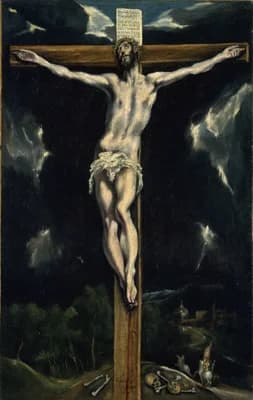
十字架のキリスト

The Martyrdom of Saint Sebastian
1577
Christ Carrying the Cross
1580

Christ Driving the Money Changers from the Temple
1595
Self-Portrait (?)
1595

View and Plan of Toledo
1610

The Burial of the Count of Orgaz
1586
The Ecstasy of Saint Francis of Assisi
1575
Timeline
Born in Crete in 1541, El Greco trained as an icon painter in the post-Byzantine tradition. This Eastern Orthodox heritage remained a fundamental element throughout the development of his unique artistic style.1
Moving to Venice around age 26, he is said to have been a disciple of Titian. He learned color and dramatic composition from masters like Tintoretto, absorbing Renaissance styles and dramatically transforming his own approach.1
He boldly criticized Michelangelo's 'Last Judgment,' offering to repaint it. He held such high self-esteem that he remarked Michelangelo was a good man but did not know how to paint.1
In Rome, he stayed at Cardinal Alessandro Farnese's palace, engaging with the intellectual elite. The connections and education gained during this period formed the basis for his major religious commissions in Spain.1
In Rome, he stayed in a darkened room even in summer, stating that daylight disturbed his 'inner light.' This anecdote symbolizes his preference for spiritual vision over external reality.1
Moving to Toledo, Spain in 1577 was the greatest turning point of his life. There, he perfected his unique expression and produced masterpieces like 'View of Toledo' and 'The Burial of the Count of Orgaz.'1
More than just a painter, he was an intellectual with a library of 130 volumes. His study of the Greek Bible and architectural texts provided the spiritual and intellectual foundation for his complex compositions.1
Long forgotten, his art was rediscovered in the 20th century. His subjective and intense expression is seen as a precursor to Expressionism and Cubism, greatly inspiring modern artists like Picasso.1