Artist
Albert Gleizes
Works (16)
収穫物の脱穀
1912

The Tree
1910
L'Homme au hamac (Man in a Hammock)
1913

Composition for "Jazz"
1915
Le Chemin, Paysage à Meudon
1911
The Publisher Eugène Figuière
1913

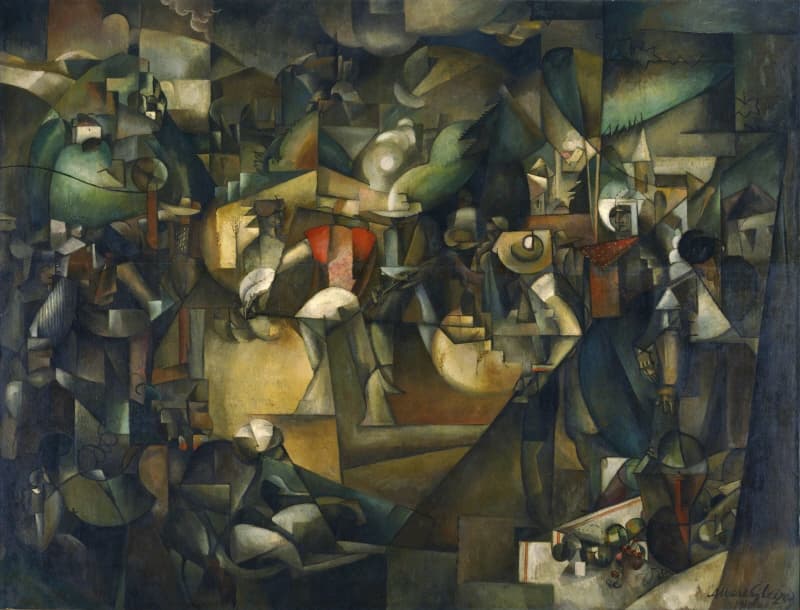
Harvest Threshing
1912
Football Players
1912
La Chasse
1911

Woman with Phlox
1910

On Brooklyn Bridge
1917

Passy, Bridges of Paris
1912
The Bathers
1912

Man on a Balcony
1912
Portrait of Jacques Nayral
1911

Portrait of an Army Doctor
1914
Timeline
Born in Paris in 1881, Gleizes grew up in an artistic environment with a fabric designer father and a Prix de Rome-winning uncle. He was self-taught, initially painting in an Impressionist style influenced by Pissarro.1
In 1906, he co-founded the Abbaye de Créteil, a self-supporting community for artists to work free from commercial concerns. Despite its utopian goals, it closed after two years due to a lack of income.1
Around 1908, after a brief Fauve influence, he transitioned to proto-Cubism, reducing natural forms to primary shapes. His style emphasized structural rhythms, closer to the Pont-Aven School than to Cézanne.1
From 1910, he met regularly with Metzinger, Léger, and others at Le Fauconnier's studio. Along with writers like Apollinaire, they discussed a new art focused on the 'research into form' rather than color.1
His exhibition in Salle 41 at the 1911 Salon des Indépendants brought Cubism to public attention. It caused a scandal, with critics dismissing the group as 'ignorant geometers' reducing the body to cubes.1
In 1912, he and Jean Metzinger wrote 'Du Cubisme,' the first major treatise on the movement. It provided a theoretical foundation for Cubism and significantly influenced future generations of artists.1
Gleizes spent four crucial years in New York during WWI, playing a key role in introducing modern art to America. He was active in the Society of Independent Artists, stimulating the local art scene.1
From the mid-1920s to the late 1930s, he focused on writing. In works like 'La Peinture et ses lois,' he theorized his artistic philosophy and the evolution of plastic consciousness.1
He was a founder and director of the international group Abstraction-Création. He played a vital role as a bridge between Cubism and the development of abstract painting.1