Artist
Gustav Klimt
Austria, 1862–1918
Works (11)
Beethoven Frieze
1902

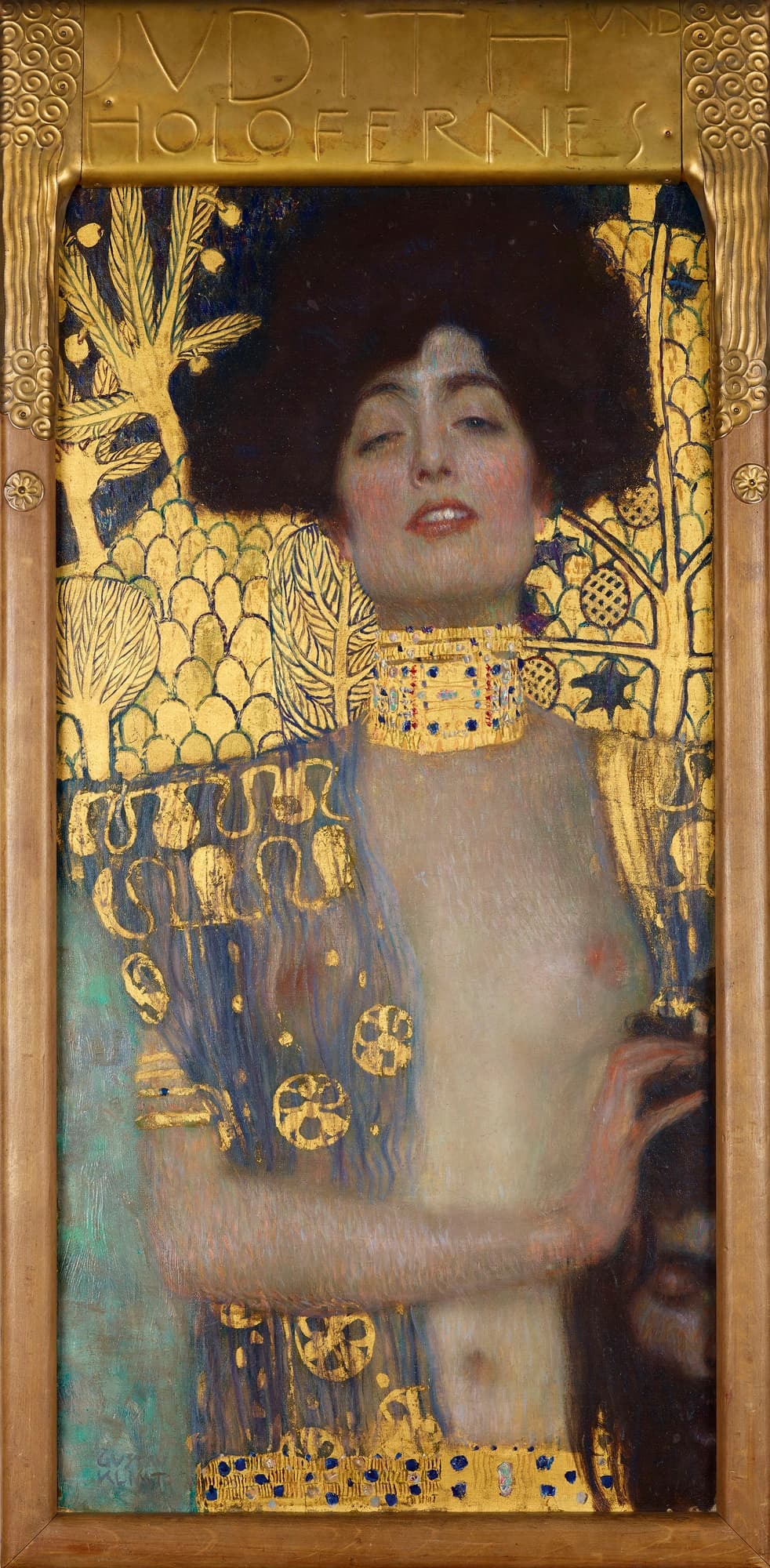
Judith I
1901
Auditorium of the old Burgtheater
1888

Pallas Athena
1899
Portrait of Emilie Flöge
1902

The Kiss
1907
Portrait of Elisabeth Lederer
1914
Portrait of Adele Bloch-Bauer I
1907

Mäda Primavesi (1903–2000)
1912–13

Reclining Nude with Drapery
ca. 1912–13

Serena Pulitzer Lederer (1867–1943)
1899
Timeline
His father Ernst was a gold engraver, and it is believed that the technical background of precious metal processing influenced Klimt's later development of his 'Golden Phase'.1
He studied architectural painting and was initially highly acclaimed for his academic style influenced by Hans Makart, decorating public buildings like the Burgtheater.1
Fashion designer Emilie Flöge was his lifelong companion. While their relationship was likely platonic, it is widely believed they are the models for his masterpiece 'The Kiss'.1
The deaths of his father and brother Ernst in 1892 caused deep psychological trauma, leading him to move away from traditional styles toward a unique symbolic expression.1
Among the Vienna Secessionists, Klimt was particularly influenced by Japanese art, as seen in his flat compositions, decorative patterns, and spatial concepts.1
His 'Faculty Paintings' for the University of Vienna were criticized as 'pornographic' due to their frank eroticism, leading him to refuse all future public commissions.1
During his 'Golden Phase' in the 1900s, he created masterpieces like 'The Kiss' using real gold leaf, a style merging decorativeness and eroticism that became his trademark.1
He discovered the young Egon Schiele and significantly influenced his artistic growth as a mentor and supporter, introducing him to models and purchasing his work.1
He died in 1918 at age 55 from a stroke and pneumonia. Since then, his works have fetched record prices at auction, cementing his status as one of the world's most popular artists.1
In 1945, many of his important works, including the controversial University of Vienna paintings, were destroyed when retreating German forces burned Schloss Immendorf.1