Artist
Jean-Auguste-Dominique Ingres
Works (8)

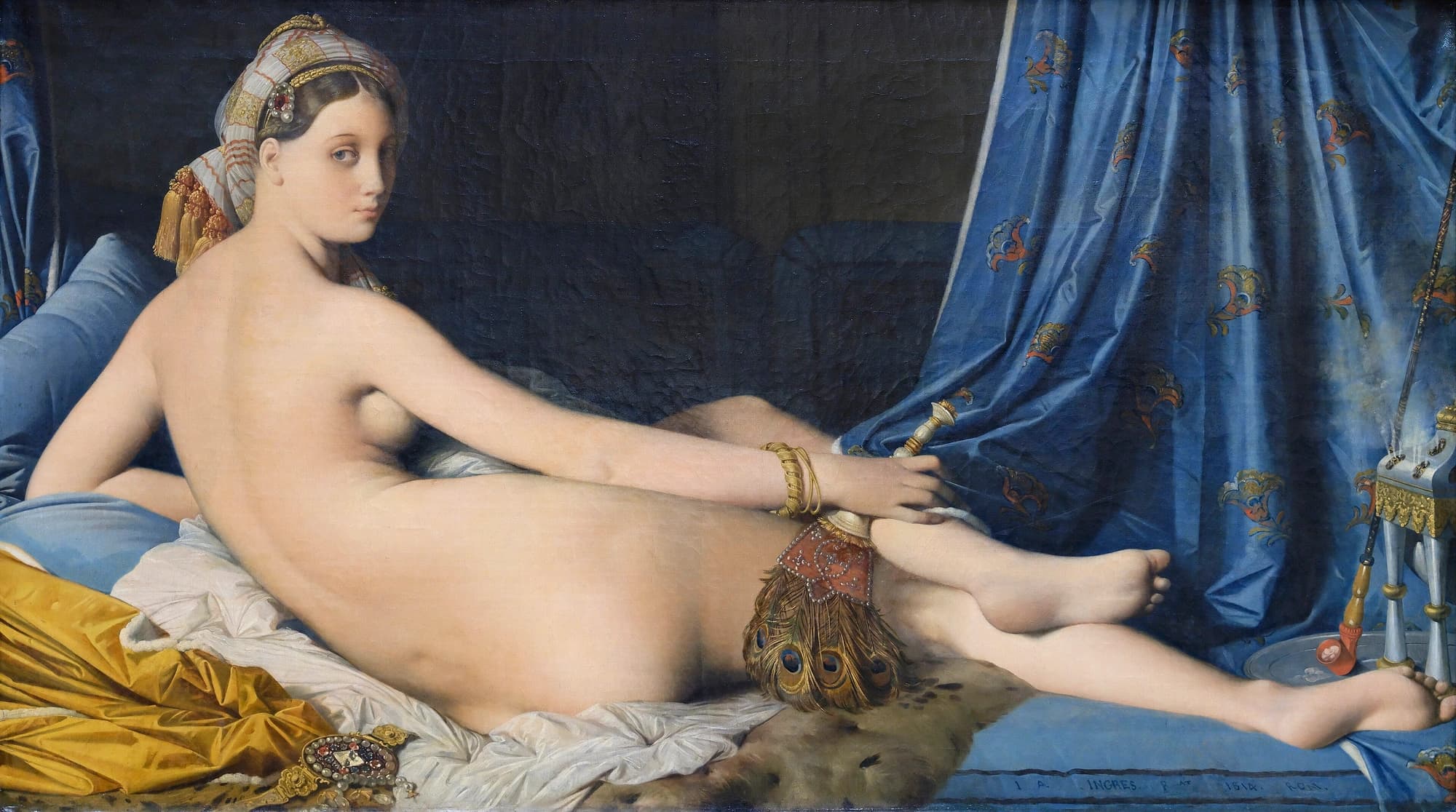
Grande Odalisque
1810
The Martyrdom of Saint Symphorian
1834

Napoleon I on his Imperial Throne
1806

Raphael and the Fornarina
1814

The Dream of Ossian
1813

The Turkish Bath
1862
Joséphine-Éléonore-Marie-Pauline de Galard de Brassac de Béarn (1825–1860), Princesse de Broglie
1853

Portrait of Monsieur Bertin
1832
Timeline
In addition to his painting talent, Ingres was an accomplished violinist. He played second violin in the Orchestre du Capitole de Toulouse from ages 13 to 16, a versatility that later inspired the phrase 'violon d'Ingres'.1
In 1797, Ingres entered the studio of Jacques-Louis David, the leader of Neoclassicism. While learning his master's rigorous realism, Ingres gradually developed his own style focused on purity of line and form.1
In 1801, Ingres won the Prix de Rome with 'The Ambassadors of Agamemnon'. Although this entitled him to study in Italy, his departure was delayed until 1806 due to a shortage of state funds.1
Ingres spent much of his life in Rome and Florence. During his residency in Italy from 1806 to 1824, he studied the works of Renaissance masters intensely, solidifying his artistic foundation.1
The success of 'The Vow of Louis XIII' at the 1824 Salon established Ingres as the leader of the Neoclassical school in France, bringing him long-awaited fame as a history painter and financial stability.1
Indignant at the harsh criticism of 'The Martyrdom of Saint Symphorian' in 1834, Ingres left Paris to become director of the French Academy in Rome. He was known for being highly sensitive to criticism.1
The late masterpiece 'The Turkish Bath' was completed when Ingres was 83. It represents the culmination of his lifelong obsession with the female nude, expressed through mature composition and smooth curves.1