The first person he wrote in his letters, and what the people around him said. The two do not agree.
Nikolai Astrup wrote letters constantly — about colour, about woodblocks, about the plants he put in his garden. He hesitates as he writes, then takes back what he has just said.
The people who watched him work said something quite different. Both are gathered here. The painter is in the gap between them.
In his own words
Followed by where he lived and when. Only about a third of the letters carry a date, so these are ordered by the period each quotation is about — not by when it was written.
The Parsonage — 1880–1899
Born into a parsonage, he grew up from 1883 in the vicarage at Jølster where his father served. These are his first pictures — painted before he studied art at all.
The picture Midsummer Eve is among the first that I painted – The young girl staring at the fire and most of the landscape I had painted before I enrolled in the painting school in Christiania (Oslo), before I had seen any art
Letter from Nikolai Astrup to Edvard Waldemar Aslaksen, October 10, 1908. · 公式カタログ・レゾネ
My first pictures I painted with ordinary house paint colours and one of the first attempts occurred on Midsummer Eve and so I attempted to paint this little girl and the bonfire
Letter from Nikolai Astrup to Edvard Waldemar Aslaksen, October 10, 1908. · 公式カタログ・レゾネ
He went on painting this same subject for six more years. The series begins with a note about house paint.
Betting on Jølster — 1902–1912
His first solo show came in 1905. Between 1906 and 1912 he painted the midsummer bonfires again and again, and began cutting woodblocks. In 1907 he married Engel, then fifteen.
have staked my reputation
I am perhaps one of the painters in this country who is most rooted in place and the land – and have staked my reputation on remaining unaffected by the many art movements
Letter from Nikolai Astrup to Edvard Waldemar Aslaksen, October 10, 1908. · 公式カタログ・レゾネ
Written at twenty-eight, with the bonfire series still unfinished. He never withdrew the bet.
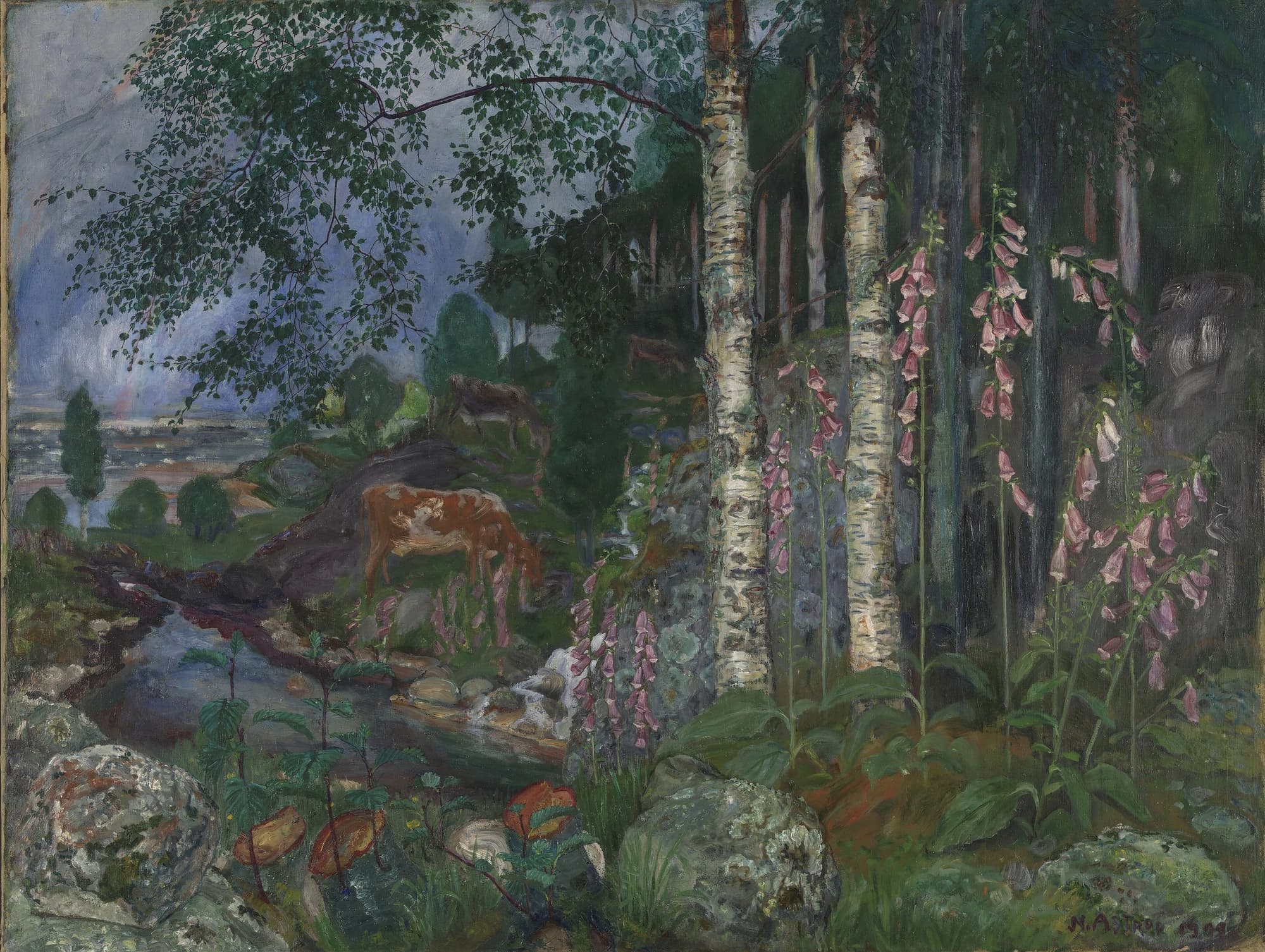
I have attempted to express something of the sense of nature that overwhelms one when wandering about in Jølster’s landscape – these vapours and damp soil saturated with age-old paganism and prehistoric religions – this soil full of legend – these predominantly raw colours have more value for my art than merely as subjects for my pictures.
Letter from Nikolai Astrup to Edvard Waldemar Aslaksen, October 10, 1908. · 公式カタログ・レゾネ
In my own mind, they [the woodcuts] are too much like experiments. Nor have I really made use of the woodblock technique as it is usually employed by modern painters. I work in my own way, and several of my impressions can appear to be more paintings that woodcuts and this is, of course, really a fault – that is also why I have not considered exhibiting them. Some of them also require a lot of work to print, as I use 5–6 blocks for each impression.
Astrup to Sigurd and Isabella Høst, 16 September 1910 · 公式カタログ・レゾネ
Munch had already bought three of them. The same letter mentions using five or six blocks for a single impression.
Sandalstrand — 1912–1928
In 1912 he took the plot across the lake — “one of the saddest places in Jølster,” as he called it (catalogue raisonné). He worked it as a self-sufficient farm with his own hands, fixed vantage points inside the garden and painted some twenty pictures from them. Eight children, asthma, and a long journey through southern Europe and North Africa. He died in 1928, aged forty-seven.
weakness for experimenting with all possible and impossible plants that can grow here in the mountain village – even those that cannot grow here – most of my attempts finish up in this latter category …
I do not know whether you are acquainted with ‘the modern art of woodblock printing’– ‘colour woodcuts’ and ‘black-and-white woodcuts’. It is an art form that interests me greatly. It comes originally from Japan, but is adopted in a somewhat different form here in Europe, one that is better suited to our art. Here in this country, Munch and I are two of the few who have tried our hand at this ‘modern woodcut’, as it is called in contrast to the previously known wood-engravings or what is also called: Xylography (almost a mechanical process). Munch is very enthused about my woodcuts and has previously bought 3 of my things.
Astrup to Hans Jacob Meyer, undated, most likely 1917 · 公式カタログ・レゾネ
… each “retouche” is unfortunate – as a single stroke with the paintbrush is enough to alter the mood of the picture, as it becomes a different style to that which is printed.
Astrup to Hans Jacob Meyer, 17 July 1920 · 公式カタログ・レゾネ
the mystique of a summer’s night and golden light
you communicate better with him than I can – you find words for the mystique of a summer’s night and golden light etc.
Letter to Per Kramer, 16 December 1924 · 公式カタログ・レゾネ
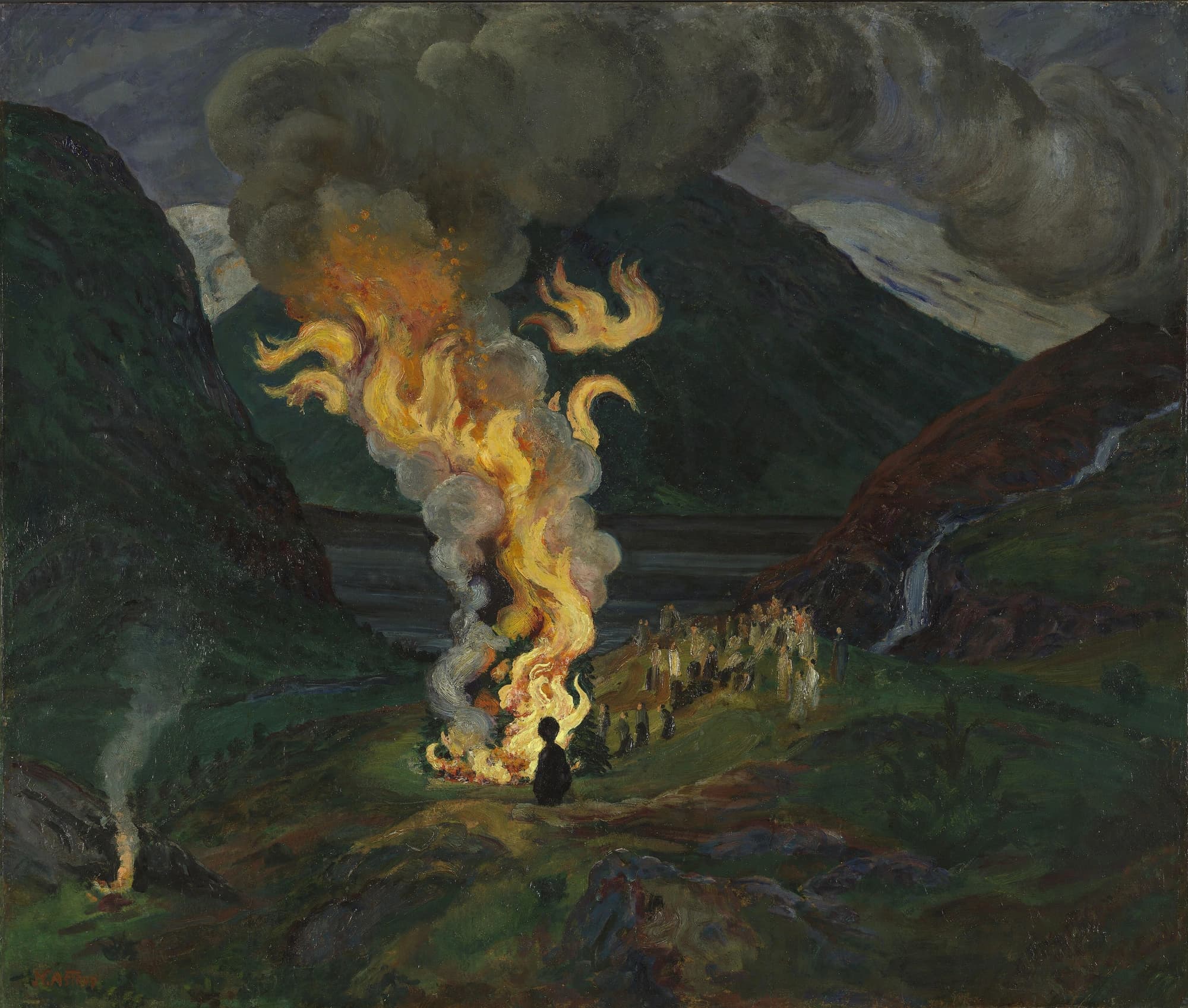 Bonfire celebrating Midsummer Night