Artist
Nikolai Astrup
ノルウェー, 1880–1928
Nikolai Astrup was born on August 30, 1880, in Kalvåg on the island of Frøya, Norway, and grew up in Ålhus in Jølster, an area where agriculture was the primary industry 110. His father, a parish priest, wanted his son to become a priest, but Astrup failed his Latin exams at the Trondheim Cathedral School, which he had attended since 1895, and chose the path of art instead 1. In 1899, he entered the Royal Academy of Design in Christiania and studied at Harriet Backer's painting school; from 1901 to 1902, he furthered his studies in Paris at the Académie Julian and the Académie Colarossi under the instruction of Christian Krohg 1. In his youth, he struggled financially and sometimes painted on the fabric of old trousers because he could not afford canvases, but with the support of figures such as Olaf Schou, he held major exhibitions in Christiania and Bergen from 1905 onwards 12. Engel Sunde, whom he married in 1907, served as a great inspiration to him, and in 1913, he moved with his eight children to Sandalstrand (now Astruptunet) on the shores of Lake Jølstravatnet 1210.
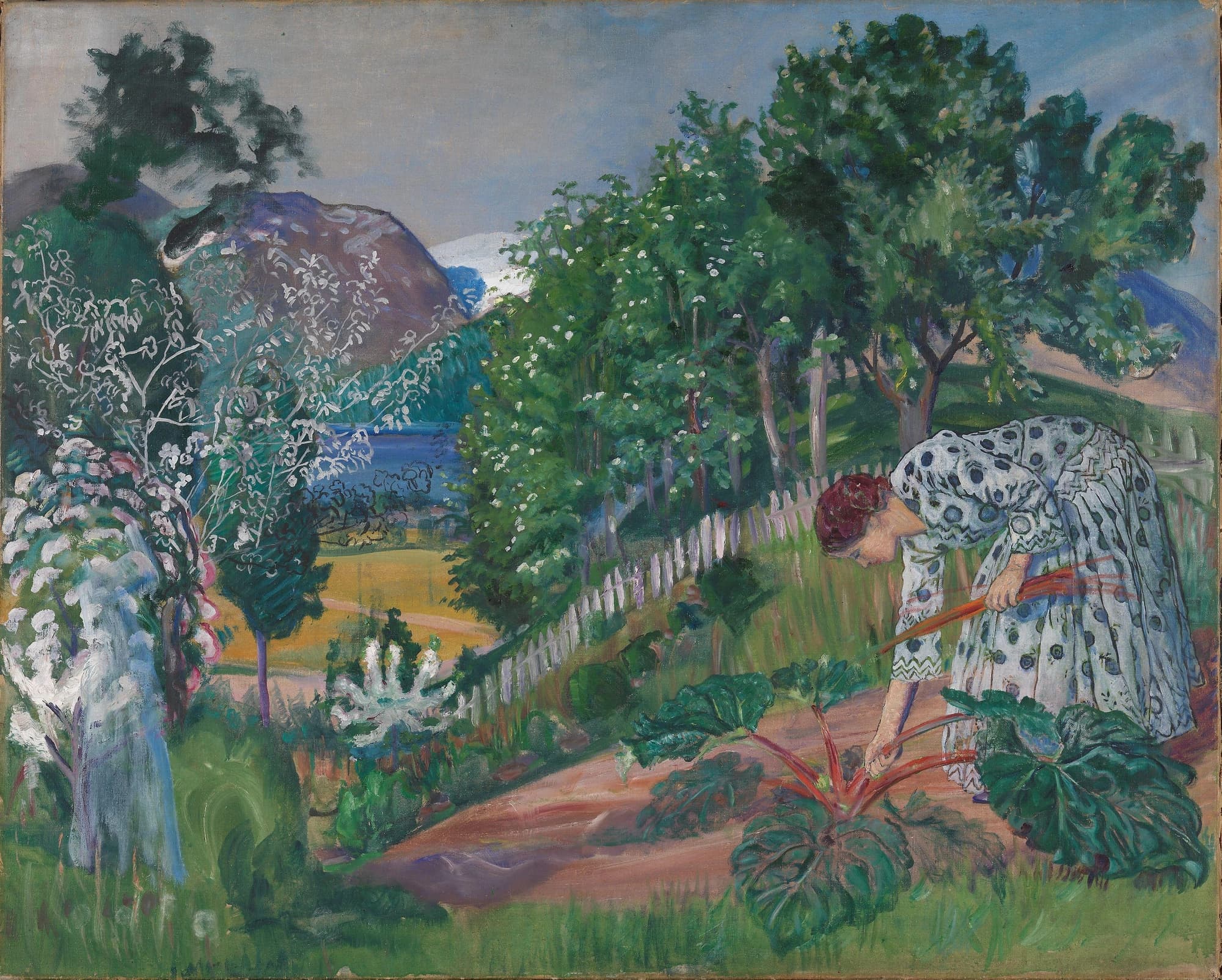
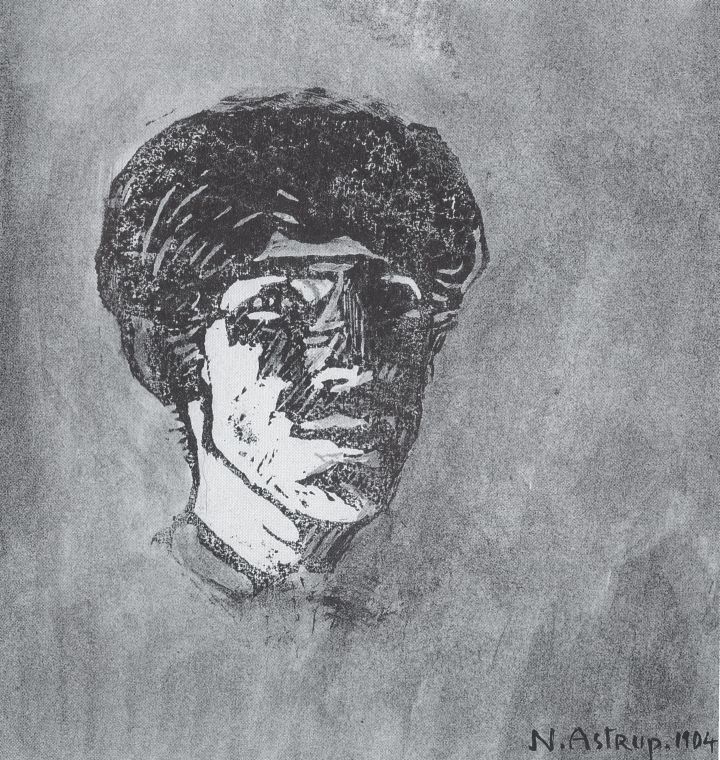
Astrup favored intense and rich colors to depict the lush landscapes of Western Norway, expressing the intimate interaction between nature and the human environment with bold lines 1. His style is described as "Neo-Romanticism" or "Natural Naive" 1. This "Naive" style is characterized by flat drawing that does not follow the rules of perspective 11. He strove to establish a unique "national visual language," using "trolls" from folklore as motifs and even pruning the trees in his own garden to resemble trolls 12. These activities overlapped with the Norwegian National Romanticism movement, which sought a "national style" in architecture and social spirit 3. His art, which was attracted to pagan elements in reaction to the oppressive environment of his strict Christian household, garnered significant attention during the period when Norway gained independence following the 1905 dissolution of the union with Sweden and national pride was on the rise 24. In addition to oil paintings, he played a pioneering role in Norway in the field of woodcuts carved along the grain of the wood, and a dedicated exhibition room is now established at the KODE Art Museums in Bergen 129. He suffered from asthma and tuberculosis throughout his life and passed away from pneumonia on January 21, 1928, at the young age of 47 1.
See sources at the bottom of the page.
Feature: Who was Nikolai Astrup?Works (8)


Timeline
AugNorwegian painter Nikolai Johannes Astrup was born.1
AugNikolai Astrup was born on August 30, 1880, in Kalvåg, Bremanger, Norway.2
He moved to a parsonage in nature-rich Jølster following his pastor father's transfer.1
At age 12, he produced the oil painting "The Parsonage in Moonlight," which became an early masterpiece.1
Following his father's wishes, he began studying classical languages to prepare for a career in theology.1
1895年から神学校に進むためトロンハイムへ送られたが、そこで美術館に通いノルウェーの近代画家たちの作品に触れた。3
He returned to Jølster and produced early works while serving as a tutor for his younger siblings.1
From 1899 to 1901, he studied at Harriet Backer's painting school in Kristiania (now Oslo).2
AugHe enrolled in the Royal School of Art and Design in Oslo and later studied under Harriet Backer.1
During his studies in Paris, he researched the works of Henri Rousseau, Maurice Denis, Paul Gauguin, and Hokusai.1
Between 1901 and 1902, he lived in Paris and studied at the Académie Julian and Académie Colarossi.2
The businessman Olaf Schou provided financial support in 1901 for Astrup to study in Denmark, Germany, and France.1
After returning from studies in Paris, he began painting Jølster landscapes with a unique color palette.1
Between 1903 and 1905, he produced numerous landscape paintings of Jølster.1
He began researching woodcut techniques and became a pioneer of the medium in Norway.1
In 1905, he exhibited his paintings and early prints at the art dealer Blomqvist Kunsthandel in Christiania.1
He completed "A Farmyard in Jølster," a masterpiece acclaimed for its color.1
Following the 1905 exhibition, the National Gallery of Norway purchased 'Stabbur i Jølster' upon the recommendation of Eilif Peterssen.1
He met Engel Sunde and began his representative series "Midsummer Eve Bonfire."1
He suffered from severe tuberculosis in 1906 but was diagnosed as non-infectious in the spring of 1909 and returned to his normal life and work.1
In the autumn of 1906, he traveled to Schousnesfjord to paint Mount Kleivafjellet and rented a second-floor room at Anders Sunde's farm as a workspace.1
Between 1906 and 1912, he produced several works depicting Midsummer bonfire scenes using bright and vivid colors.1
He married Engel Sunde in 1907, and she became a significant source of inspiration for him.4
DecFollowing the first marriage banns on December 8, 1907, he married Engel Andersdotter Sunde on December 23 of the same year.1
JanIn late January 1908, Astrup traveled to London using his scholarship funds to view the works of John Constable.1
AprIn April 1908, he submitted 63 oil paintings, several woodcuts, and one watercolor to the Bergen Art Association's spring exhibition.1
He revisited Germany on a grant to observe the latest modern art, including Cubism.1


His eldest son, Nikolai Egil, was born, and he eventually had eight children in total.1
In 1911, Hans E. Kinck wrote a treatise on Nikolai Astrup in the magazine "Kunst og Kultur".1
He acquired farmland in Sandalstrand along Lake Jølster and moved his base there.1
He created the representative work "A Night in June and Buttercups," featuring one of his major motifs.1

He created the woodcut 'Grovær' (Growing Weather) in 1915.1
His artistic achievements were widely recognized, and he gained fame within the local community of Jølster.1
Art journals highly praised the decorative qualities and techniques found in his works.1
He embarked on an extensive sketching trip with his wife through Southern Europe and North Africa.1
DecHe contracted malaria in Venice and, after recovering, traveled through Naples and Sicily.1
In 1923, upon returning from a long trip to Africa with his wife Engel, a welcome party was held for them by local youth groups.1
JanDuring his stay in Algeria, his son was born, and he continued his travels for several more months.1
AugHe returned from his travels in Europe and North Africa, and his health temporarily stabilized.1
In 1925, Astrup was honored by the local community.1

In a letter to the writer Hans Kinck, he detailed his methods of color expression.1

He was buried in the old cemetery of Ålhus, and the funeral expenses were covered by the citizens of Jølster.1
Trygve Bidar, a doctor and friend living in Førde, recorded Astrup's movements just before he developed pneumonia.1
After her husband's death, Engel studied art at Amble Gård in Kaupanger and became active as a textile artist.1
JanThe cause of death was pneumonia, which had a devastating effect on his lungs already weakened by long-term asthma, tuberculosis, and bronchitis.1
JanAt the time of his death in 1928, he had eight children with his wife Engel, to whom he had been married for 21 years.1
JanHe died of pneumonia at the age of 47 on January 21, 1928, in Førde, Norway.2
Sources
- [1]Per A. Holst, Nikolai Astrup: The Colorful Painter from Jølster (Per A. Holst Forlag, 2008)
- [2]Nikolai Astrup - Wikipedia
- [3]ja.wikipedia.org
- [4]Nikolai Astrup Paintings, Bio, Ideas | TheArtStory
- [5]Nikolai Astrup — 公式カタログ・レゾネ