On Borrowed Land
In western Norway, by a lake between mountains, there was a vicar’s son. On Sundays he was expected at his father’s services in the church at Ålhus, and from the age of seventeen until he was twenty-seven he lived in the old parsonage. His early paintings were all made in that house. But the land was leased from the state. It would never be his.[6]
Even as a working painter, the landless life went on. On the family plot he moved into the extension of an old storehouse that had been waiting for demolition and made it his studio; for a time he lodged in the local post office building, doing all the housework himself. The places he painted in, the places he lived in — always borrowed. The story of Astrup’s garden makes no sense unless it starts here.[6]
Thirty-Three, and Ground of His Own
Then, 1913. At thirty-three, Astrup moved to Sandalstrand in Jølster. And for the fifteen years until his death in 1928, at forty-seven, he cleared this land into a self-sufficient farm — in the words of the official catalogue, a work of art in its own right.[1]
He built terraces with Engel. He kept two or three cows, a few sheep, and a cart horse. He rebuilt, with his own hands, a table he had seen on a journey to Algeria, and set it in his home. The man who had drifted through borrowed houses was now making everything — from the soil to the furniture — himself.[1,6]
The Garden Begins to Make Paintings
And the garden did not stop at being a farm. He pruned trees into troll-like shapes and made a “grotto” inspired by Japanese and English gardens. He fixed a number of viewpoints inside the garden and painted the views from them — some twenty-two paintings came into being this way. Here, tilling and painting were a single act.[1]
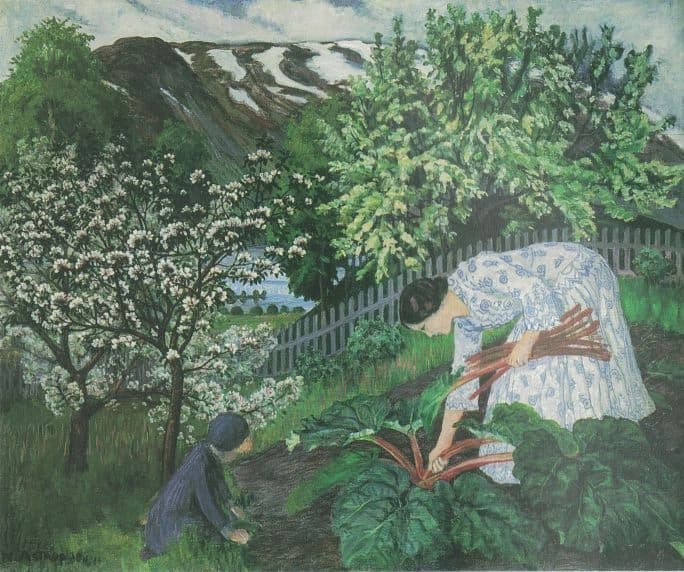
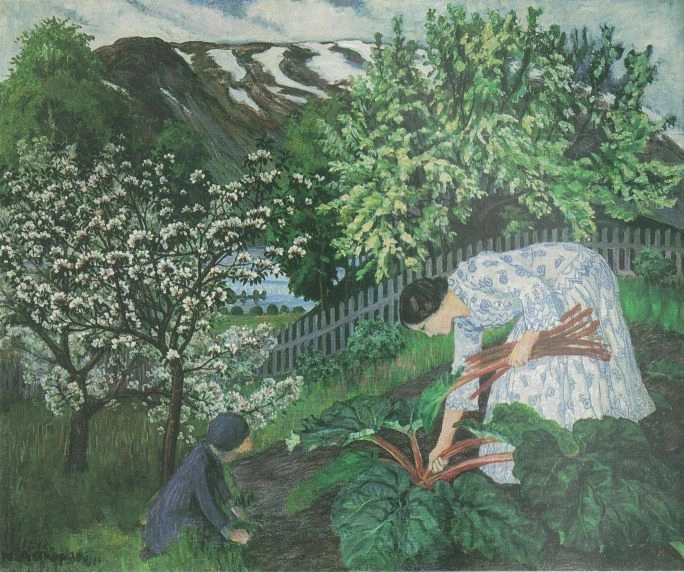
In a garden, a woman is picking rhubarb. The bent back, the bundle of red stalks, the great leaves filling the foreground. Rhubarb — Rabarbra in the original. The place of its making is recorded as Ålhus, the village where he grew up; begun in 1911, it was worked and reworked for ten years, until 1921 — spanning the move to Sandalstrand. Through the very years he was building a garden of his own, he kept painting the gathering of a garden’s harvest. This painting reads like his testimony.[6,3]
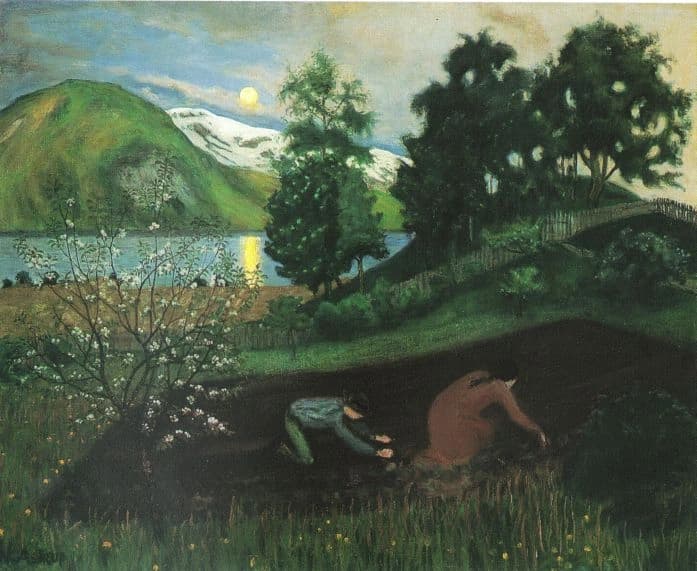
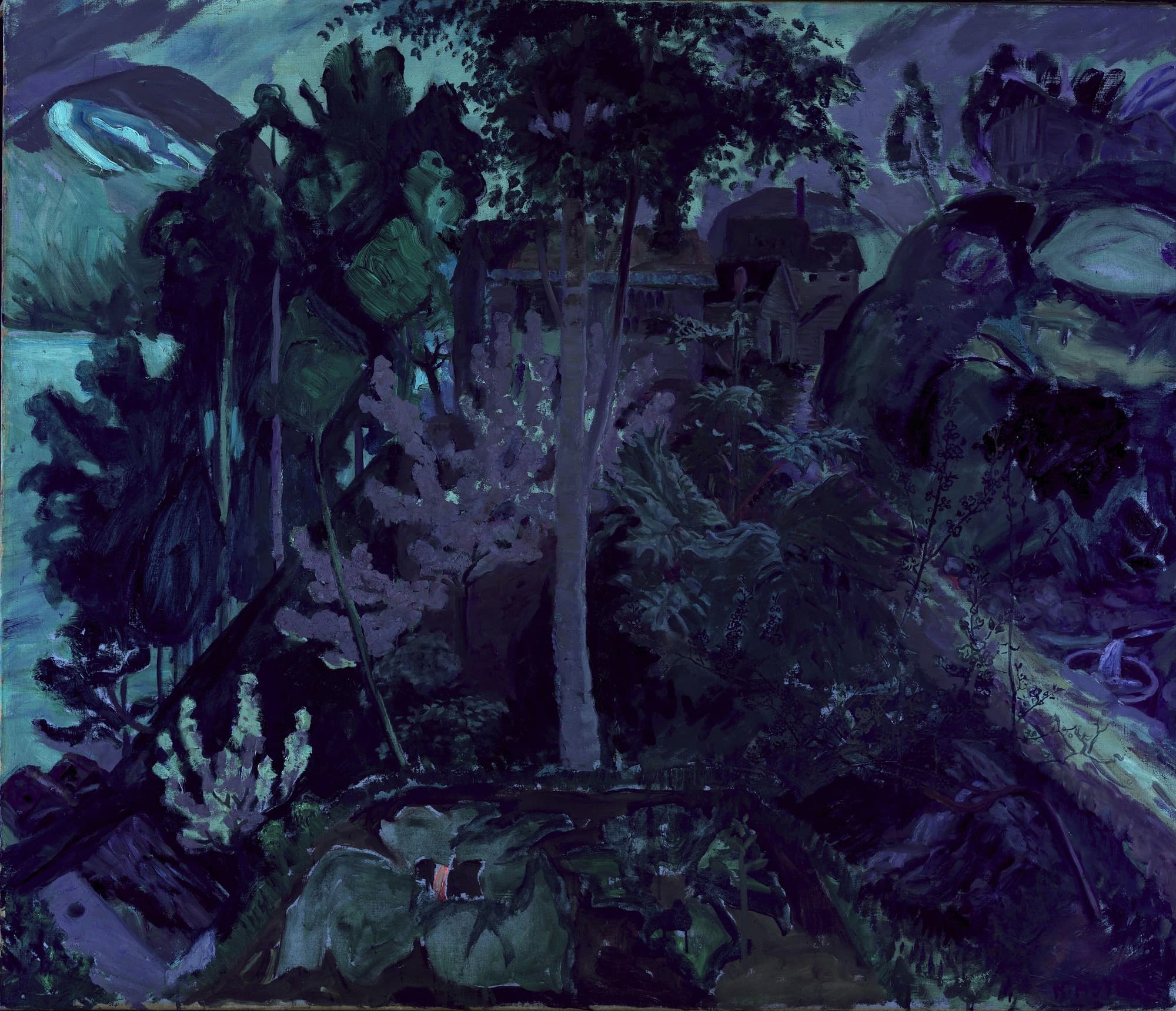
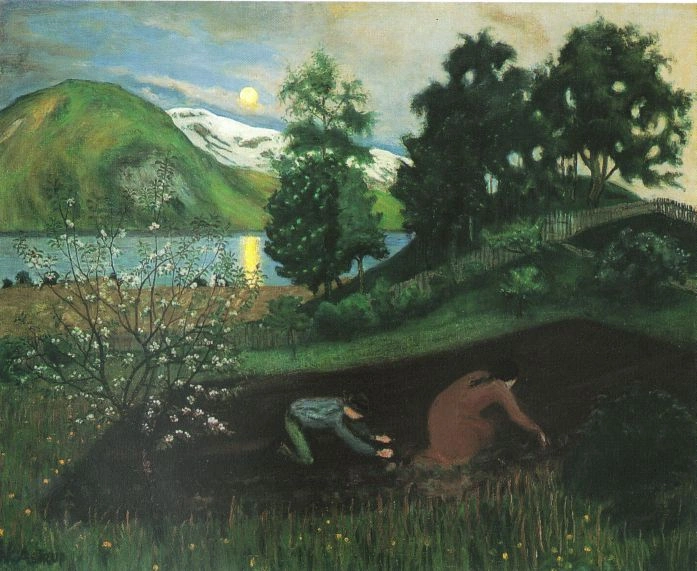
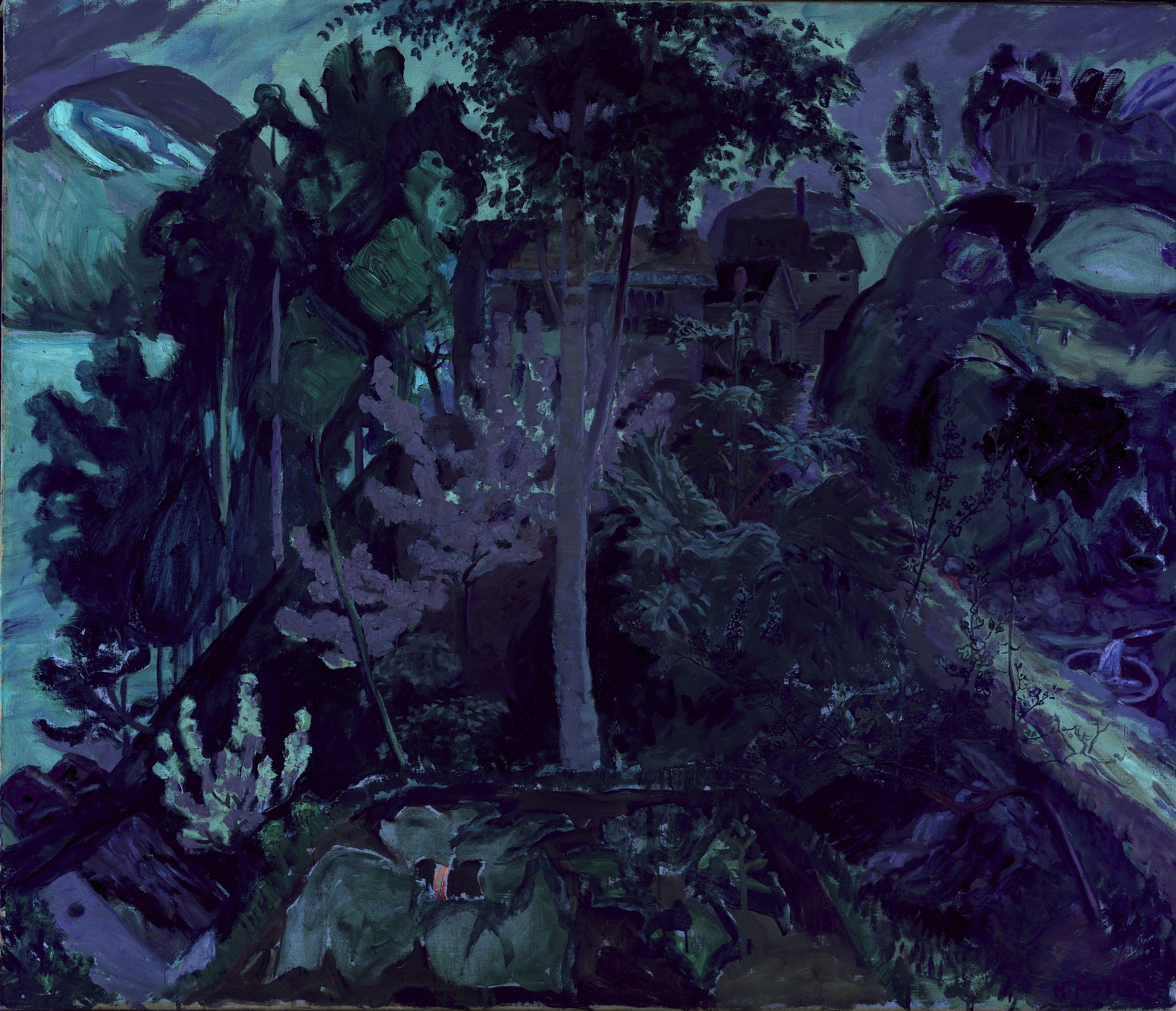
In fact, painting gardens began before he had land of his own. Spring Night in the Garden, from 1909 — four years before the move to Sandalstrand — shows the garden at Ålhus: black-soil flower beds ringed by trees, with Lake Jølstravatn beyond. Then, once he had his own farm, Spring in Jølster (1925) depicts Sandalstrand, its motifs recorded in the official catalogue as farmhouse, path, garden, lake, tree and stream — a whole life, laid out in one picture.[6,4,5]
What the Gardener Planted: A Field Guide to the Paintings
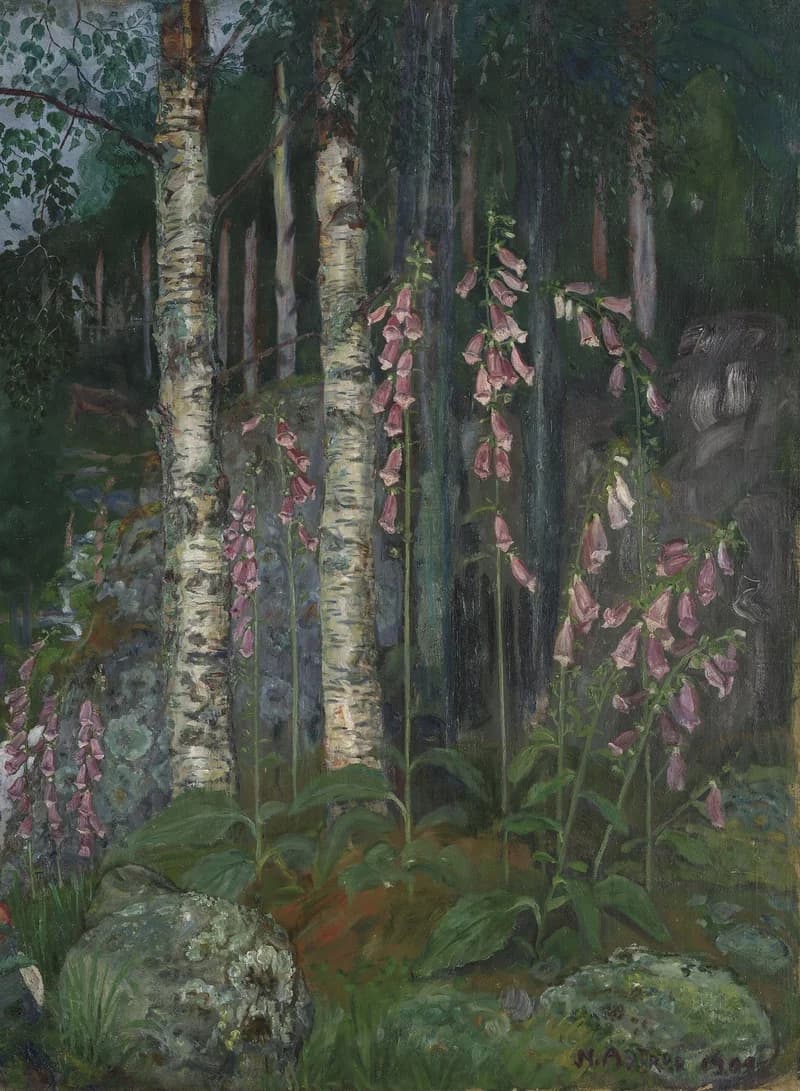
Look closely now at what he grew and painted. Rhubarb, foxgloves — plants that may well be growing in your own garden or a nearby bed. These are details of paintings, and at the same time an inventory of what one gardener chose to plant on his own ground.


The Garden Cannot Travel. The Paintings Can.
Astrup died in 1928, at forty-seven. Engel kept the garden, and after her death in 1966 it opened to the public as a museum — Astruptunet. The 1985 thesis on which his catalogue raisonné is founded carries a title of its own: “The Gardener under the Rainbow.”[1,6,2,8]
But that garden cannot leave its valley. The terraces, the troll trees — you would have to travel to Norway to see them. The paintings, though, can travel. In the winter of 2026 they come to Tokyo, for Japan’s first retrospective of the painter. The red of a harvest that a landless painter kept painting through the very years he was making ground his own — and where, in that surface, the ten years of brushwork lie: that is something you can only find out in front of the real canvas.