

Artist
Paul Gauguin
French, 1848–1903
Works (23)
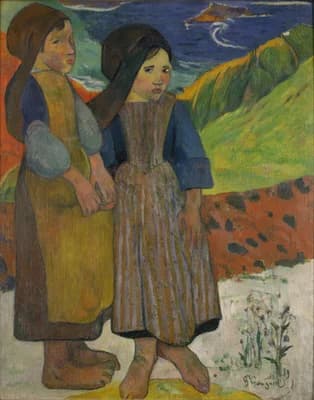
海辺に立つブルターニュの少女たち
1889
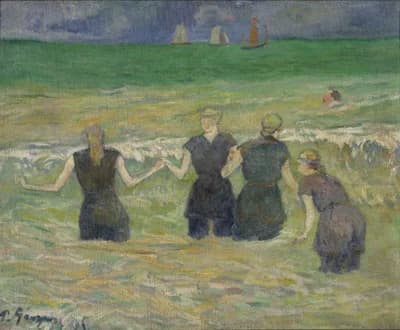
水浴の女たち
1885

When Will You Marry?
1892

Fatata te Miti
1892

Tahitian Women on the Beach
1890

Where Do We Come From? What Are We? Where Are We Going?
1897
Self-Portrait
1889
Manaò tupapaú
1892

Still Life

Two Tahitian Women
1899

Still Life with Teapot and Fruit
1896

The Siesta
ca. 1892–94

Two Women
1901 or 1902

A Farm in Brittany
ca. 1894

Heads of Tahitian Women, Frontal and Profile Views
1891/93

Te atua (The God), from the Noa Noa Suite
1894

Noa noa (Fragrant)
1894/95

Polynesian Woman with Children
1901

No te aha oe riri (Why Are You Angry?)
1896

Merahi metua no Tehamana (Tehamana Has Many Parents or The Ancestors of Tehamana)
1893

Arlésiennes (Mistral)
1888

Mahana no atua (Day of the God)
1894

Ia Orana Maria (Hail Mary)
1891
Timeline
Gauguin was born in Paris in 1848, amidst the tumult of Europe's revolutionary year.1
Gauguin's family moved to Peru after Napoleon III's coup d'état in 1848.3
Gauguin was born in Paris in 1848, a year of revolutionary upheavals throughout Europe.1
JunPaul Gauguin was born on June 7, 1848, in Paris.2
JunPaul Gauguin was born in Paris on June 7, 1848.1
In 1850, Gauguin moved to Peru with his family and lived in a privileged environment until age six. These childhood memories left a lasting impression, fueling his later longing for exoticism and vibrant colors in his art.4
In 1850, Gauguin's family settled in Peru, where he experienced a privileged childhood.1
The Impressionist master Camille Pissarro was Gauguin's early mentor. Pissarro taught him Impressionist techniques and introduced him to other artists, playing a crucial role in the self-taught Gauguin's entry into the art world.4
For about 11 years starting at age 23, Gauguin was a successful stockbroker in Paris. Despite his high income, the 1882 stock market crash prompted him to make the major decision to pursue painting full-time.4
Gauguin broke away from Impressionism to establish 'Synthetism,' characterized by bold colors and distinct outlines. This style prioritized the symbolic expression of the artist's subjectivity and spirituality over realistic depiction.4
After the 1882 stock market crash, Gauguin abandoned a stable job to support his family and pursue his career as an artist.3
The financial crisis of 1882 significantly impacted Gauguin's brokerage career, prompting a shift to full-time painting.1
Gauguin lost his job due to the stock market crash in 1882, which allowed him to focus on painting.3
Gauguin visited and worked in Martinique with painter Charles Laval in 1887.5
Gauguin is well known for his time living with Vincent van Gogh. Although their relationship ended tragically due to a clash of intense personalities, it was a significant period where they deeply influenced each other's art.4
In 1891, disillusioned with Western civilization, Gauguin traveled to Tahiti in search of primitive beauty. His works depicting the local nature and spiritual world later gained high acclaim in Europe, becoming his signature style.4
Though he struggled financially during his life, his fame was established posthumously through exhibitions organized by dealer Ambroise Vollard. His innovative expression greatly influenced modern masters like Picasso and Matisse.4
MayPaul Gauguin died on May 8, 1903, in Atuona, Marquesas Islands.1
MayPaul Gauguin died on May 8, 1903, in Atuona, Marquesas Islands.2