
Artist
Georges Seurat
France, 1859–1891
Works (10)
Young Woman Powdering Herself
1889

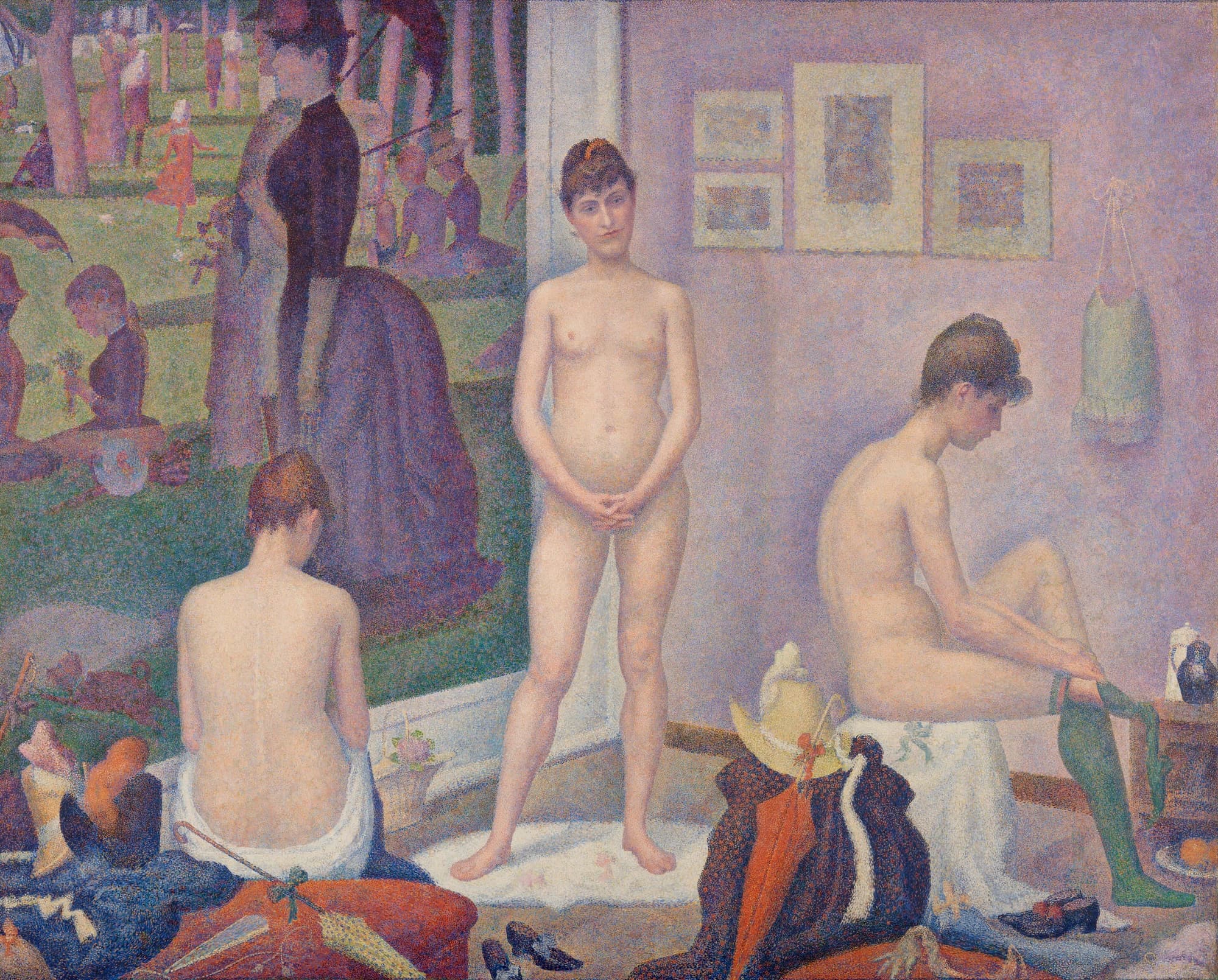
The Models
1886
Le Chahut
1889

Bathers at Asnières
1884

Gray Weather, Grande Jatte
ca. 1886–88
View of the Seine
1882–83

Study for "A Sunday on La Grande Jatte"
1884

A Man Leaning on a Parapet
ca. 1881

Circus Sideshow (Parade de cirque)
1887–88

A Sunday on La Grande Jatte — 1884
1884–86, border added 1888–89
Timeline
During the Paris Commune in 1871, Seurat's family temporarily withdrew to Fontainebleau.2
He received formal academic training under Henri Lehmann at the École des Beaux-Arts, where he developed the rigorous drawing skills that underpinned his later work.3
NovIn November 1879, Seurat left the École des Beaux-Arts for a year of military service.1
He developed a unique drawing style using Conté crayons on rough paper, utilizing the paper's texture to create subtle gradations of light and shadow.3
Influenced by Michel Eugène Chevreul's color theories, he applied scientific principles of complementary colors and simultaneous contrast to achieve optical harmony.3
He met Paul Signac and shared his pointillist techniques; Signac became his most important collaborator in establishing and promoting Neo-Impressionism.3
After his major work 'Bathers at Asnières' was rejected by the Salon, he helped found the Société des Artistes Indépendants, initiating the Neo-Impressionist movement.3
He established Pointillism, a technique of painting with small dots of pure color that blend optically in the viewer's eye rather than being mixed on the palette.3
"Bathers at Asnières" is a major early painting by Seurat, created in 1884.1
He spent two years and created over 60 preparatory studies for his masterpiece 'A Sunday Afternoon on the Island of La Grande Jatte,' a landmark of modern art.3
He kept his relationship with his model Madeleine Knobloch secret, even from his family, until shortly before his death. They had a son together in 1890.3
He died at the young age of 31, leaving his final ambitious work 'The Circus' unfinished. His sudden death was a significant loss to the art world.3