Water has no fixed shape. It plunges straight down, shatters against rock, churns, and slips away in a quiet flow. Never, not even for an instant, does it hold the same form.
And yet Hokusai caught that instant. The white threads of a falling waterfall, the swell of a churning rapid, the small waves crossing a calm river. How did he fix something in ceaseless motion into a single picture? Let us trace the masterworks of water that read almost like an answer.
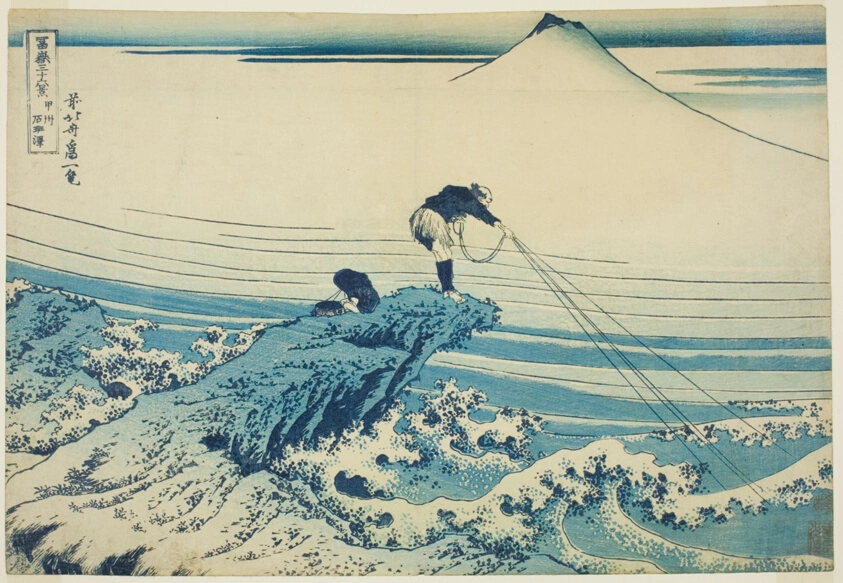
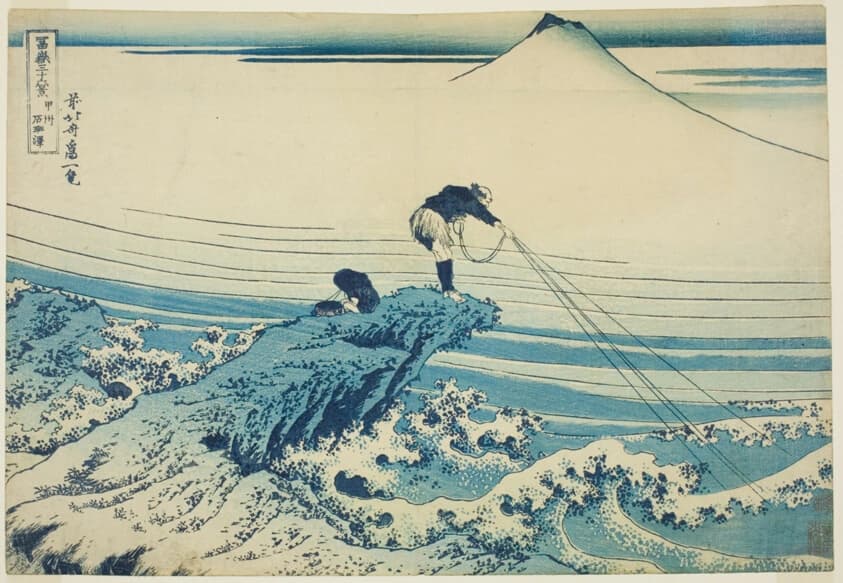
Take this "Kajikazawa in Kai Province." One of the Thirty-six Views of Mount Fuji, it depicts the area of Kajikazawa in Fujikawa, Yamanashi — the point where the Kamanashi and Fuefuki rivers meet and become the Fuji River. This was a hub of river shipping, and at the same time a treacherous stretch of water known as the "Rabbit’s Rapid." At the fisherman’s feet, the water churns up in white threads. As we will see later, Hokusai looked with the same eye at both this raging water and at water at rest.[3]
The painter Hokusai
What kind of painter was Hokusai in the first place? The works he produced over his lifetime are said to number more than 34,000. From human gestures to landscapes, plants and animals, natural phenomena, and even imaginary creatures — all the myriad things of this world became his subjects. Water was one of the motifs that drew him most strongly of all.[1]
The work that stands for Hokusai’s very name is the print series on Mount Fuji, the Thirty-six Views of Mount Fuji. Published between 1831 and 1834, it bore the title "thirty-six views," yet ten further "back views of Fuji" were added later, bringing it to 46 prints in all. Many of his water masterworks come from this same series. A river with Fuji beyond it, and the water spreading in the foreground — Hokusai bound together Fuji, water, and the life of the people in a single picture.[2]
Violent water — waterfalls and rapids
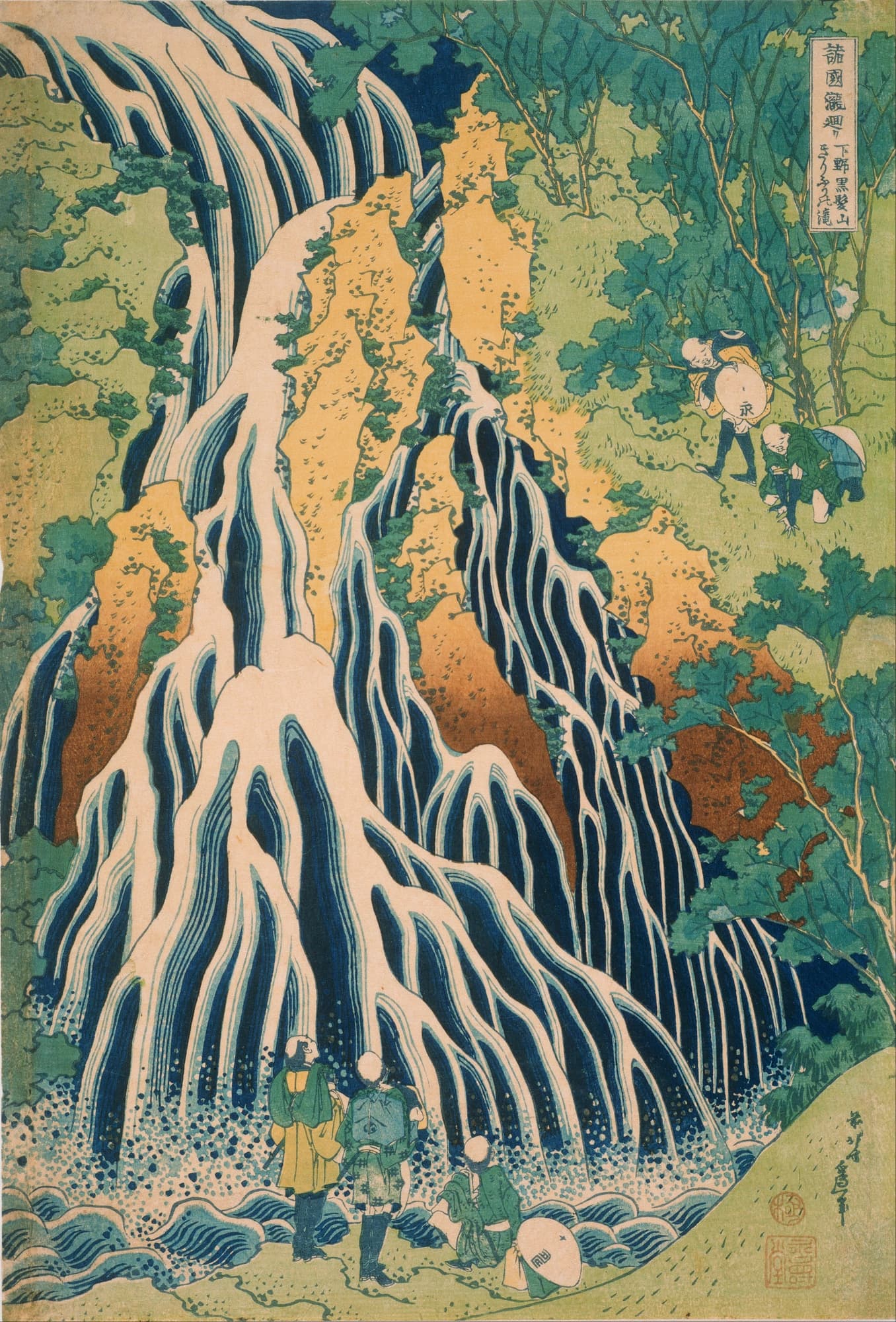
Let us begin with the most violent water. Hokusai made a series called A Tour of Waterfalls in the Provinces, depicting waterfalls across the country. One of its sheets, "Kirifuri Waterfall at Kurokami Mountain in Shimotsuke," shows Kirifuri Waterfall, one of the three famous falls of Nikkō. The actual waterfall divides into an upper and a lower fall, but for the sake of composition Hokusai placed the upper fall at top left and the lower fall at top right, gathering two waterfalls into a single picture.[4]
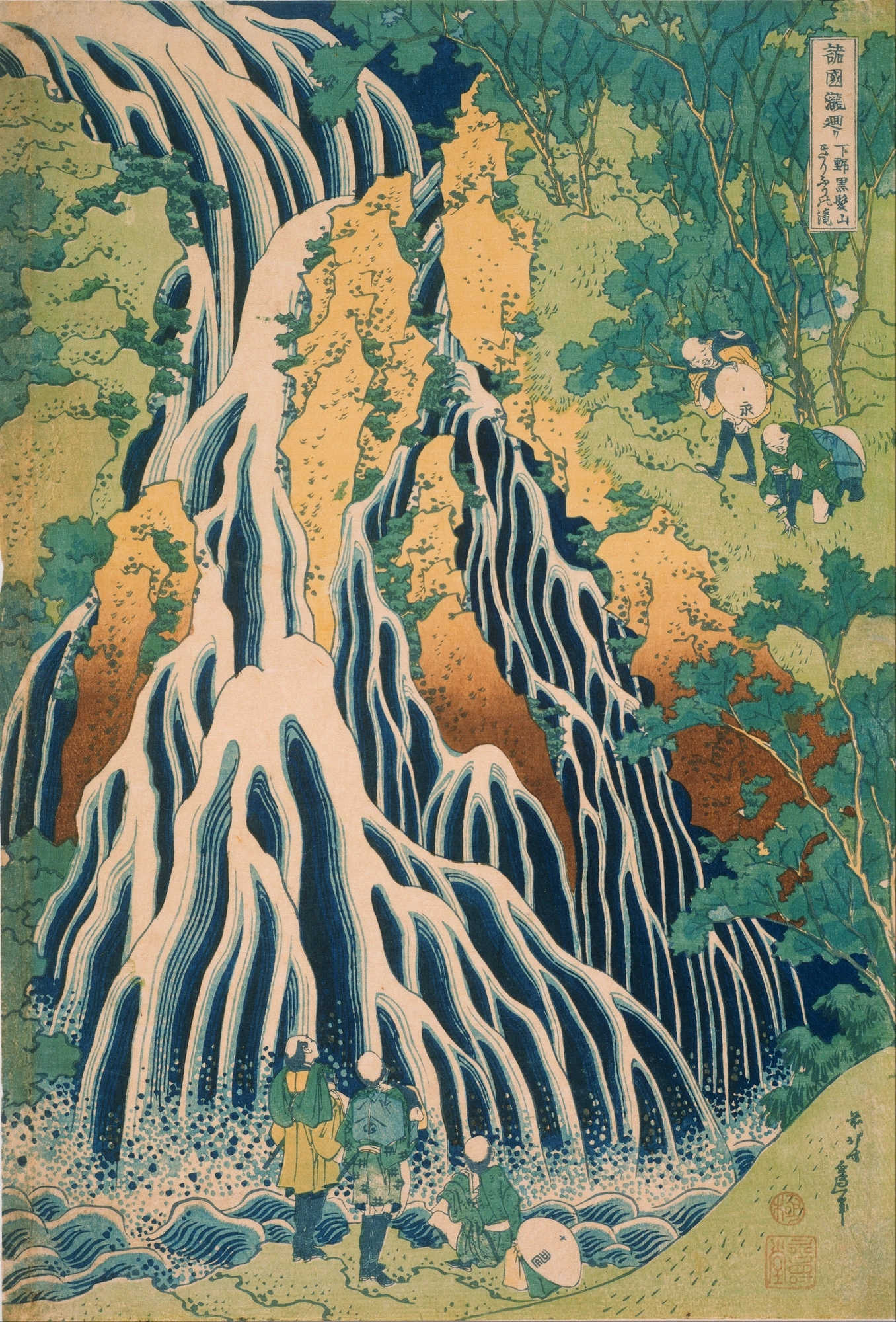
The falling water branches into many threads, drawn with a touch that recalls a woman’s black hair. This may have been an idea drawn from the mountain’s other name, "Kurokami," meaning "black hair," an alternative name for Mount Nantai. The white and indigo threads of water splitting as they hit the rock, the green trees around, the yellow rock face — the picture is built from a vivid contrast of color, and the waterfall is given a brilliant blue by a lavish use of that same "bero-ai." The composition, looking up from below, also draws on the manner of Chinese landscape painting.[4]
The Kirifuri Waterfall Hokusai painted still flows at Nikkō in Tochigi — one of the three famous falls of Nikkō.
View on Google MapsIf the waterfall is "falling water," then "Kajikazawa in Kai Province," which we saw at the start, is "churning water." The stage, the "Rabbit’s Rapid" of the Fuji River, was known as a treacherous stretch, and beside the fisherman leaning from the rocks toward the river, even a child and a basket are drawn in. What he holds is said to be a casting net for taking fish. Each single thread of the churning rapid is caught with a line utterly unlike that of still water — and here Hokusai’s eye for telling one water from another comes through.[3]
The rapid of the Fuji River depicted in "Kajikazawa in Kai Province" — near Kajikazawa in Fujikawa, Yamanashi.
View on Google MapsCalm water — rivers and daily life
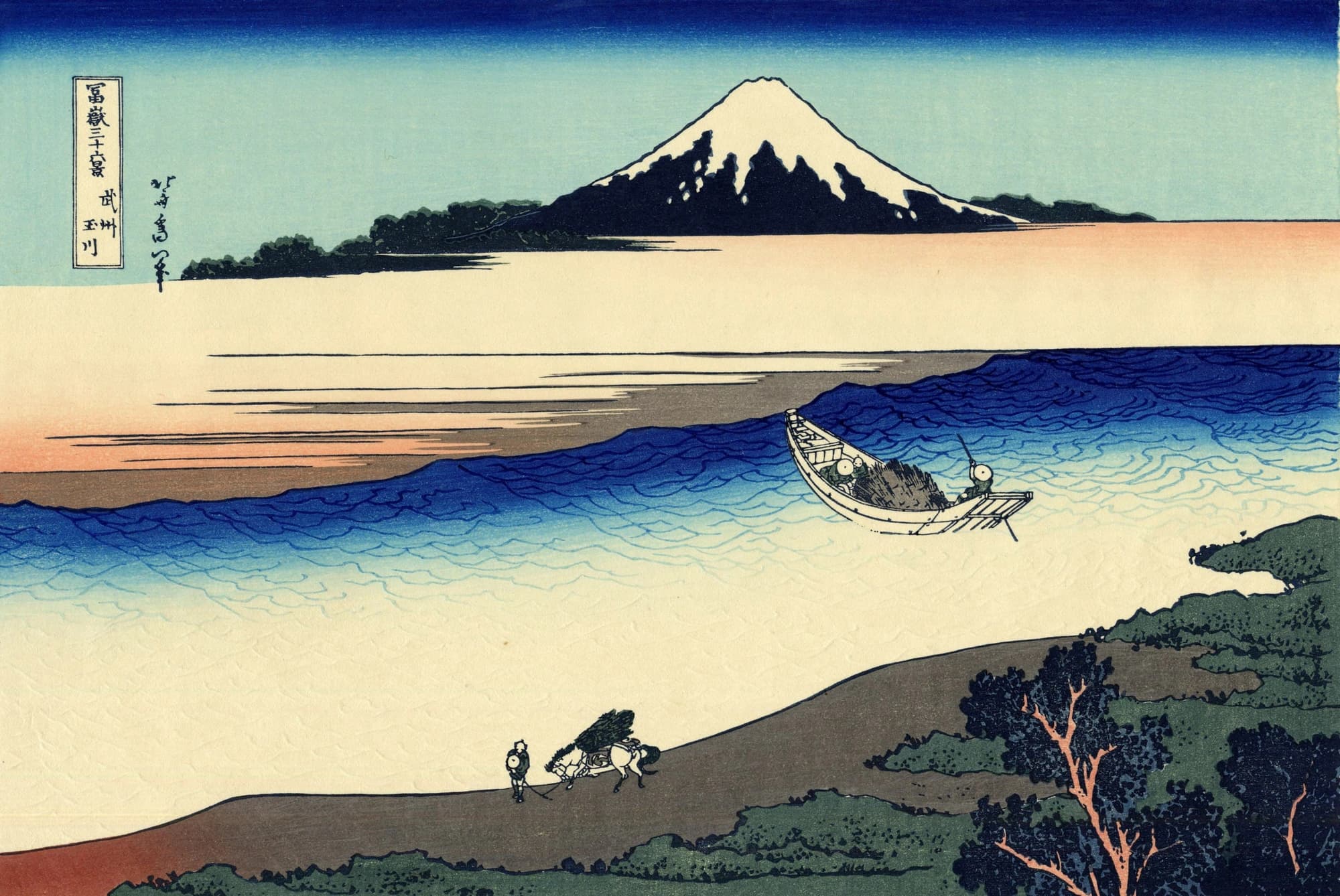
At the opposite pole from violent water lies calm water. "The Tama River in Musashi Province," from the same Thirty-six Views of Mount Fuji, depicts Mount Fuji seen across the Tama River, a first-class river of the Kantō region. A river of generous volume lies across the center, and beyond it, past a band of haze, Mount Fuji rises high. The tension of the waterfall and the rapid is absent here; the water simply flows on, quietly.[5]
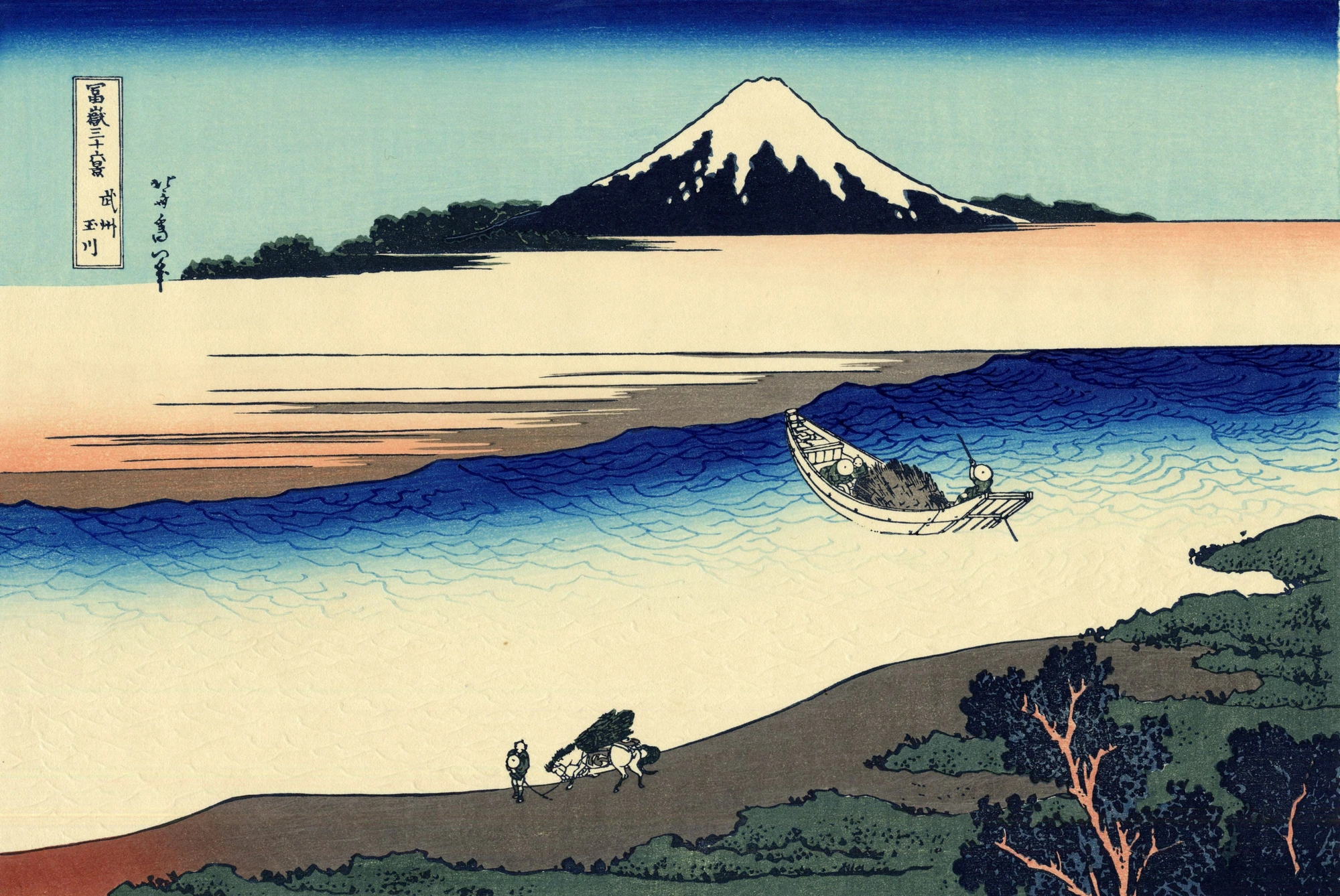
The heart of this print is the waves on the water surface. The waves are rendered with lines, yet each single line is drawn so as to take a different shape — Hokusai expressed the faint stirring of a calm surface through the drawing of lines alone. The scene has no houses; it is a sparse landscape in which only a man leading a horse along the bank and a boatman and crew poling a boat laden with brushwood are drawn. On the near side of the river a technique called "kara-zuri," a most delicate blind embossing, is applied — something seen only in first impressions or works very close to them.[5]
The Tama River depicted in "The Tama River in Musashi Province" — thought to show a ferry crossing near Chōfu, in the river’s middle reaches.
View on Google MapsThe eye that caught a single instant of water
A waterfall plunging straight down, a churning rapid, the small waves crossing a quiet river. However varied the subjects, what Hokusai tried to catch was always one and the same: "water," which holds no fixed shape and never rests in the same form for an instant. That single instant of something in ceaseless motion, he caught with line and color.
The white threads of a fall, the swell of a rapid, the small waves of a river surface — every one of Hokusai’s waters is drawn distinctly, line by line. Each sheet holds the fineness of an eye that never stopped watching what never stops moving.