Artist
William Powell Frith
Works (3)

Timeline
William Powell Frith was elected to the Royal Academy in 1853, presenting The Sleeping Model as his Diploma work.2
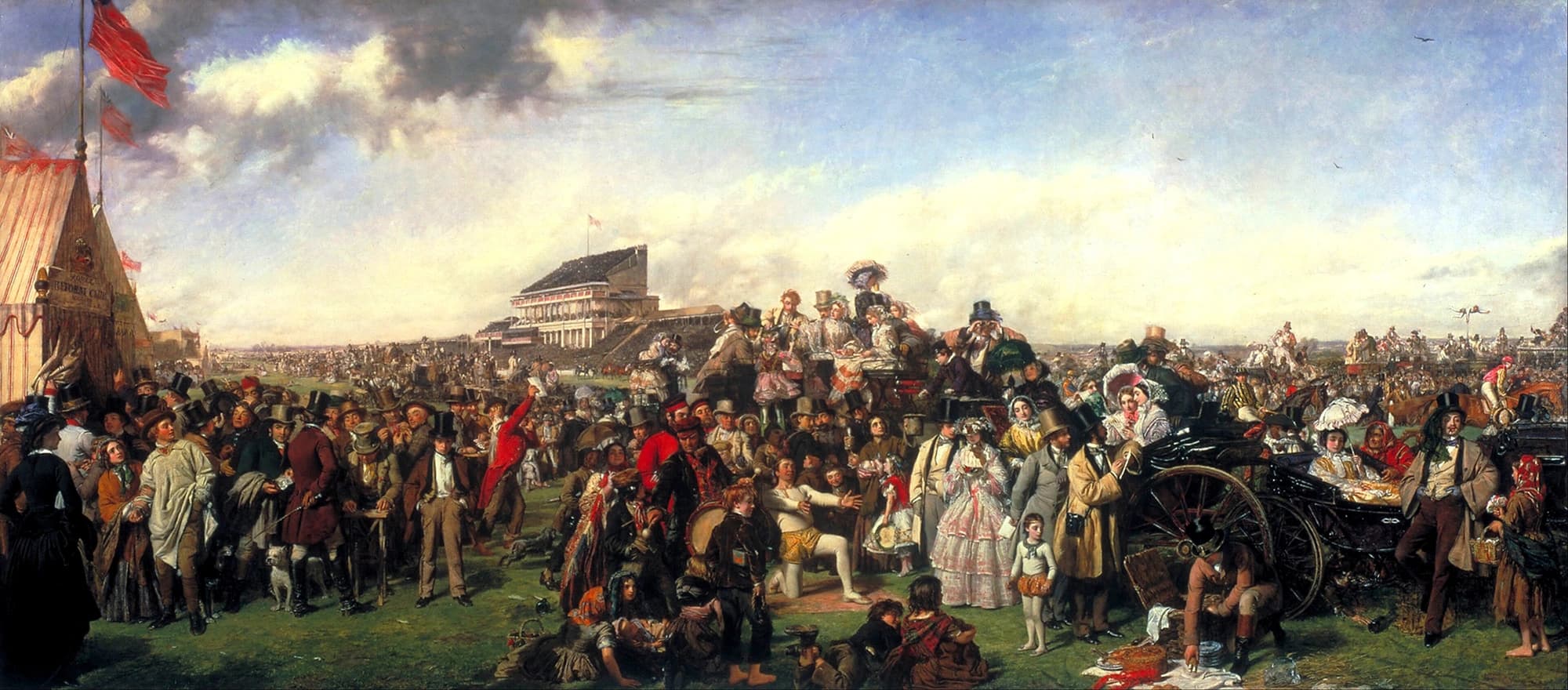
For his 1858 masterpiece 'The Derby Day', Frith used photographic studies by Robert Howlett as reference, employing modern technology to capture the dense details of the crowd.1
When 'The Derby Day' was shown at the Royal Academy, it was so popular that a special rail had to be installed to protect the painting from the crowds.1
His 1858 painting 'The Crossing Sweeper' broke new ground by depicting the collision of wealth and poverty on a London street, addressing contemporary social issues.1

In 1863, he was chosen to paint the marriage of the Prince of Wales (later Edward VII) and Princess Alexandra, solidifying his status as a leading Victorian artist.1
In 1863, William Powell Frith was chosen to paint the marriage of the Prince of Wales (later King Edward VII) and Princess Alexandra of Denmark.2
In the manner of William Hogarth, he painted moral series like 'The Road to Ruin' (1878), using five-picture sequences to warn against social vices like gambling.1
Despite depicting upright family scenes, Frith led a double life, maintaining a mistress and seven children just a mile away from his wife and their twelve children.1
A staunch traditionalist, Frith opposed the Pre-Raphaelites and the Aesthetic Movement, satirizing Oscar Wilde in his 1883 painting 'A Private View at the Royal Academy'.1

After retiring from the Royal Academy in 1890, he continued to exhibit until 1902. His popular autobiographies made him a well-known raconteur in his later years.1
NovWilliam Powell Frith died on November 2, 1909, in London, at the age of 90.2