
Artist
Jean-François Millet
France, 1814–1875
Works (8)


Timeline
Born into a farming family in Normandy, Millet helped with farm work from a young age. This experience became the origin of his later subjects, such as sowing and harvesting.1
Daumier's powerful draftsmanship influenced Millet's heavy rendering of peasant subjects. Alfred Sensier, his future biographer, supported Millet financially and emotionally throughout his life.1
In 1849, Millet left Paris and moved to the village of Barbizon. There, he formed the Barbizon school with artists like Théodore Rousseau, establishing a style that realistically depicted peasants in nature.1
Millet initially painted idealized pastoral scenes but gradually shifted to Realism, reflecting the harsh social conditions of the time. He shocked the art world by depicting peasant labor as noble and powerful.1
In 'The Gleaners,' the lines of the women's backs are drawn toward the ground to express the fatigue of repetitive, backbreaking labor. It depicts a traditional right granted to the poor.1
Originally titled 'Prayer for the Potato Crop,' 'The Angelus' received its current name after a church steeple was added. The image of praying peasants later became a French national symbol.1

In the 1860s, patron Emile Gavet commissioned 90 pastels from Millet. This support stabilized his finances, and in 1868, he gained fame by being named a Chevalier de la Légion d'Honneur.1
Toward the end of his career, Millet became increasingly interested in pure landscapes. Using pastels, Conté, and etching, he pursued expressions of light and atmosphere that influenced Impressionism.1
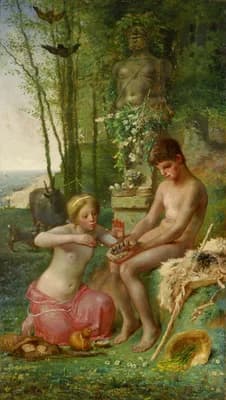
Due to material shortages during the Franco-Prussian War, Millet painted over his ambitious work 'Captivity of the Jews in Babylon.' This was discovered via X-ray in 1984.1
After Millet's death, the contrast between high resale prices and his family's poverty led to the creation of 'droit de suite,' a law ensuring artists or heirs receive a portion of resale profits.1