Artist
Karl Bryullov

Timeline
Born in 1799 in St. Petersburg to a family of artists, including his woodcarver father, he was of Huguenot descent and felt a strong draw to Italy from his early years.1
Educated at the Imperial Academy of Arts from 1809 to 1821, Bryullov never fully embraced the classical style taught by his mentors, despite being a promising student.1
After his education, he worked in Rome until 1835 as a portraitist and genre painter, eventually gaining fame through his historical paintings.1
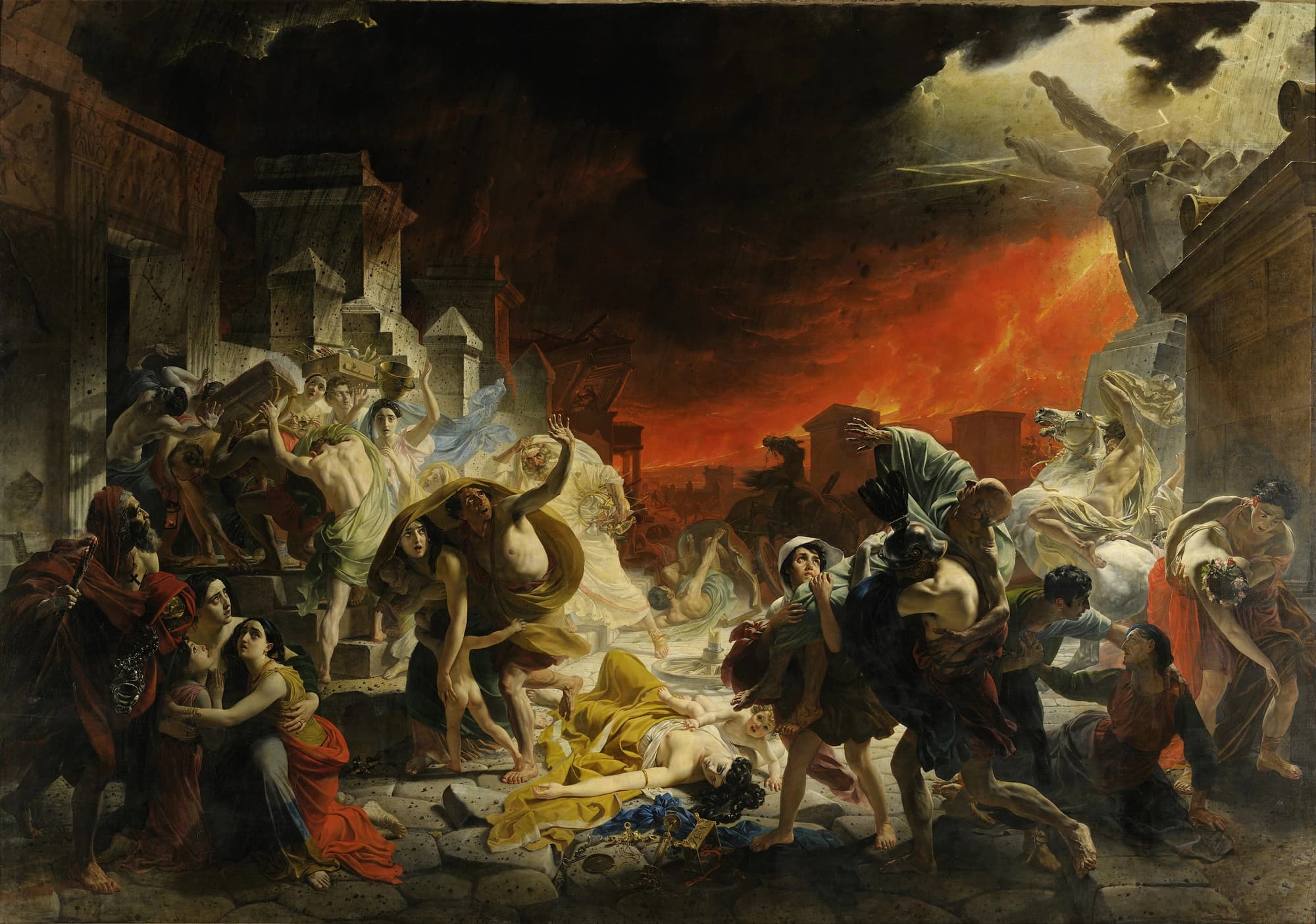
His masterpiece, 'The Last Day of Pompeii', combined dramatic action, romantic lighting effects, and sculptural plasticity, establishing him as a premier European painter.1
His work 'The Last Day of Pompeii' was compared by Pushkin and Gogol to the best works of Rubens and Van Dyck, creating a sensation across Europe.1

While teaching at the academy, he developed a portrait style combining neoclassical simplicity with romantic tendencies and deep psychological penetration.1
His health deteriorated while working on the St. Isaac's Cathedral plafond; he moved to Madeira and then Italy, where he died in 1852.1