
Artist
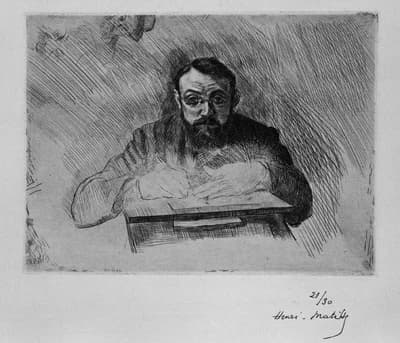
Henri Matisse
France, 1869–1954


Timeline
In 1889, while recovering from appendicitis, Matisse's mother gave him art supplies. He discovered 'a kind of paradise' and decided to become an artist, deeply disappointing his father who wanted him to be a lawyer.1
Matisse studied under Gustave Moreau at the École des Beaux-Arts. Moreau encouraged his students to think outside formal lines and follow their own visions, providing an inspirational foundation for Fauvism.1
After meeting John Russell in 1896, Matisse was introduced to Impressionism and Van Gogh's work. He abandoned his earth-colored palette for bright colors, crediting Russell for explaining color theory to him.1
During the 1902 Humbert Affair financial scandal, Matisse became the sole breadwinner for seven people. He temporarily adopted a somber, formal style to produce more saleable works during this hardship.1
Influenced by Paul Signac, Matisse adopted Divisionist techniques between 1898 and 1901. His 1904 work 'Luxe, Calme et Volupté' remains his most important neo-Impressionist painting.1
When Matisse faced harsh criticism, Gertrude and Leo Stein purchased his controversial painting 'Woman with a Hat'. This act significantly boosted his morale and improved his financial situation.1
In 1905, critic Louis Vauxcelles described the intense colors of Matisse and his peers as 'wild beasts' (Fauves). This movement emphasized emotional expression through dissonant colors rather than natural representation.1
In 1917, Matisse relocated to Nice. His work during the 1920s adopted a more relaxed and decorative style, gaining him critical acclaim as an upholder of the classical tradition in French painting.1
In his final years, ill health prevented Matisse from painting, leading him to create 'cut paper collages'. This medium allowed him to achieve a bold simplification of form and mastery of expressive color.1