Artist
Dieric Bouts
Works (9)


Timeline
An Early Netherlandish painter, Bouts was strongly influenced by Rogier van der Weyden and Jan van Eyck. He may have studied under van der Weyden, carrying on the traditions of Northern painting.1
Bouts produced many small devotional panels of the 'Virgin and Child.' Following the icon of Notre-Dame-des-Grâces, he developed a style blending delicate detail with serene emotional expression.1
Bouts worked in Leuven, Belgium, from around 1457 until his death in 1475. His works are still held in Leuven's St. Peter's Church, reflecting his deep roots in the local community.1
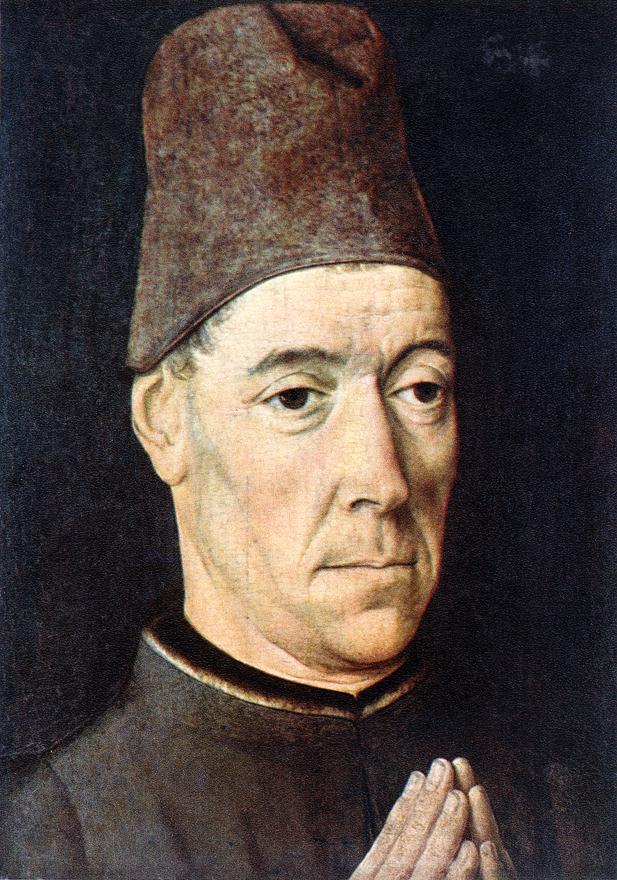
The 1462 'Portrait of a Man' is an early example of a sitter shown in three-quarter view against a landscape background seen through a window, a format that became a standard in portraiture.1
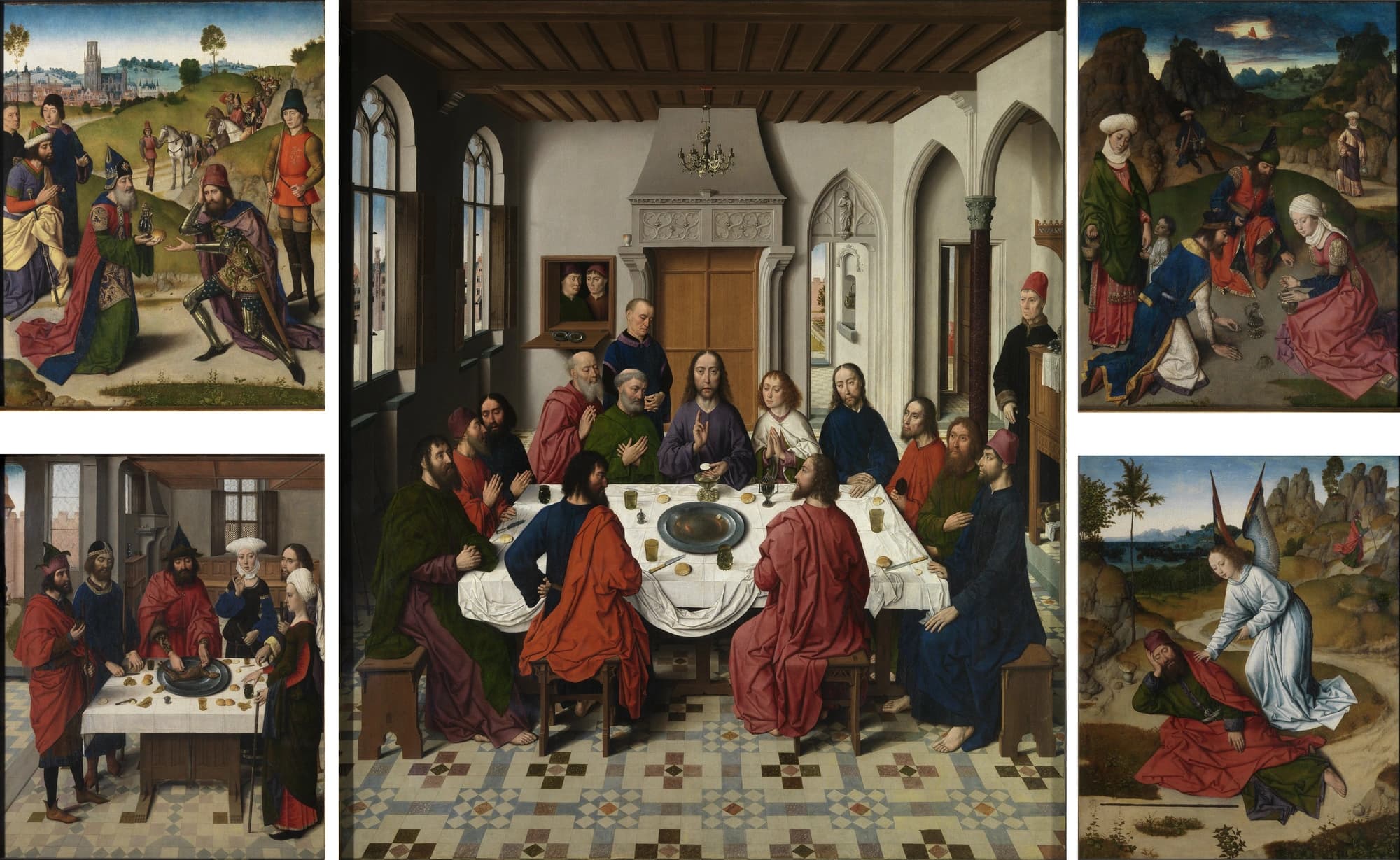
In 'The Last Supper,' Bouts focused on the ritual aspect of Christ performing the Eucharist as a priest, rather than the betrayal. This was an innovative interpretation in Flemish painting of the time.1
The 'Altarpiece of the Holy Sacrament' was commissioned by the Leuven Confraternity of the Holy Sacrament. The painting includes figures dressed in Flemish attire, likely portraits of the confraternity members.1
Bouts was among the first Northern painters to adopt Italian linear perspective. In his masterpiece 'The Last Supper,' he used a single vanishing point converging above Christ's head to organize the space.1
Appointed as the city painter of Leuven in 1468, Bouts began receiving major public commissions like the 'Justice Panels' for the Town Hall, establishing his status as the city's leading artist.1
The 'Justice Panels' for Leuven Town Hall depict the story of the 11th-century Emperor Otto III. Intended as moral lessons for the courtroom, they remained unfinished upon Bouts' death in 1475.1

After Bouts' death, his sons Dieric the Younger and Aelbrecht took over the workshop. Aelbrecht, in particular, continued his father's iconographic traditions while developing his own style into the 16th century.1

