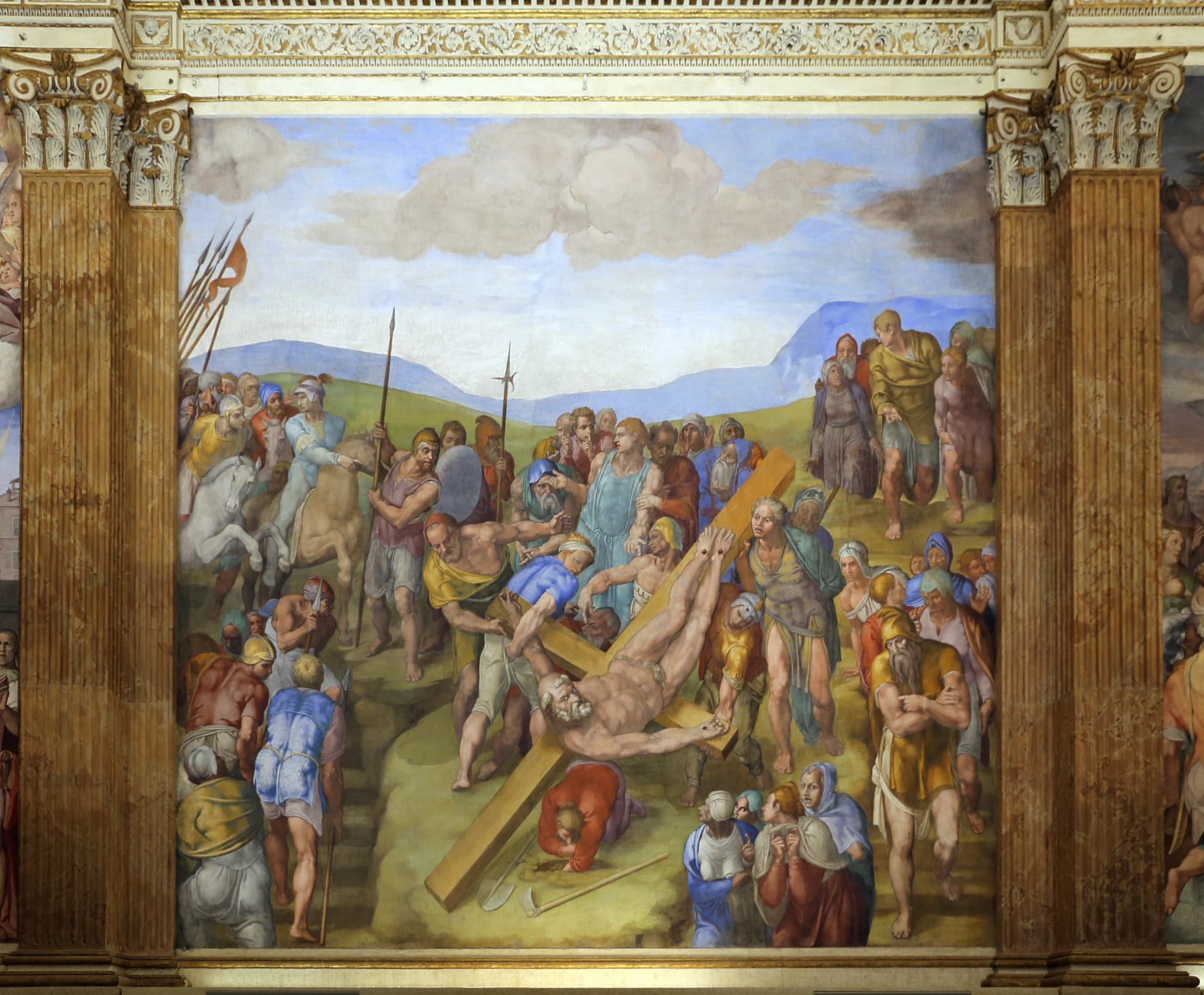
Artist
Michelangelo
Italy, 1475–1564
Works (6)


Timeline
Raised in the town of Settignano by a stonecutter's family, Michelangelo learned to use a chisel and hammer from his nurse's husband, fostering his lifelong love for marble carving.1
At age 13, Michelangelo was apprenticed to Domenico Ghirlandaio. His talent was so evident that his father persuaded the master to pay him as an artist, which was rare for an apprentice.1
Under the patronage of Lorenzo de' Medici, Michelangelo attended the Platonic Academy, where he was influenced by prominent Humanist philosophers and writers of the day.1
At age 17, fellow pupil Pietro Torrigiano struck Michelangelo on the nose, causing a permanent disfigurement that is visible in all subsequent portraits of the artist.1
Michelangelo studied anatomy by dissecting cadavers at the church of Santo Spirito, which allowed him to depict the human form with unparalleled physical accuracy and expressive power.1
Michelangelo achieved fame early, completing two of his most famous sculptures, the Pietà and David, before the age of 30, establishing himself as a master of the High Renaissance.1
Born in the Republic of Florence, Michelangelo was mostly active in Rome from his 30s onwards, where he created his most influential works for the Papacy.1
At age 71, he became the chief architect of St. Peter's Basilica. He transformed the plan and designed the iconic dome, working on the project until his death at age 88.1
Michelangelo was the first Western artist to have his biography published during his lifetime. Giorgio Vasari lauded him as supreme in sculpture, painting, and architecture.1