Artist
Kanji Maeta
1896–1930
Kanji Maeta was born in Tottori Prefecture on October 1, 1896, the year after the end of the First Sino-Japanese War 13. During his childhood, he had a gentle personality and grew up exposed to urban culture and scientific knowledge through magazines sent by his uncle 1. At the former Kurayoshi Middle School, he was a classmate of the future Marxist theorist Kazuo Fukumoto and received his first formal instruction from the drawing teacher Kinzo Nakai 2. After failing the entrance exam for a higher school, he aspired to become a painter after reading a biography of the painter Corot; he then studied at the Hakubakai Aoibashi Western Painting Institute before entering the Western Painting Department of the Tokyo School of Fine Arts in 1916 2. While still a student, he exhibited works at the Kofukai and Kabutoya Western Painting Exhibitions, and he graduated from the school in 1921 23. That same year, he gained attention as a rising artist when his works were simultaneously selected for both the Nika Exhibition and the Teiten (Imperial Art Exhibition) 2.
Motivated by a French painting exhibition held in 1922, he yearned to travel to France, setting sail at the end of that year and staying in Paris for three years starting in 1923 123. At the Académie de la Grande Chaumière, he studied the realism of Courbet and mastered a method of capturing subjects through the three elements of texture, volume, and a sense of presence 34. During his stay in Europe, he formed a close friendship with Yuzo Saeki and others, referring to himself as the "Piglet of Paris" 3. Furthermore, under the ideological influence of Kazuo Fukumoto, whom he met again, his style shifted toward socialist realism around 1924, focusing on themes such as laborers and factories 134. After returning to Japan in 1925, he received high acclaim, with his work *Portrait of Miss J.C.* receiving the Special Prize at the Teiten 2. In 1926, he established the "1930 Association," and in 1928, he opened the "Maeta Realism Institute" to guide the next generation of artists 34.
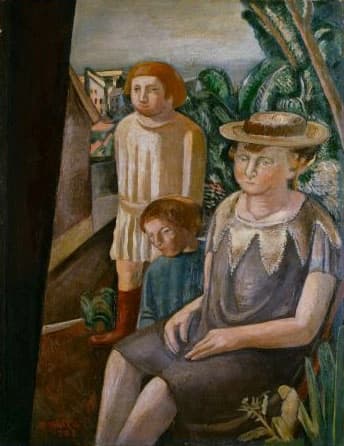
Maeta's painting style, which fused classical composition with Fauvist brushwork, had such a significant impact on the art world that it gave rise to the popular term "Maekan-bari" 4. Throughout his life, he favored children as subjects, and he developed a unique theory of realism, which included painting a portrait of the singer Noriko Awaya and using a bluish-black that reflected the colors of the shadows in his hometown 14. In 1929, he established his position in the art world by receiving the Imperial Art Academy Award and being selected as a juror for the Teiten; however, that same year, he developed a nasal tumor during a sketching trip 24. In 1930, after completing his final masterpiece *The Sea* in his hospital room, he passed away in April at the young age of 33 4. A collection of his works was published shortly after his death, and he left a significant mark on the history of modern art 12.
See sources at the bottom of the page.
Feature: Who was Maeda Kanji?Works (12)
Timeline
Kanji Maeta was born on October 1, 1896, the year after the First Sino-Japanese War ended.1
AprHe attended Kurayoshi Middle School, where he was a classmate of future Marxist theorist Kazuo Fukumoto, a connection that led to ideological exchanges in Paris years later.2
At Kurayoshi Middle School, he was taught by Kinzō Nakai, a graduate of the Tokyo School of Fine Arts and Maeta's first formal painting instructor.2
JulAfter failing his high school entrance exams, reading a biography of the painter Corot reportedly inspired him to pursue a career in art.2
AprIn 1916, he entered the Western Painting Department of the Tokyo School of Fine Arts (now Tokyo University of the Arts) after studying at the Hakubakai Aoibashi Western Painting Institute before moving to Tokyo.2
FebIn 1918, he exhibited at the Kōfūkai Exhibition, beginning to show his work publicly while still a student.2
SepIn 1919, he exhibited "The Afterlife and Church People" at the Kabutoya Western Painting Exhibition, which was judged by Sōtarō Yasui and Ryūzaburō Umehara.2
In 1921, Kanji Maeta completed his studies and graduated from the Tokyo School of Fine Arts.3
After moving to Tokyo, he lived near Ikebukuro and associated closely with young painters such as Katsuzō Satomi, Yūzō Saeki, and Takashi Nakayama, friendships that continued later in Paris.2
AugIn 1921, he held a solo exhibition at Kurayoshi Middle School, displaying 71 works from his time at the Tokyo School of Fine Arts.2
OctIn 1921, he gained attention as a rising artist after his work was accepted into both the Nika Exhibition and the Imperial Art Exhibition (Teiten).2
Just before studying in Europe, Kanji Maeta produced works using a technique similar to pointillism.3
In 1922, he exhibited "Standing Child" at the Peace Memorial Tokyo Exhibition and received an award.2
An exhibition of French paintings from the Ohara collection held in January 1922 inspired his strong desire to go to Paris.1
DecHe sailed from Yokohama for France in December 1922 and arrived in Paris in February 1923.2
In 1923, he painted "Two Laborers," depicting people in difficult social circumstances, which demonstrated his style during his period of study abroad.3
JunIn 1923, he visited Vlaminck with Katsuzō Satomi and visited Van Gogh's grave in Auvers-sur-Oise.2
AugAfter sharing a life in Paris with his fellow painter Mitsuya Ishikawa, who had traveled to France with him, Maeta broke with him due to religious differences, though their friendship continued.2
SepAfter remittances from his hometown were cut off due to the Great Kantō Earthquake, he continued his studies in Paris by borrowing money from friends.2


During his stay in Europe, he chose laborers and factories as his primary subjects and became interested in the expressive methods of socialist realism.3
In Paris, he was close to Yūzō Saeki and Katsuzō Satomi, and Maeta referred to himself and his companions as the "Pigs of Paris."3
JulIn 1924, he shared a studio in Paris with Karoku Takasu for several months and provided him with painting instruction.2

Around 1925, after his return to Japan, his style evolved into a weighty realism that accurately captured the forms of his subjects.3
In 1925, he translated and introduced a biography of Courbet, deepening his commitment to realism.2
As a culmination of his stay in Europe, he produced major figurative works such as "Breton Woman" and "Portrait of Miss J.C."2
In 1925, he produced "Nude" and "Portrait of a Woman in Black," which reflect the traditional style characteristic of his time studying abroad.3
OctAfter returning to Japan in 1925, his work "Portrait of Miss J.C." won the special prize at the Imperial Art Exhibition (Teiten).2
DecIn 1925, he held an exhibition of works from his stay in Europe in his hometown and distributed pieces to the patrons who had supported his studies abroad.2


He founded the art group 1930 Association and remained active as its central figure.3
At the 1st Prince Shotoku Memorial Exhibition in 1926, he exhibited "Portrait of a Woman in Black," an oil painting he had created the previous year.3
Around 1926, he married a woman from his hometown and established a household.2
MayIn 1926, the 1930 Association held its first exhibition, where Maeta displayed 40 works produced during his stay in Europe.2
JanIn 1927, he painted a portrait of his old friend Kazuo Fukumoto, a leader of the reorganized Communist Party who often visited Maeta's home.2
JunFrom its second exhibition in 1927, the 1930 Association Exhibition adopted an open-call format and became a gateway for young Western-style painters.2
OctIn 1927, "Reclining Nude" received the Special Prize at the Teiten, and he used the proceeds from its sale to fund the construction of his studio.2
DecIn 1927, he completed the art book "Courbet."2
DecIn December 1927, his eldest son, Tōichirō, was born.2
In 1928, he built a studio and residence in Suginami, Tokyo, and opened the Maeta Realism Institute to mentor younger artists while deepening his pursuit of realism.4
MayIn 1928, he was selected for recommendation (non-juried status) for the Teiten by the Imperial Art Academy.2
MayIn 1928, he spoke on "The Beauty of Realism" at a 1930 Association lecture, explaining his own theory of realism.2
AugIn 1928, his close friend and fellow painter Yūzō Saeki died in Paris.2


In 1929, he created illustrations for Takeru Inukai's serialized newspaper novel "Magic Lantern," which were published posthumously.2
In 1929, he was appointed as a juror for the autumn Teiten, establishing his status in the art world.2
In 1929, he fell ill during a sketching trip and was later diagnosed with a nasal cavity tumor.2
JanIn 1929, he exhibited works such as "Family of a Master Carpenter" at the fourth exhibition of the 1930 Association.2

In 1930, he completed his final major work, "The Sea," in his hospital room before passing away in April at the age of 33 due to a nasal cavity tumor.4
JanIn 1930, he exhibited representative late works such as "Two Laborers" and "The Sea" at the 1930 Association Exhibition.2
MayShortly after his death in 1930, the art book "Collected Works of Kanji Maeta" was published.2

Sources
- [1]滝悌三, 前田寛治 (日動出版部, 1977)
- [2]前田寛治の芸術展 詩情と造形 (愛知県美術館, 1999)
- [3]文化遺産オンライン(文化庁)
- [4]Wikipedia