Artist
Hyacinthe Rigaud
Works (4)


Timeline
Born in Perpignan in 1659, just before it was ceded to France from Spain, Rigaud was of Catalan descent and became a French subject, eventually rising to prominence as a court painter.1
Rigaud came from a lineage of painters and gilders in Perpignan. While his father was a tailor, his grandfather and great-grandfather created altarpieces, rooting his talent in generations of craftsmanship.1
During his training in Montpellier and Lyon, he studied masters like Rubens, Van Dyck, and Rembrandt. Absorbing their use of color and brushwork formed the basis of his later grand and majestic portrait style.1
In 1682, he won the Prix de Rome but, on the advice of Charles Le Brun, declined the trip to Italy to stay in Paris. This decision became a turning point that defined his career as a portraitist.1
In 1695, he returned home to paint his mother, Maria Serra. He depicted her from multiple angles and had a bust made by Coysevox based on these portraits, keeping it close for the rest of his life.1
Though known for portraits, in 1695 Rigaud produced 'Christ expiant sur la Croix' with strong Flemish influence, a rare instance of him engaging in the prestigious 'history painting' genre.1
In 1696, commissioned by the Duke of Saint-Simon, he painted Abbot de Rancé. Since the subject's permission was hard to obtain, he used a clever subterfuge to sketch him in secret.1
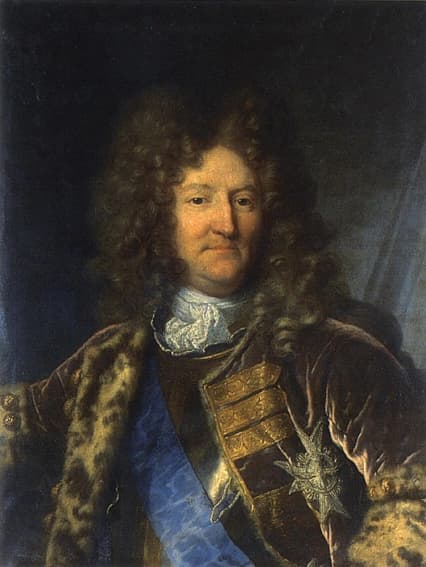
He gained immense popularity for his portraits of Louis XIV and the nobility. His ability to precisely capture costumes and backgrounds makes his work a valuable record of contemporary fashion.1
Due to his success, he was ennobled by Perpignan in 1709 and knighted in the Order of Saint Michael in 1727, marking an extraordinary rise from a tailor's son to a knight serving the king.1
He became a member of the Académie Royale in 1710 and rose to its top, serving as director and rector. He held significant influence as an authority in the French art world until his retirement in 1735.1
