Artist
Gustave Doré
Works (2)

Timeline
JanGustave Doré was born on January 6, 1832, in Strasbourg, France.1
Doré began his career as a caricaturist at the age of 15, influenced by J. J. Grandville. His early work in text comics and wood-engraving quickly established him as a prodigious talent in France.2
Gustave Doré began his career at the age of 15 as a caricaturist for the French paper Le Journal pour rire.1
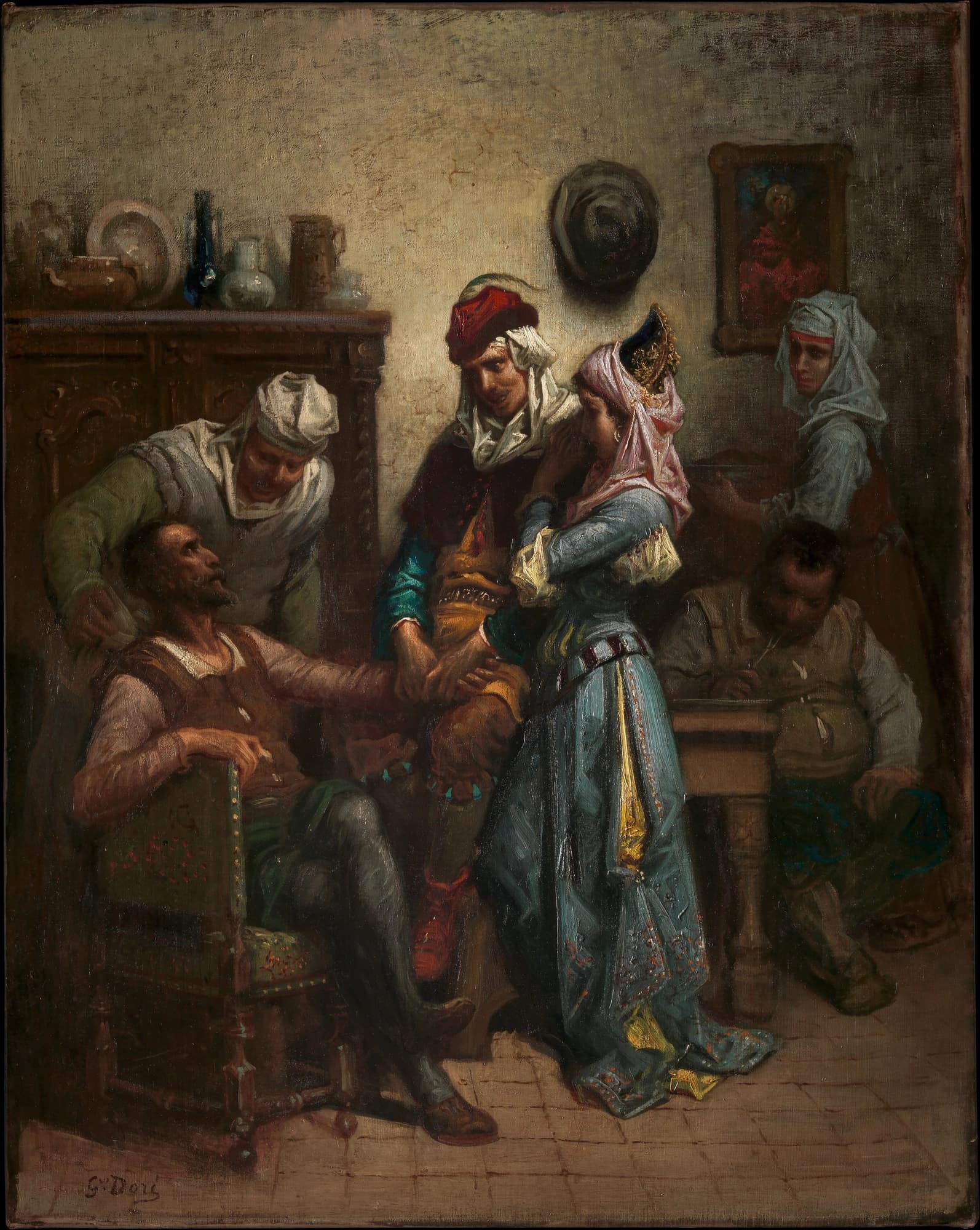
His illustrations for Cervantes's 'Don Quixote' became the definitive visual representation of the characters, influencing the interpretations of future artists, readers, and film directors.2
Following a successful exhibition in 1867, the Doré Gallery was established on Bond Street in London. This venue became a central hub for his commercial success and popularity in Britain.2
In 'London: A Pilgrimage,' Doré focused on the city's poverty. While critics accused him of 'inventing' scenes, the work profoundly impressed Vincent van Gogh, who later painted a version of one of the scenes.2
During a trip to Scotland in 1873, Doré developed his skills as a watercolorist. This expanded his artistic range beyond wood-engraving, allowing him to explore new textures in landscape painting.2
Doré never married and lived with his mother in Paris until his death in 1883. He died of a heart attack while working on a new edition of Shakespeare's plays.2
In 1883, he received a massive sum of 30,000 francs for his illustrations of Edgar Allan Poe's 'The Raven,' demonstrating his immense commercial value as an illustrator at the end of his career.2
JanGustave Doré died on January 23, 1883, at the age of 51 in Paris.1