Artist
Ford Madox Brown
Works (1)
Timeline
Born in Calais and educated in Bruges, Ghent, and Antwerp, Brown's international upbringing provided him with a rigorous academic foundation that distinguished him from his British contemporaries.1
Brown was the tutor of Dante Gabriel Rossetti and deeply influenced the Pre-Raphaelite Brotherhood. Although never a formal member, he adopted their bright colors and realistic style, becoming a key figure in the movement.1
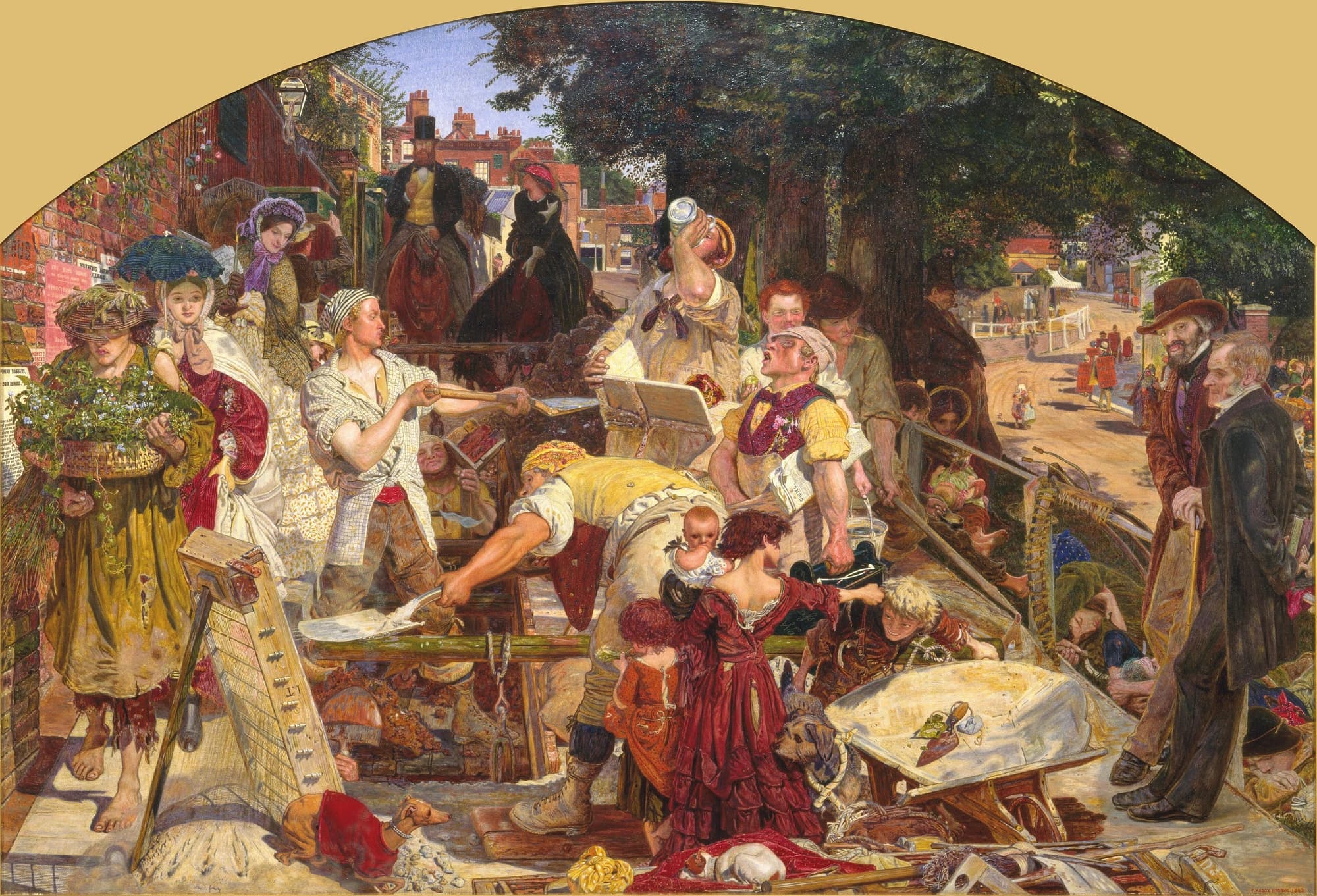
In his masterpiece 'Work', Brown spent 13 years depicting the totality of Victorian social experience. Centered on road workers in Hampstead, the painting symbolically captures the complex social hierarchy of the modern urban environment.1
Inspired by Thomas Woolner's emigration, 'The Last of England' uses a tondo format to depict the sorrow of emigrants. It includes mundane details like cabbages hanging from the ship, symbolizing the harsh social realities of the era.1

Rejecting the conservative Royal Academy, Brown ceased exhibiting there in the late 1850s. He founded the Hogarth Club to create an independent platform for artists, challenging the established artistic authorities of his time.1
As a founding partner of Morris, Marshall, Faulkner & Co., Brown designed furniture and stained glass, playing a significant role as a precursor to the Arts and Crafts movement alongside William Morris.1
The death of his promising son Oliver at age 19 was a crushing blow. Brown was so devastated that he kept a room filled with his son's belongings as a shrine, mourning the loss for the rest of his life.1
Brown dedicated his final years to 'The Manchester Murals', a cycle of twelve paintings in Manchester Town Hall. Depicting the city's history, this monumental project was the culmination of his career, finished shortly before his death at 72.1