Artist
Raden Saleh
Timeline
Born around 1811 into a noble Javanese family, Raden Saleh is considered Indonesia's first 'modern' artist, blending his Arab-Javanese roots with Western techniques.1
Discovered by Belgian artist A.J. Payen, Saleh was sent to the Netherlands with colonial government support, a major turning point in his rise as a Western painting master.1
He studied portraiture under Cornelis Kruseman in the Netherlands, achieving such skill that he was invited to various European courts as a portrait painter.1
He learned landscape painting from Andreas Schelfhout, traveling through European cities and Algeria to depict grand nature and scenery with Romantic sensibilities.1
Studying a lion from a tamer in The Hague led him to paint dynamic animal fights, which became his signature style and brought him great fame in Europe.1
He spent five years at the court of Ernest I, Duke of Saxe-Coburg and Gotha, gaining crucial patronage that solidified his status as an artist.1
Strongly influenced by Delacroix during his time in Paris, his work features the intense emotional expression of Romanticism, especially in his wildlife hunting scenes.1
Returning in 1852 after 20 years in Europe, he served as a court painter but expressed unease in letters about a colonial society obsessed only with coffee and sugar.1
He built a mansion in Cikini, Jakarta, inspired by Germany's Callenberg Castle; its grounds became a cultural center, and the building still serves as a hospital today.1
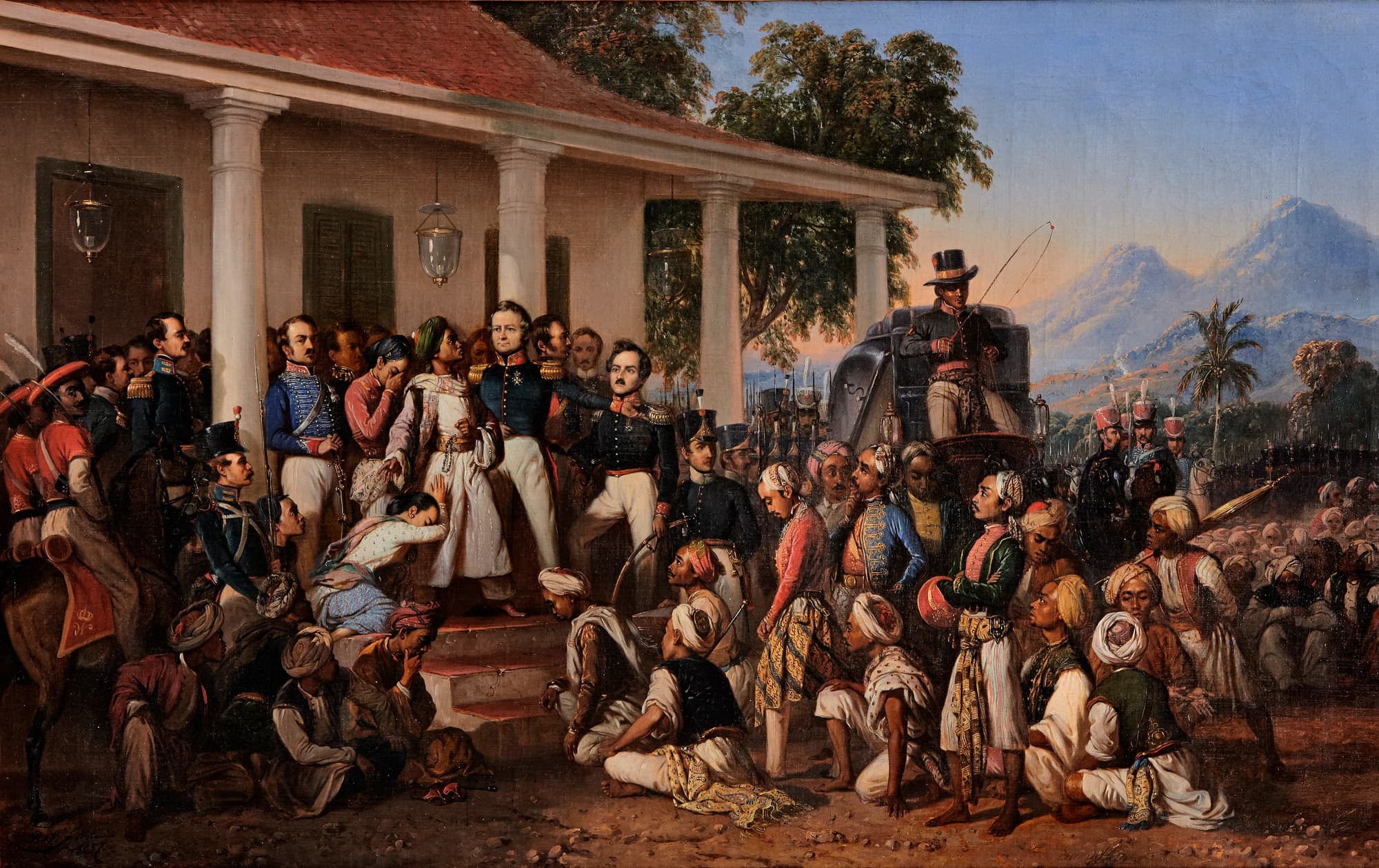
In 'The Arrest of Pangeran Diponegoro,' he depicted the prince's outrage and dignity, creating a historical work symbolizing resistance and nascent nationalism.1

Upon his sudden death in 1880, Saleh claimed he was poisoned, though an autopsy revealed a heart clot. His funeral was attended by Dutch officials and many students.1