Artist
Arthur Streeton
Works (1)
Timeline
In 1882, Streeton commenced art studies with George Folingsby at the National Gallery School, marking the beginning of his career as a leading Australian landscape painter.1
In 1886, Streeton befriended Tom Roberts and others, forming the core of the Heidelberg School and establishing the 'Australian Impressionism' style through plein air painting.1
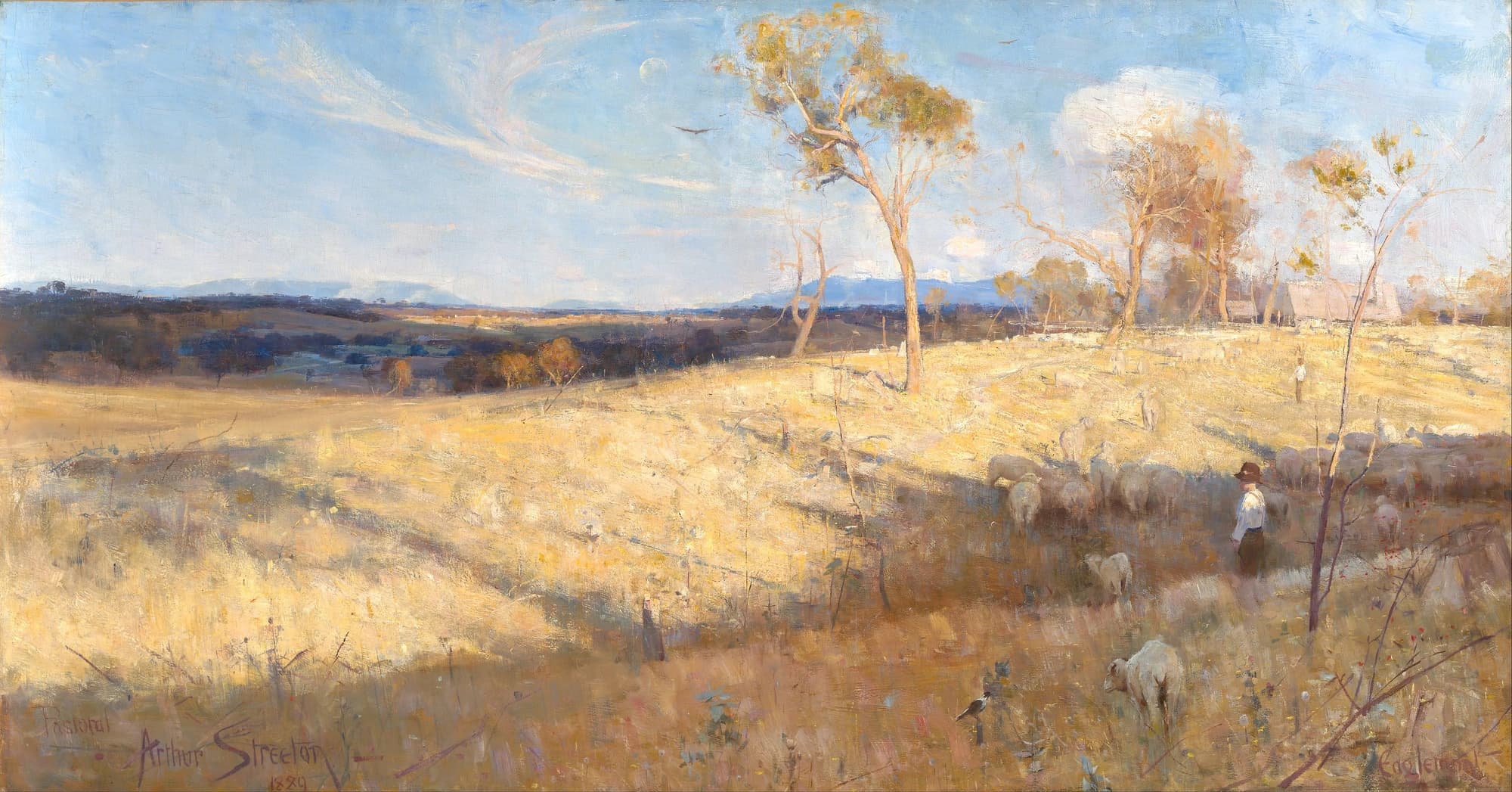
In 1888, Streeton established a base at an abandoned homestead in Eaglemont, which offered ideal views of the Yarra Valley for his creative work.1
Despite austere living conditions at Eaglemont, Streeton immersed himself in art with his peers, a period that inspired his iconic golden-hued landscape paintings.1

Streeton used a 'gold and blue' palette to represent the Australian landscape, a color scheme that became a hallmark of his work, symbolizing the dry land and clear skies.1
In the 1890s, influenced by Japanese kakemono, Streeton adopted extreme vertical formats and Symbolist elements, also applying his art to fans and furniture.1
In 1890, Streeton moved to Sydney due to an economic depression and painted from 'Curlew Camp,' capturing the harbor, city, and rural New South Wales landscapes.1
In 1891, 'Golden Summer, Eaglemont' became the first work by an Australian-born artist exhibited at the Royal Academy in London, establishing his international reputation.1
In 1893, Streeton wrote a letter protesting a proposed colliery at Sydney Harbour. Known as 'Streeton's shriek,' it was a pioneering instance of an artist advocating for environmental protection.1
Painted in 1895, 'Cremorne pastoral' served as an elegiac protest against industrialization, eventually influencing the government to abandon the mining project.1