Artist
Vasily Surikov


Timeline
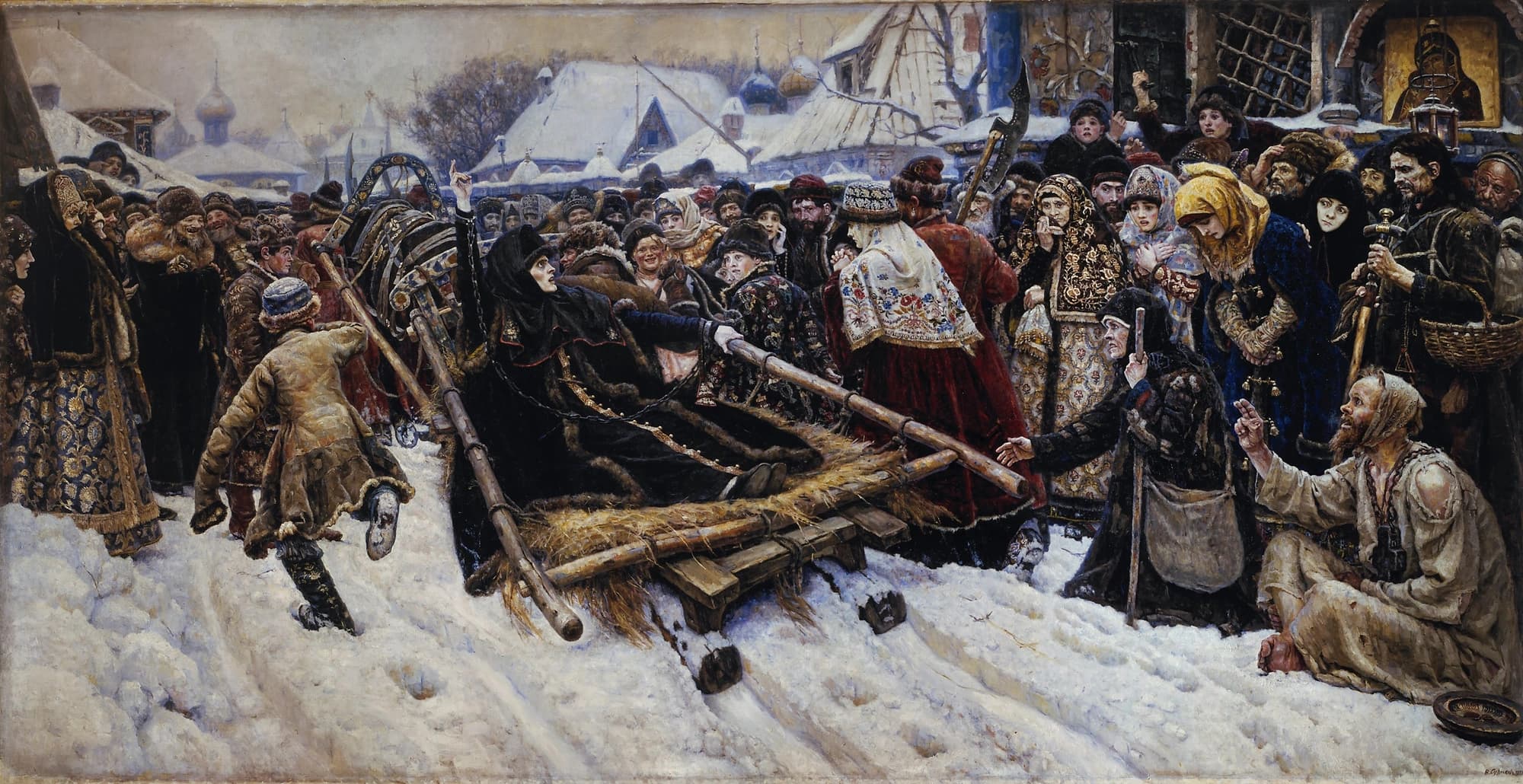
Born into a Siberian Cossack family, Surikov took great pride in his roots, which became a source of inspiration for his powerful historical crowd scenes and grand themes set in his homeland.1
Poverty following his father's death nearly ended his education, but local gold mine owner Pyotr Kuznetsov became his patron, enabling him to receive a formal art education in Saint Petersburg.1
During his time at the Imperial Academy of Arts, Surikov was nicknamed 'The Composer' due to his exceptional attention to composition, a hallmark of his style in depicting complex historical scenes.1
In 1877, moving to Moscow to paint murals for the Cathedral of Christ the Saviour marked a turning point, leading him to start the series of monumental historical paintings that established his reputation.1
In 1881, he joined the Peredvizhniki (Wanderers) after exhibiting 'The Morning of the Streltsy Execution,' impressing the Russian art world with his realist portrayal of historical turmoil from a populist perspective.1
The purchase of 'Menshikov in Beryozovo' by the great collector Pavel Tretyakov provided Surikov with the funds for a European tour, which significantly enriched his sense of color.1
After his wife's death in 1888, a grieving Surikov returned to Siberia. It was during this period of recovery that he painted 'The Capture of Snow Town,' one of his most lighthearted and colorful works.1
For 'The Conquest of Siberia by Yermak Timofeyevich,' Surikov made extensive sketches on the Ob River to relive the history his ancestors participated in, blending personal roots with national history.1
His painting 'Suvorov Crossing the Alps,' created after a visit to Switzerland, was purchased by Tsar Nicholas II, showing that his mastery was highly regarded even by the highest authorities.1
In his later years, he founded an art school in Krasnoyarsk to train future artists. Despite suffering from heart disease, he remained passionate about painting Russian landscapes and history until his death.1