Artist
Walter Sickert
Works (2)
Timeline
Born in Munich and moved to London at age eight, Sickert first pursued a career as an actor in Henry Irving's company before studying art, an experience that influenced his dramatic compositions.1
Starting as a pupil of Whistler, Sickert later met Edgar Degas in Paris, whose use of pictorial space and emphasis on drawing had a powerful effect on him, leading him to paint from memory rather than directly from nature.1
In the late 1880s, Sickert began portraying London music halls. Though denounced as 'ugly and vulgar' by critics, these works announced his recurring interest in urban culture and sexually provocative themes.1
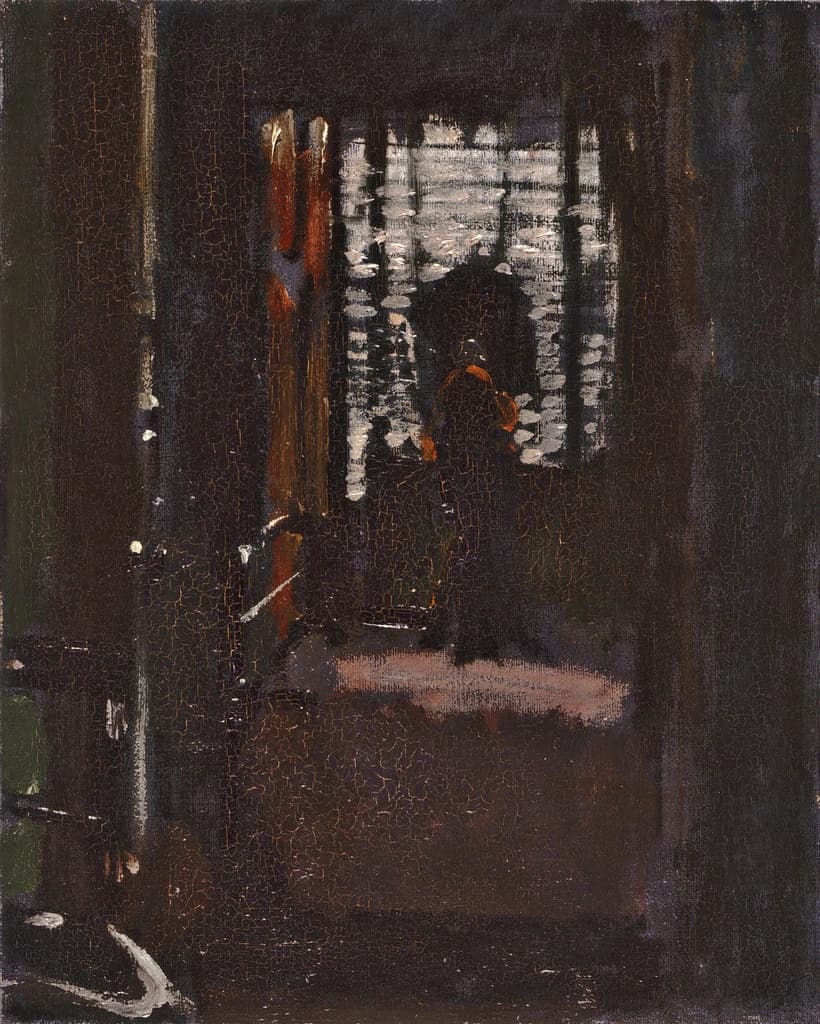
Between 1894 and 1904, Sickert visited Venice multiple times. He shifted from topography to multiple-figure tableaux, often using prostitutes as models to explore psychological estrangement.1
Inspired by the 1907 Camden Town murder, Sickert painted a controversial series of nudes. These works combined narrative tone with a documentary realism that was unprecedented in British art.1
As an influential teacher at the Westminster School of Art and his own school, Rowlandson House, Sickert mentored artists like David Bomberg, significantly impacting British avant-garde art.1

In 1911, he co-founded the Camden Town Group. Preferring 'the kitchen to the drawing room,' he focused on drab suburban life, becoming a leading figure in British Post-Impressionism.1
His masterpiece 'Ennui' depicts a psychologically estranged couple in a dingy interior. The work uses heavy impasto and a narrow tonal range to evoke a sense of Victorian narrative and modern boredom.1
From 1927, Sickert stopped drawing and began painting from photographs. He used a grid system for enlargement, often leaving the pencil lines visible in the finished paintings as a modern technique.1