Artist
Cimabue
Works (3)
Timeline
The Crucifixion in Arezzo (c. 1270) is considered his earliest work to depart from the Byzantine style, featuring a distinctively curved body of Christ.1
The Santa Croce Crucifix shows advanced naturalism, likely inspired by the sculptural works of Nicola Pisano.1
Traditionally regarded as the teacher of Giotto, whom he allegedly discovered drawing sheep, though modern scholars often debate this claim.1
The Maestà (c. 1280) established a style followed by numerous artists, including Duccio and Giotto, setting a new standard for Italian painting.1

He created extensive frescoes at the Basilica of San Francesco in Assisi, which are now in poor condition due to the oxidation of the pigments used.1
In the Santa Trinita Maestà, his style evolved to include softer expressions, suggesting influence from his contemporary (and former pupil) Giotto.1
Dante mentioned him in the Divine Comedy as a symbol of fleeting fame, noting how Giotto's revolution quickly eclipsed Cimabue's reputation.1
The mosaic of St. John the Evangelist in Pisa Cathedral is the only surviving work by the artist supported by contemporary documentation.1
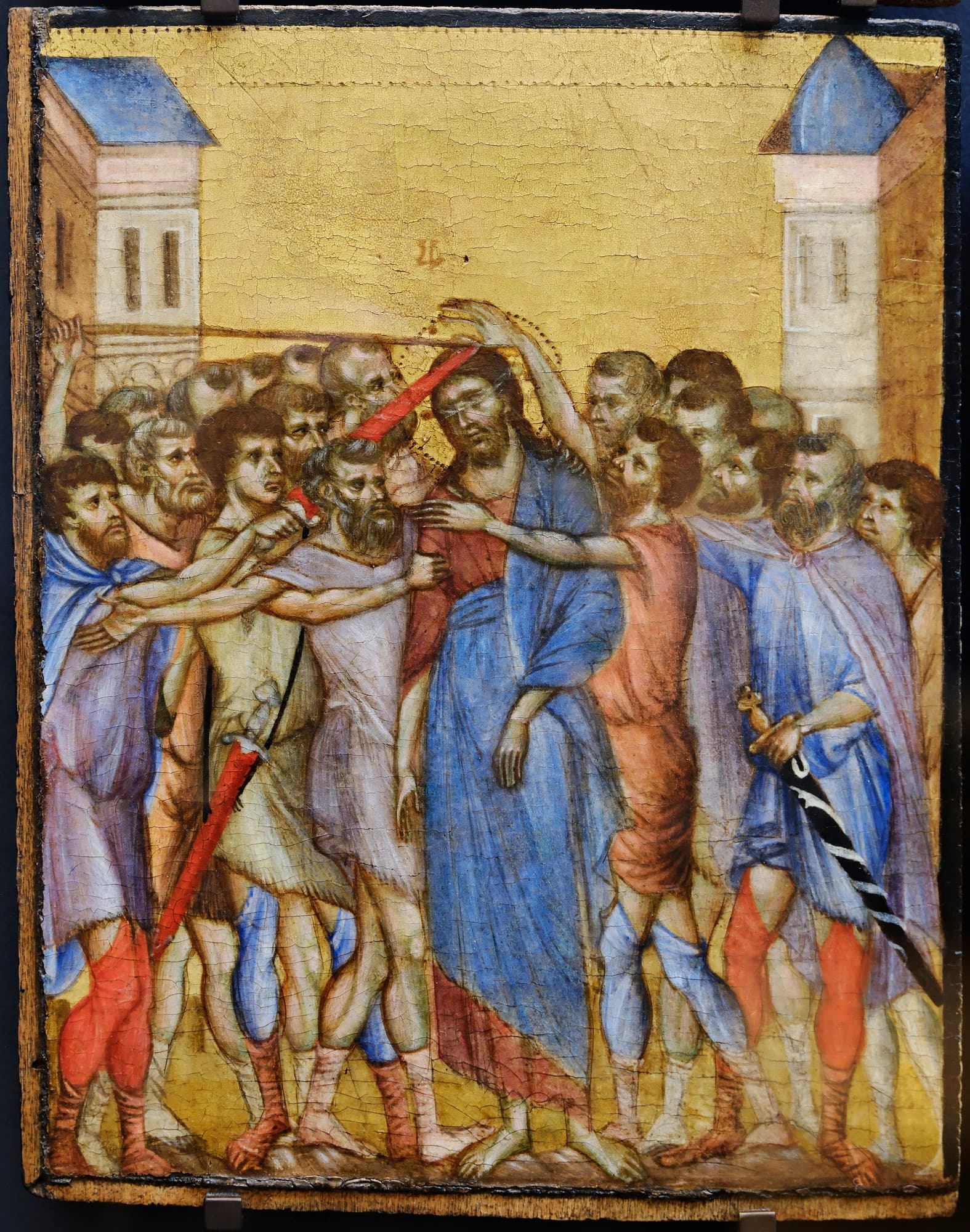
In 2019, 'The Mocking of Christ' was found in a French kitchen and sold for €24m, setting a world record for a medieval painting at auction.1