Artist
Thomas Cole
Works (1)

Timeline
Born in England in 1801, he immigrated to the US in 1818. The contrast between the smog-filled industrial cities of Britain and the pristine nature of the New World formed the basis of his artistic vision.1
Largely self-taught, he started as an engraver and portraitist before establishing a method of re-composing idealized landscapes in the studio based on detailed outdoor sketches.1
Moving to New York in 1825, his landscapes of the Catskills caught the eye of prominent artists like John Trumbull, marking a major turning point in his career.1
Discovered by John Trumbull, he was introduced to influential patrons like Daniel Wadsworth and Robert Gilmor Jr., establishing his commercial success and fame.1
Known as the founder of the Hudson River School. He specialized in romantic landscapes, characterized by allegorical compositions featuring small figures or structures set against vast nature.1
He established a studio at 'Cedar Grove' in Catskill, New York, where he spent his later years. The site is now open to the public as the Thomas Cole National Historic Site.1
In his masterpiece 'The Oxbow,' he depicts the contrast between wild nature after a storm and cultivated land, representing the boundary between sublime nature and human activity.1
Beyond simple landscapes, he created grand allegorical series such as the five-part 'The Course of Empire' and the four-part 'The Voyage of Life,' depicting the rise and fall of civilizations.1
He held critical views on industrialism, urbanism, and westward expansion, depicting untouched nature as a 'Garden of Eden' to warn against the loss of the American landscape.1
He also showed talent in architecture, winning third place in the 1838 Ohio Statehouse design competition; his design is said to be reflected in the final building.1
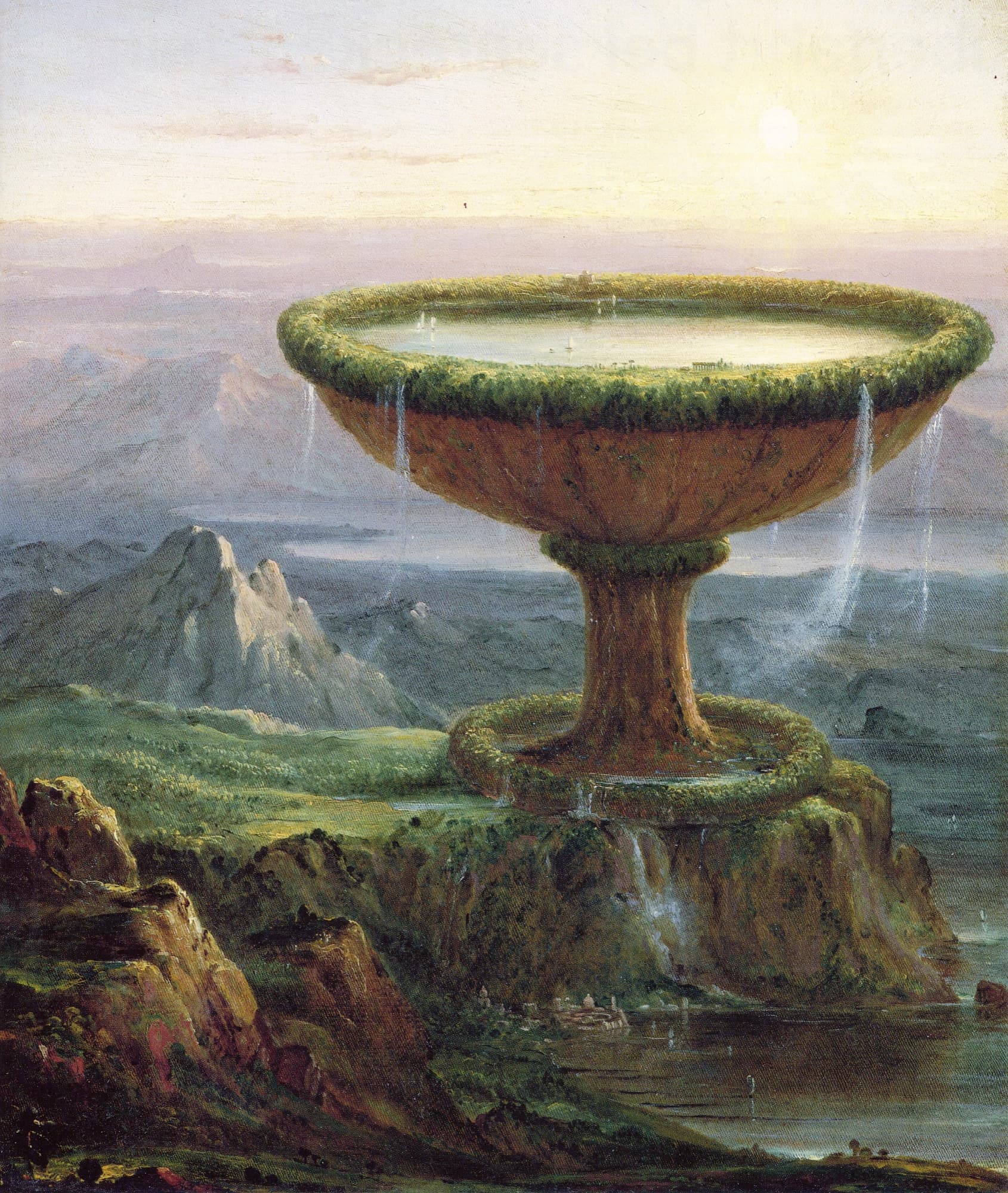
Fascinated by Mount Etna during his 1842 European tour, he produced at least six oil paintings, using the contrast of ancient ruins and the volcano to express time and nature's power.1
From 1844 to 1846, he mentored Frederic Edwin Church, teaching him the technique of sketching from nature and developing it into idealized, finished compositions.1