Artist
Andrea Mantegna
Works (7)


Timeline
At age 11, Mantegna became an apprentice to Francesco Squarcione in Padua. The master was an enthusiast of ancient Rome, and Mantegna studied Roman sculpture and Latin there, forming his artistic foundation.1
The frescoes in the Ovetari Chapel in Padua are considered his early masterpiece. Though mostly destroyed in WWII, their innovative use of classical architectural backgrounds remains highly regarded.1
Andrea Mantegna received his first important commission in 1448, painting frescoes for the Eremitani Chapel in Padua.2
Andrea Mantegna created an altarpiece for the church of Santa Sofia in 1448.3
At age 17, Mantegna left Squarcione's workshop to work independently. He later claimed his master profited from his work without fair payment, and this departure marked a major turning point in his career.1
Andrea Mantegna created the San Luca Altarpiece in 1453.3
In 1453, Andrea Mantegna married Nicolosia, the daughter of Jacopo Bellini.3
In 1453, he married Nicolosia Bellini, daughter of the famous painter Jacopo Bellini. This union connected him to the prominent Bellini family of Venice, significantly influencing his subsequent style.1
The San Zeno Altarpiece (1457–1459) is considered the first great example of Renaissance art in Verona. Its composition, using classical architectural structures, greatly influenced subsequent artists.1

In 1488, Andrea Mantegna was called by Pope Innocent VIII to paint frescoes in a chapel in the Vatican.3
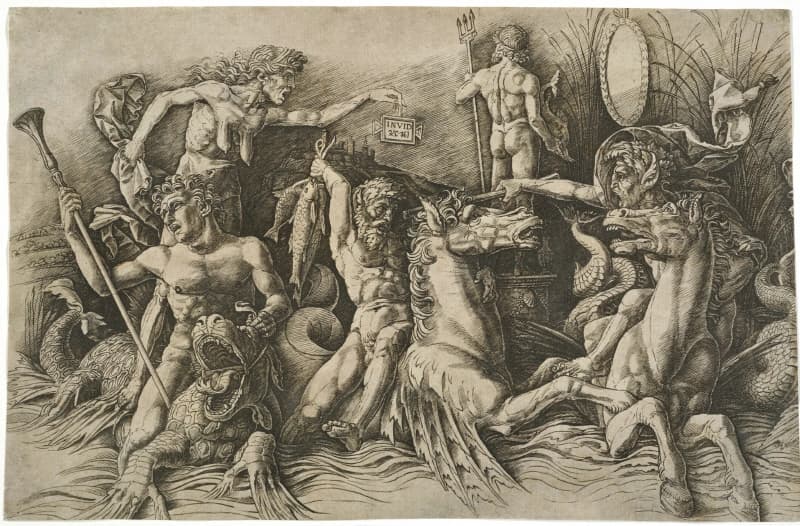
Before 1500, he led a workshop in Venice that was a leading producer of prints. His exceptional draftsmanship spread widely through these prints, inspiring artists across Italy.1
SepAndrea Mantegna died at the age of 74–75.3
Mantegna's fresco series was almost entirely lost in the 1944 Allied bombings of Padua.3