Artist
Fujishima Takeji
Japan, 1867–1943
Works (1)
Timeline
Born in 1867 to an ex-samurai family in Kagoshima. The samurai spirit cultivated in his youth is said to underlie his later powerful painting style and sincere attitude toward art.1
Initially studied Nihonga under Kawabata Gyokusho but later switched to Western-style painting. Learning techniques from Yamamoto Hosui and Soyama Yukihiro, he began a unique path merging Japanese tradition with Western sensibility.1
His graduation piece 'Cruelty,' exhibited in 1891, caught the eye of novelist and art critic Mori Ogai. This event was a major catalyst for the young Fujishima to gain attention as a painter.1
Appointed assistant professor at Tokyo Art School through Kuroda Seiki's recommendation. He also joined Kuroda's 'Hakubakai' and became a central figure in bringing the bright colors of Pleinairism to Japanese Western-style painting.1
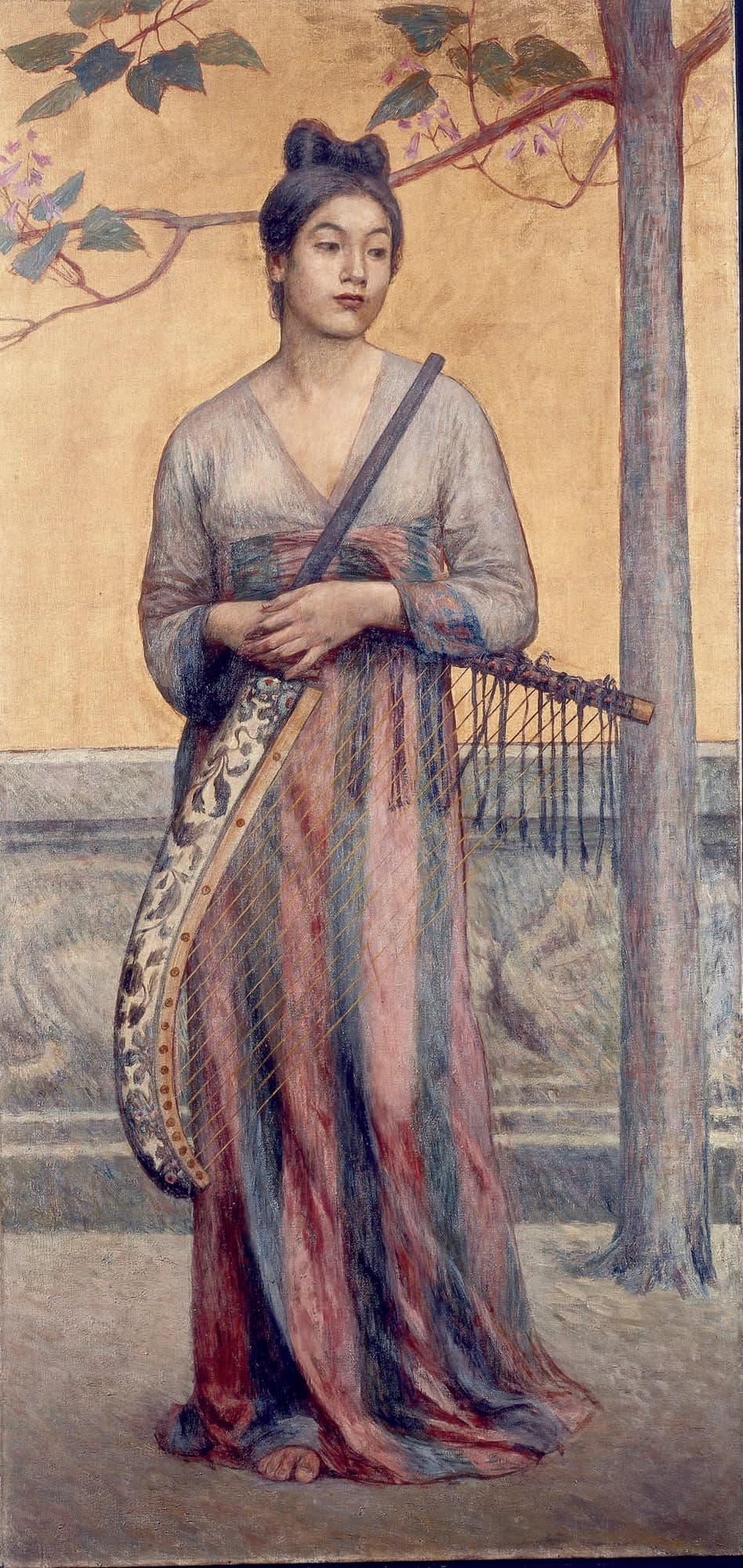
Fujishima is known as a leader of Romanticism in Japanese Western-style painting. In works like 'Reminiscence of the Tempyo Era,' he masterfully expressed Japanese classical aesthetics through Western oil techniques, creating a unique lyricism.1

Representative works such as 'Butterfly' and 'Reminiscence of the Tempyo Era' are designated as National Important Cultural Properties. They remain highly regarded as a pinnacle achieved by Japanese Western-style painting from the Meiji to Showa eras.1
Traveling to Europe in 1905, he studied historical painting under Fernand Cormon in Paris. Mastering academic techniques added classical elegance and solid compositional strength to his work.1
In Rome, Italy, he studied portraiture under Carolus-Duran. The Renaissance art and the sense of light he encountered during his stay greatly influenced the establishment of his glamorous and decorative female portraits after returning to Japan.1
In his later years, influenced by Art Nouveau, he incorporated decorative curves and planar compositions. This style brought a fresh breeze to the Japanese Western-style art world of the time, expanding the possibilities of decorative beauty.1
He taught for many years as a professor at the Tokyo Art School, nurturing many successors. His guidance extended beyond technique to the spirituality of being an artist, playing a decisive role in the development of modern Japanese Western-style painting.1
In his late masterpiece 'Sunrise over the Eastern Sea,' he depicted the rising sun with powerful brushstrokes, expressing a grand landscape symbolizing Japanese spirituality. It is a piece that condenses his passion for capturing the vitality of nature.1
In 1937, upon the establishment of the Order of Culture, he was selected as one of the first recipients in recognition of his great achievements. This symbolizes his peak status in Japan's modern art world.1