Artist
Emily Carr
Works (1)
Timeline
Born in Victoria, British Columbia in 1871 to English parents, Carr pursued art seriously after her parents' deaths, studying in San Francisco and London to transform herself into a professional artist.1
In 1898, during a visit to a Nuu-chah-nulth village, Carr was given the name 'Klee Wyck' (the Laughing One), which she later used as the title for her award-winning first book.1
A 1907 trip to Alaska inspired Carr's mission to document the 'vanishing totems' and the way of life of the First Nations, leading to a five-year project of recording Indigenous villages in British Columbia.1
In France (1910-1911), Carr embraced the Fauve style, adopting a vibrant color palette and bold brushwork that dramatically transformed her artistic style from her earlier traditional training.1
A 1912 sketching trip to Haida Gwaii and the Upper Skeena River provided the inspiration for iconic works like 'Big Raven,' capturing the misty, lonesome atmosphere of Indigenous villages.1
Returning to Vancouver in 1912, Carr organized an exhibition of her French works, becoming the first artist to introduce the radical style of Post-Impressionism to the local art scene.1
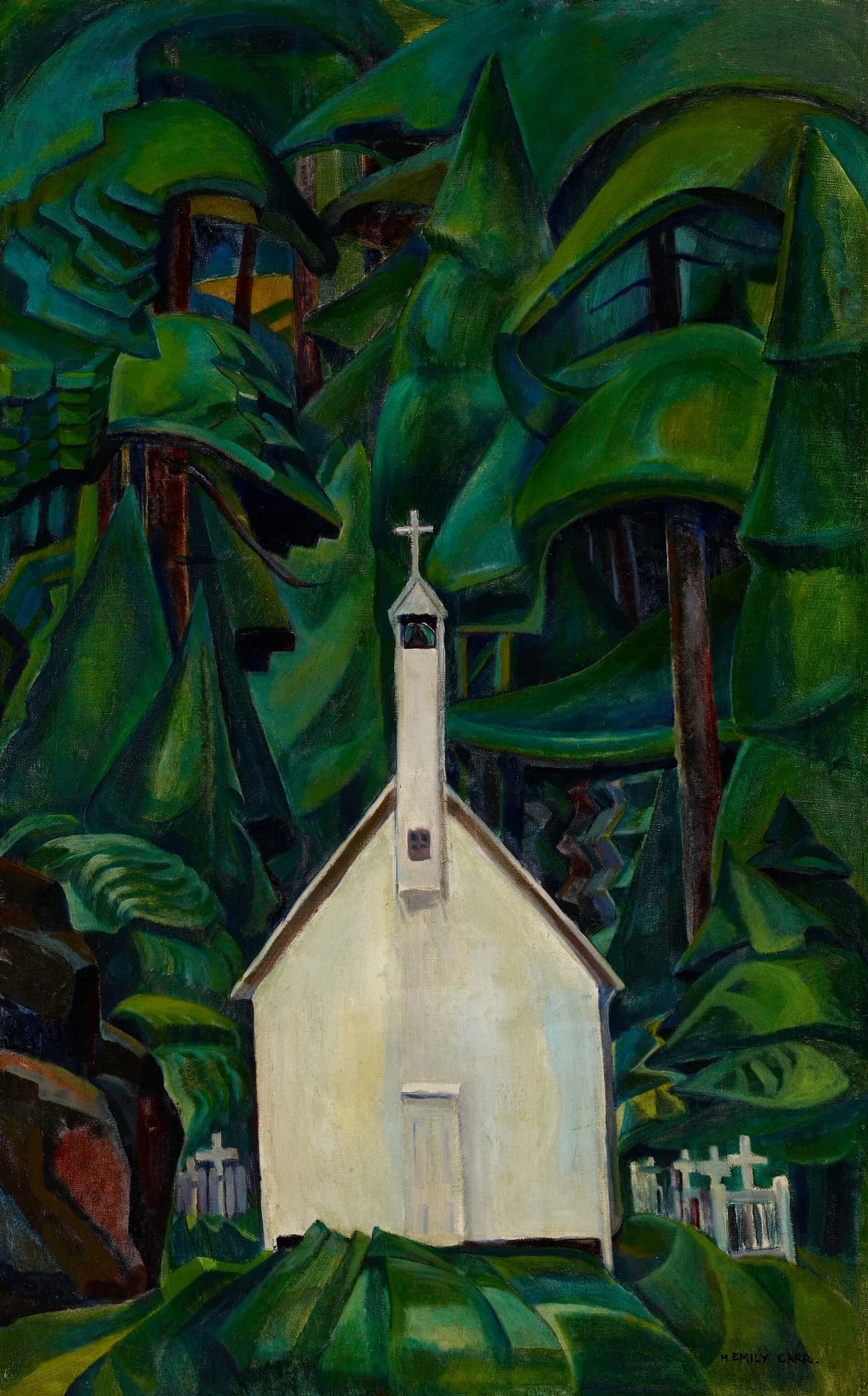
Initially misunderstood, Carr's stature grew until she was recognized as a national treasure. Her 1929 painting 'The Indian Church' is one of the key works that established her importance in Canadian art.1

In her later years, declining health led Carr to focus on writing. Her first book, 'Klee Wyck' (1941), won the Governor General's Literary Award, establishing her as a significant Canadian author.1