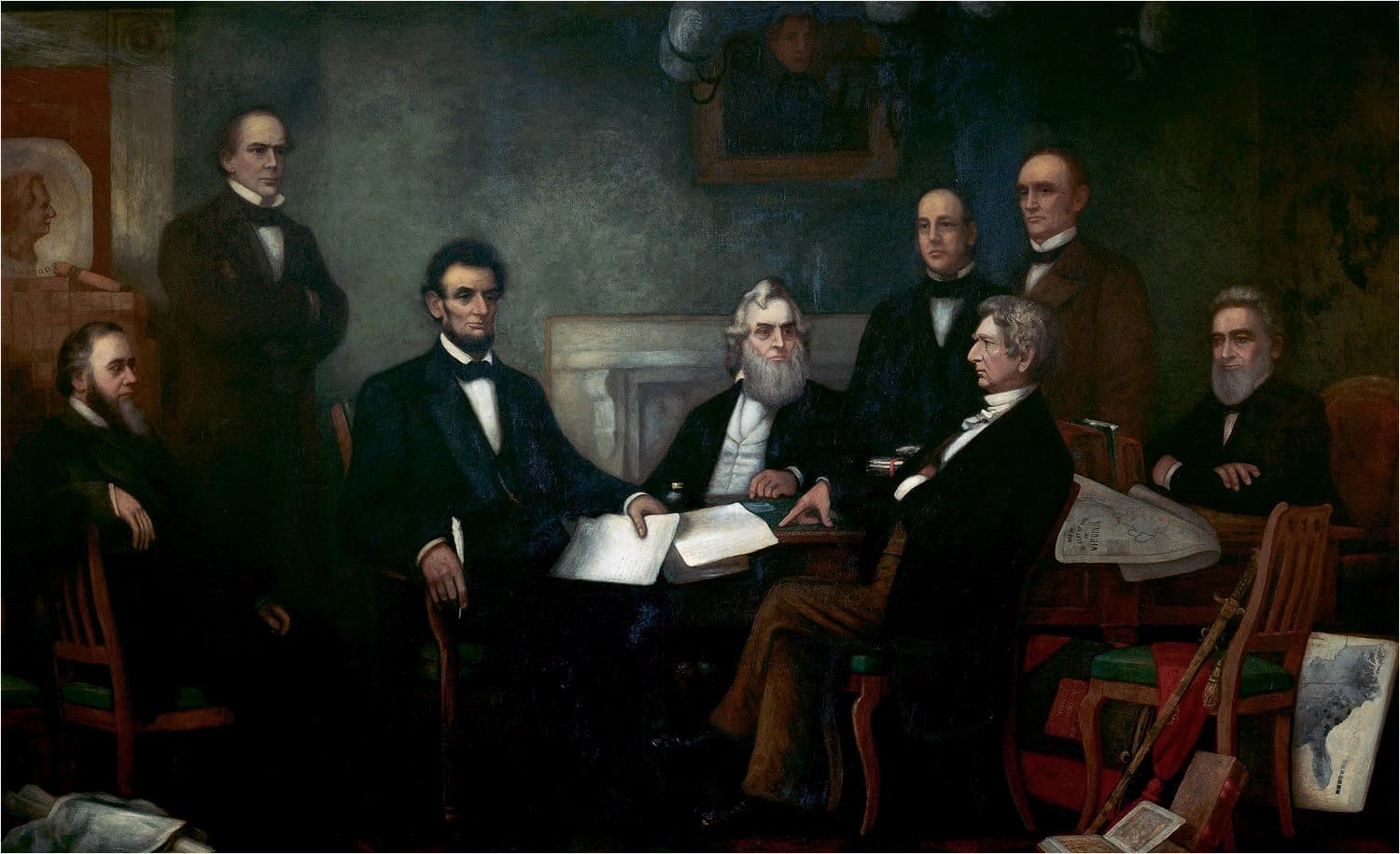
Artist
Francis Bicknell Carpenter
Timeline
In 1844, after his father approved of a portrait he painted of his mother, Carpenter studied under Sanford Thayer in Syracuse for six months, marking the start of his career.1
At 18, he won an American Art-Union prize, and by 21, he established a studio in NYC. He was elected an associate member of the National Academy of Design in 1852.1
Starting with President Millard Fillmore in 1852, he painted portraits of several presidents and mid-19th century notables, establishing his reputation as a portraitist.1
Deeply moved by the Emancipation Proclamation, Carpenter desired to express its moral grandeur and gained Lincoln's permission to work at the White House with financial backing from a friend.1
In 1864, he resided at the White House for six months. He was granted free access to Lincoln's office and used the State Dining Room as his personal studio.1
For his work, he used life sketches of Lincoln and his Cabinet along with photographs by Mathew Brady, seeking both realism and historical accuracy through various sources.1

In 1866, he published 'Six Months at the White House with Abraham Lincoln,' a memoir detailing his personal relationship with the President and the behind-the-scenes of his painting.1
By the late 1870s, he became increasingly interested in religion and spirituality; some art historians believe this obsession undermined the quality of his later work.1
His masterpiece, 'First Reading of the Emancipation Proclamation,' was purchased for $25,000 in 1877 by Elizabeth Thompson and donated to Congress for display in the Capitol.1
In 1929, a portrait of Mary Lincoln attributed to Carpenter was discovered, but its provenance involved a mysterious story by a former vaudeville performer, leading to questions of authenticity.1