Artist
C. F. Goldie
Timeline
In 1891, former Governor Sir George Grey was impressed by Goldie's still-life paintings and persuaded his strict father to allow him to study abroad, a pivotal moment for his career.1
Around 1892, encouraged by a former Governor of New Zealand, he studied at the Académie Julian in Paris. This training in rigorous realism and drawing became the foundation for his later detailed portrait style.1
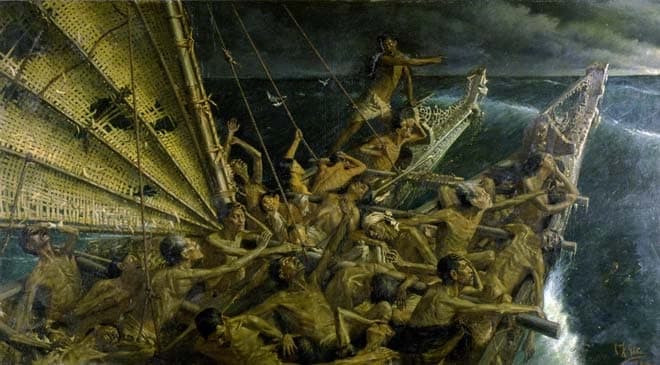
After returning in 1898, he collaborated with his mentor Steele on 'The Arrival of the Maoris in New Zealand.' This large-scale work, inspired by Géricault, launched his career with high artistic praise.1

To achieve fine detail, he licked his brushes coated in lead white paint. This led to lead poisoning, causing his health to deteriorate and his artistic output to stall during the 1920s.1
Encouraged by Governor-General Lord Bledisloe, he resumed painting around 1930. He later regained international recognition, exhibiting at the Royal Academy in London and the Paris Salon.1
After his death, forger Karl Sim legally changed his name to 'C.F. Goldie' to sign copies 'legitimately.' This episode illustrates how iconic and popular Goldie's works remain.1
His works hold immense market value in New Zealand art history. In 2022, a portrait of a Māori chief sold for NZ$1.8 million, far exceeding 100 million yen at the time.1