Artist
Victor Meirelles

Timeline
Born in 1832 in Florianópolis, Brazil, to humble merchants, Meirelles was a self-taught child prodigy. His talent was recognized early, leading to his admission to the Imperial Academy of Fine Arts at the age of 14.1
At the Academy, he studied under José Correia de Lima, a pupil of Debret. In 1852, he won the Travel to Europe Prize with his historical painting 'Saint John the Baptist in Prison,' securing a scholarship for overseas study.1
During his studies in Italy, he trained under Nicola Consoni to refine his anatomical drawing. In Florence, exposure to the works of Veronese and Titian significantly influenced the style of his later monumental history paintings.1
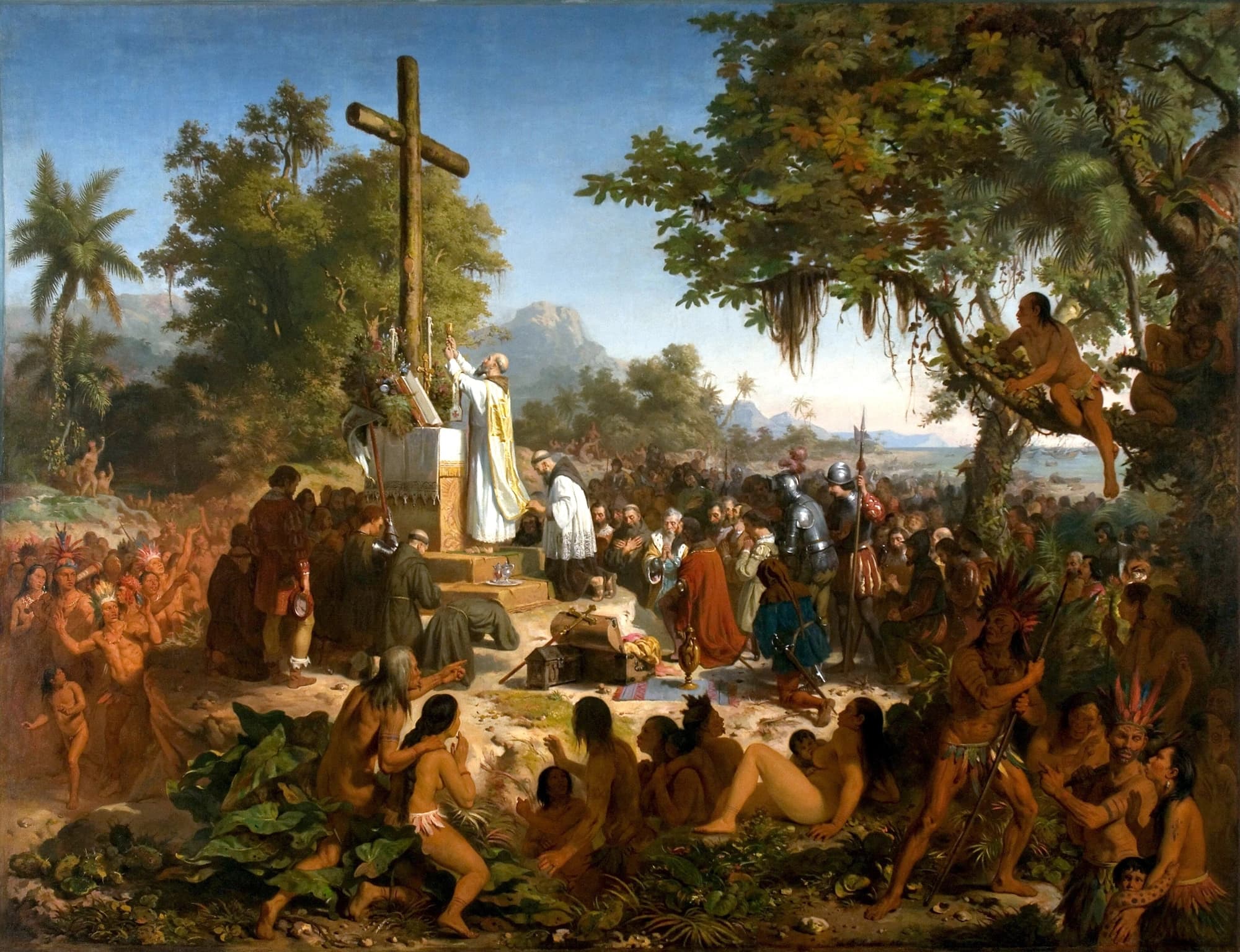
His masterpiece 'First Mass in Brazil,' painted in Paris, was the first work by a Brazilian artist to be admitted to the Paris Salon. It remains a sacred icon representing the nation's origins.1
Upon returning to Brazil, he became a favorite of Emperor Pedro II. He was a central figure in the monarch's project to create visual symbols of Brazilian history, producing numerous monumental works.1
As a professor at the Imperial Academy, he dedicated himself to training the next generation of painters. His rigorous yet passionate teaching helped produce many talents who laid the foundation for modern Brazilian art.1
He created massive history paintings like 'Battle of Guararapes' and 'Naval Battle of Riachuelo.' These works celebrated Brazilian military victories and patriotism, praised as the pinnacle of academic technique.1
With the advent of the Republic in 1889, his close ties to the Imperial government led to his ostracism. He lost his former glory and died in poverty and obscurity in 1903.1