Artist
Frans Hals
1582–1666
Works (14)

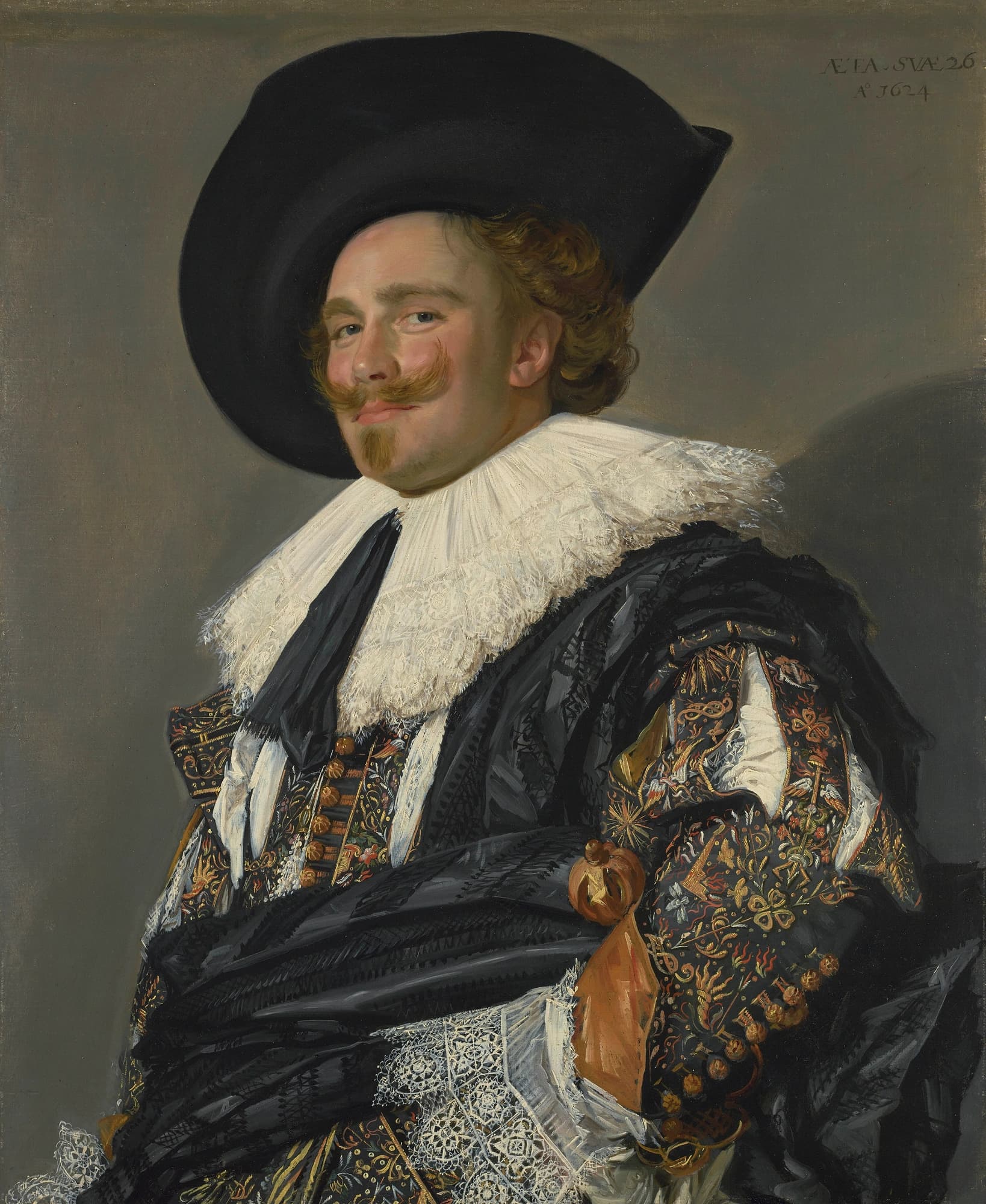
Laughing Cavalier
1624
Banquet of the Officers of the St George Civic Guard
1627

A Militiaman Holding a Berkemeyer, Known as the ‘Merry Drinker’
1629

Portrait of a Young Man
1650

Portrait of a Woman
1660

Girl Singing
1700

Merrymakers at Shrovetide
ca. 1616–17

Petrus Scriverius (1576–1660)
1626

The Smoker
ca. 1623–25

Portrait of a Man, Possibly Nicolaes Pietersz Duyst van Voorhout (born about 1600, died 1650)
ca. 1636–38

Portrait of a Woman
ca. 1650, reworked probably 18th century

Boy with a Lute
ca. 1625

Paulus Verschuur (1606–1667)
1643

Portrait of a Bearded Man with a Ruff
1625
Timeline
Born in Antwerp, he moved to Haarlem as a child to escape the Spanish invasion. This migration significantly influenced his career, as many of his clients were fellow émigrés.1
He studied under Karel van Mander, a Flemish émigré. While his master was influenced by Mannerism, Hals developed a unique realistic style with little trace of his teacher's influence.1
Due to restrictions on religious art in Haarlem, Hals focused on portraiture. While working as a city art restorer, he refined his unique portrait style to meet the demands of the citizens.1
He achieved great success with the 1616 life-sized group portrait 'The Banquet of the Officers of the St George Militia Company,' which established him as a sought-after painter for the elite.1
He married his second wife, Lysbeth, when she was eight months pregnant. A devoted father of eight, he was once falsely rumored to be a heavy drinker and abusive, though these claims are now debunked.1
In 1649, he painted the famous philosopher René Descartes. Hals portrayed all levels of society, from tavern heroes to mayors, with an intimate and radical realism.1
In his later years, his style fell out of fashion, leading to financial hardship and the seizure of his property in 1652. However, the city granted him an unusual pension out of respect for his work.1