Artist
Wassily Kandinsky
France, 1866–1944
Works (1)
Timeline
At age 23, he joined an ethnographic research group in the Vologda region. The shimmering colors of folk art in local houses made him feel as if he were moving into a painting, influencing his later use of vibrant color.1
At age 30, he abandoned a career in law and economics for art. Seeing Monet's 'Haystacks' in Moscow, he was struck by how color could move him independently of the object, marking his first step toward abstraction.1
In Munich, he met his student Gabriele Münter, who became his professional and personal partner. During their time in Murnau, Bavaria, he began to develop his unique style of abstract expression.1
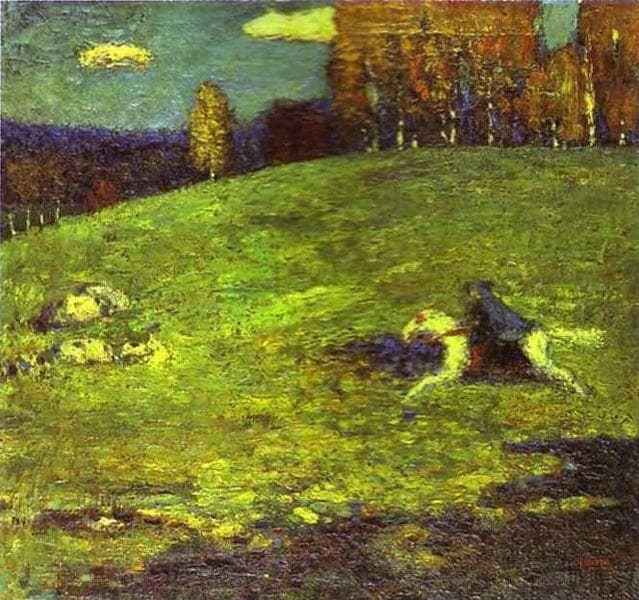
In his 1903 work 'The Blue Rider,' he depicted the figure as a series of colors rather than in detail. This technique of allowing viewers to participate in the creation marked a transition toward pure abstraction.1

Deeply influenced by Theosophy, he believed creation follows a geometric progression from a single point. His book 'Concerning the Spiritual in Art' theoretically links geometric shapes to spiritual necessity.1
Returning to Russia during WWI, he joined the cultural administration after the Revolution. However, his spiritual outlook clashed with Soviet materialism, leading him to return to Germany and later move to France.1
From 1922 to 1933, he taught at the Bauhaus in Germany. Until the Nazis closed the school, he taught theories of point, line, and plane, evolving his style into a more geometric and refined form.1
In his later years, he moved to France and became a citizen in 1939. Living in Neuilly-sur-Seine after fleeing Nazi persecution, he produced some of his most prominent abstract works until his death in 1944.1