Artist
Fidus
Works (1)

Timeline
Born the son of a confectioner in Lübeck, he showed early talent. Though born Hugo Höppener, he spent his career as 'Fidus,' a name reflecting his loyalty to his mentor Diefenbach.1
In 1886, he met artist Karl Wilhelm Diefenbach and joined his commune. He earned the pseudonym 'Fidus' (faithful) after serving a brief prison sentence for public nudity on Diefenbach's behalf.1
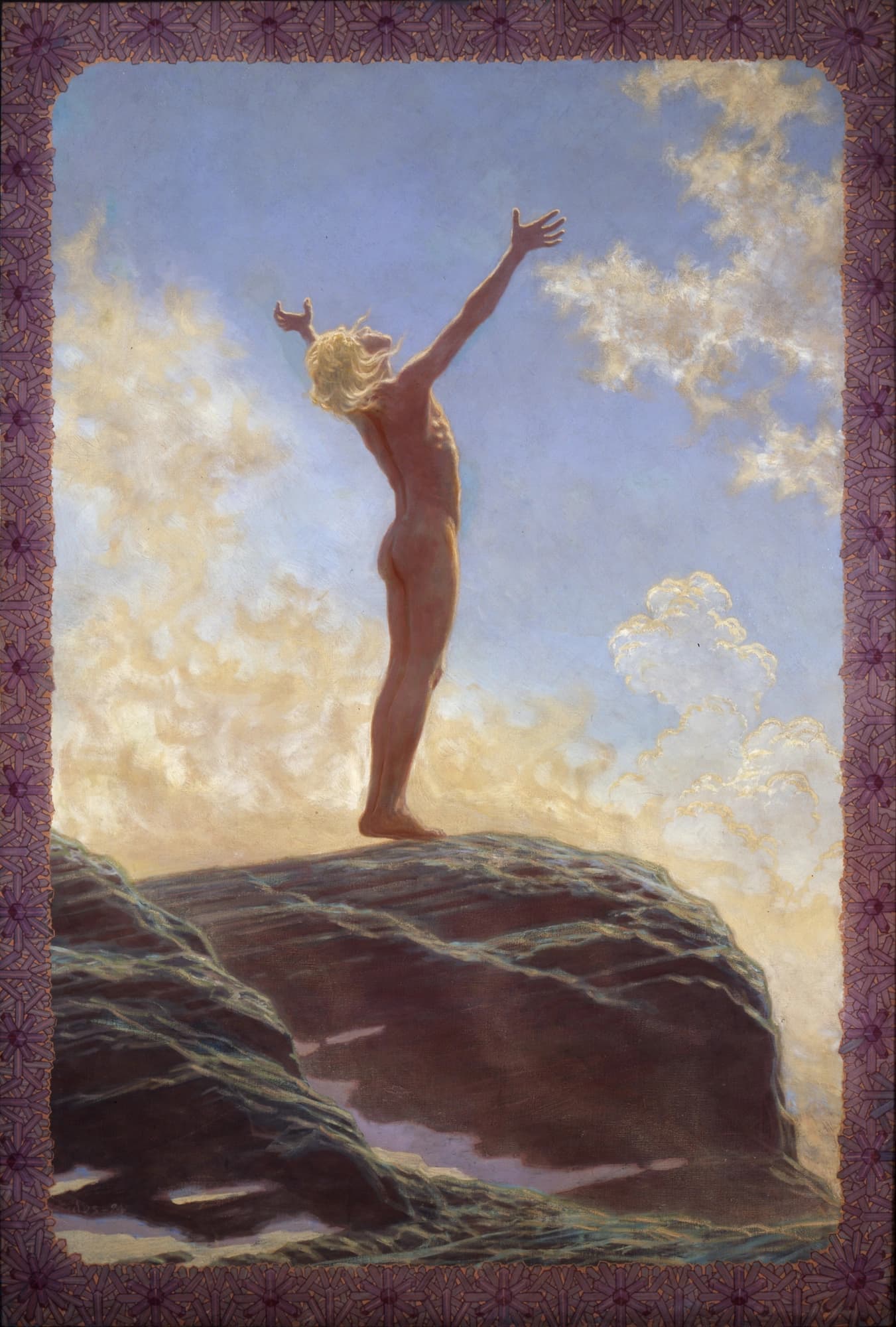
His most famous painting, 'Light Prayer,' was created in eleven different versions between 1890 and 1938, becoming an iconic representation of his mystical and nature-worshipping ideals.1
Part of the symbolist movement, his work was influenced by Art Nouveau and the Vienna Secession. His art drew from mysticism and Germanic neopaganism, featuring dream-like abstractions and ornamental drawings.1
Moving to Berlin in 1892, he established a new commune and worked as an illustrator for the magazine Sphinx, creating diverse designs for book decorations, ex-libris, and posters.1
He contributed to 'Der Eigene,' an early homosexual magazine published by Adolf Brand, incorporating diverse physical expressions and eroticism that challenged contemporary social norms.1
By 1900, he was one of Germany's most famous painters, frequently contributing to magazines like Jugend. He was also a pioneer in using advertising postcards to promote his own artistic work.1
Deeply involved in theosophy and mythology, he joined the Germanic Faith Community in 1908. His work reflected a blend of Germanic neopaganism and teachings about self-redemption.1
In 1912, he designed a famous poster for a 'biological hygiene' congress in Hamburg, depicting a man breaking his bonds and rising to the stars, symbolizing physical and spiritual elevation.1
In 1913, he attended the theosophical meeting in Berlin during the split between Rudolf Steiner and Annie Besant. He chose to leave Steiner's group and remain with the original Besant faction.1
He joined the Nazi Party in 1932, seeing a fit with his nature worship, but his work was banned in 1937 for promoting esotericism. He later renounced his membership and joined the CDU after the war.1
Rediscovered in the 1960s, his decorative and mystical style directly influenced the psychedelic movement and concert poster art, particularly in the San Francisco area.1