Artist
Fra Angelico
1400–1455


Timeline
Born around 1395 as Guido di Pietro, he was a Dominican friar known as Fra Angelico, meaning 'Angelic Brother,' due to the serene and devout nature of his paintings.1
Trained as a manuscript illuminator, his delicate technique is evident in his early works. He also mentored pupils like Benozzo Gozzoli, passing his style to the next generation.1
A pioneer of the early Renaissance, he moved away from flat Medieval styles to embrace linear perspective and depth, integrating innovative techniques into his exclusively religious subjects.1
Under the patronage of Cosimo de' Medici, he decorated the San Marco convent. Cosimo so valued Angelico's work that he maintained a private cell there for spiritual retreat.1
He painted frescoes in the cells of the San Marco convent to aid meditation. His 'Annunciation,' located at the top of the stairs, is world-renowned for its simple and pure beauty.1
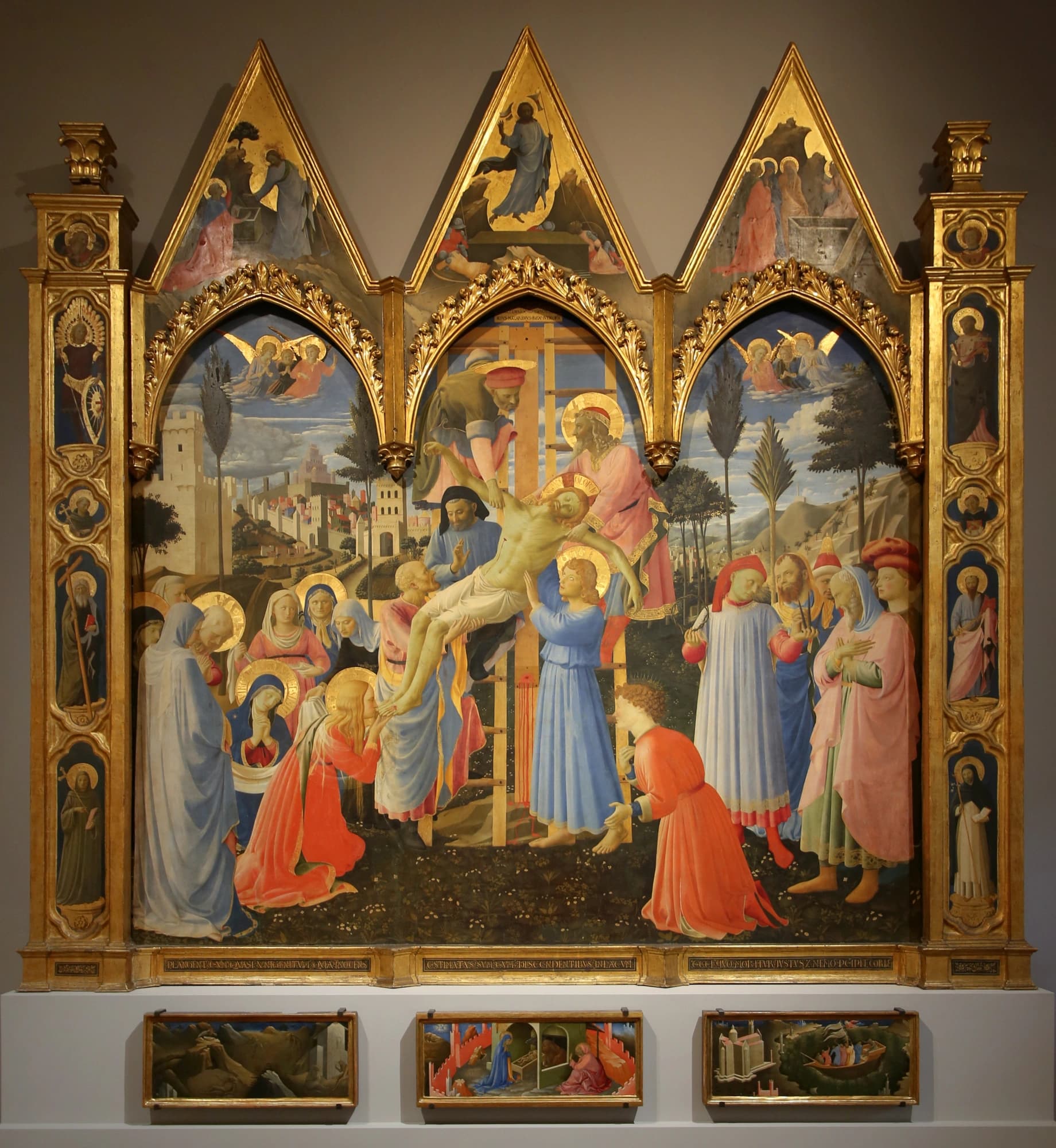
In 'The Deposition of Christ,' he replaced traditional Gothic gold backgrounds with naturalistic landscapes and expressive figures, reflecting the naturalistic spirit of the 15th century.1
In the 1439 San Marco Altarpiece, he established the 'Sacra Conversazione' (Sacred Conversation) genre, depicting saints in a naturalistic space, influencing later masters like Raphael.1
Summoned to Rome by Popes Eugene IV and Nicholas V, he decorated the Niccoline Chapel. He was so highly regarded that he was reportedly offered the Archbishopric of Florence.1
He died in 1455 while working in Rome and was buried in Santa Maria sopra Minerva. His tomb, featuring a relief of him in his Dominican habit, remains a site of pilgrimage.1
In 1982, Pope John Paul II beatified him, and in 1984, declared him the patron saint of Catholic artists, honoring the profound union of his faith and art.1