Artist
Konstantin Makovsky
Works (1)

Timeline
Born to an artist father and a composer mother, he was exposed to art and music from childhood. Entering the Moscow School at age 12, he developed his talent early under masters like Tropinin and Bryullov.1
He once aspired to be a composer and went to France, but after experiencing traditional and classical music across Europe, he ultimately chose painting. His musical sensibility later influenced his colorful style.1
In 1863, he joined the 'Revolt of the Fourteen,' protesting the Academy's restrictive themes and leaving without a diploma. This event was a key turning point for the realism movement in Russian art.1
He joined Ivan Kramskoi's 'Artel of Artists' and became a founding member of the 'Peredvizhniki (Wanderers)' in 1870, pursuing realism that depicted everyday Russian life.1
His travels to North Africa and Serbia in the mid-1870s led to a dramatic stylistic change, evolving from pure realism to a more decorative style emphasizing vibrant colors and forms.1
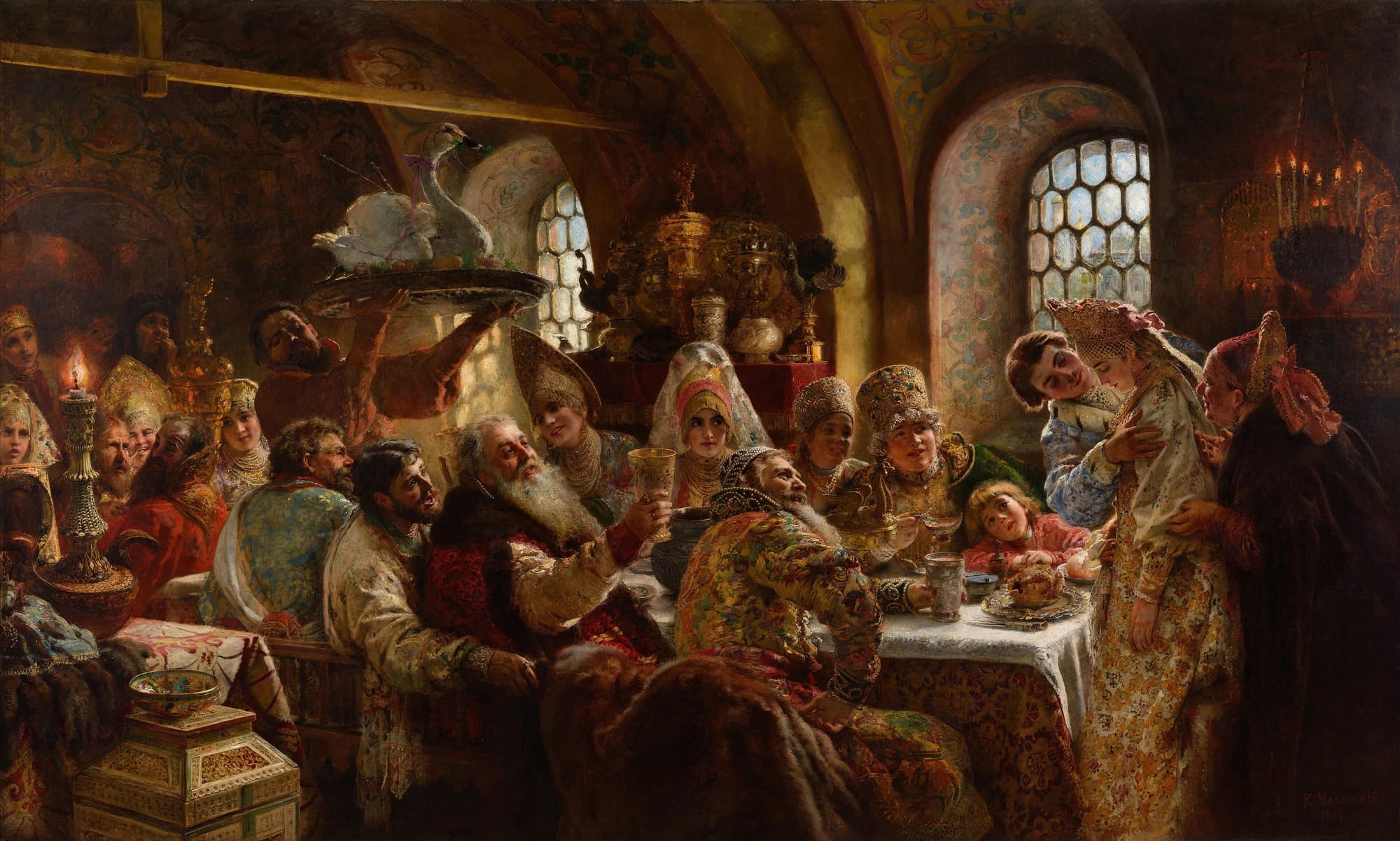
In historical paintings like 'The Russian Bride's Attire,' he presented an idealized view of old Russian life. His meticulous depiction of costumes and grand staging gained immense popularity among the aristocracy.1
At the 1889 Paris World's Fair, he won the Large Gold Medal for works including 'Death of Ivan the Terrible.' This success brought him international fame and made him one of Russia's highest-paid artists.1
Despite his academic training, he is regarded as a forerunner of Russian Impressionism due to his handling of light and brushwork, blending traditional techniques with a modern sensibility.1
In 1915, his life ended tragically in St. Petersburg when his carriage collided with a tram. It was a sudden end for one of the great masters representing Russia's Belle Époque.1