Artist
Joseph Noel Paton

Timeline
Born to damask designers, he served as a design director in a muslin factory. The decorative sensibility and attention to detail developed during this time became the foundation for the intricate patterns in his later paintings.1
In 1843, while studying in London, he met Millais and was invited to join the Pre-Raphaelite Brotherhood. Although he declined official membership, his detailed style resonated with their ideals and influenced his early work.1
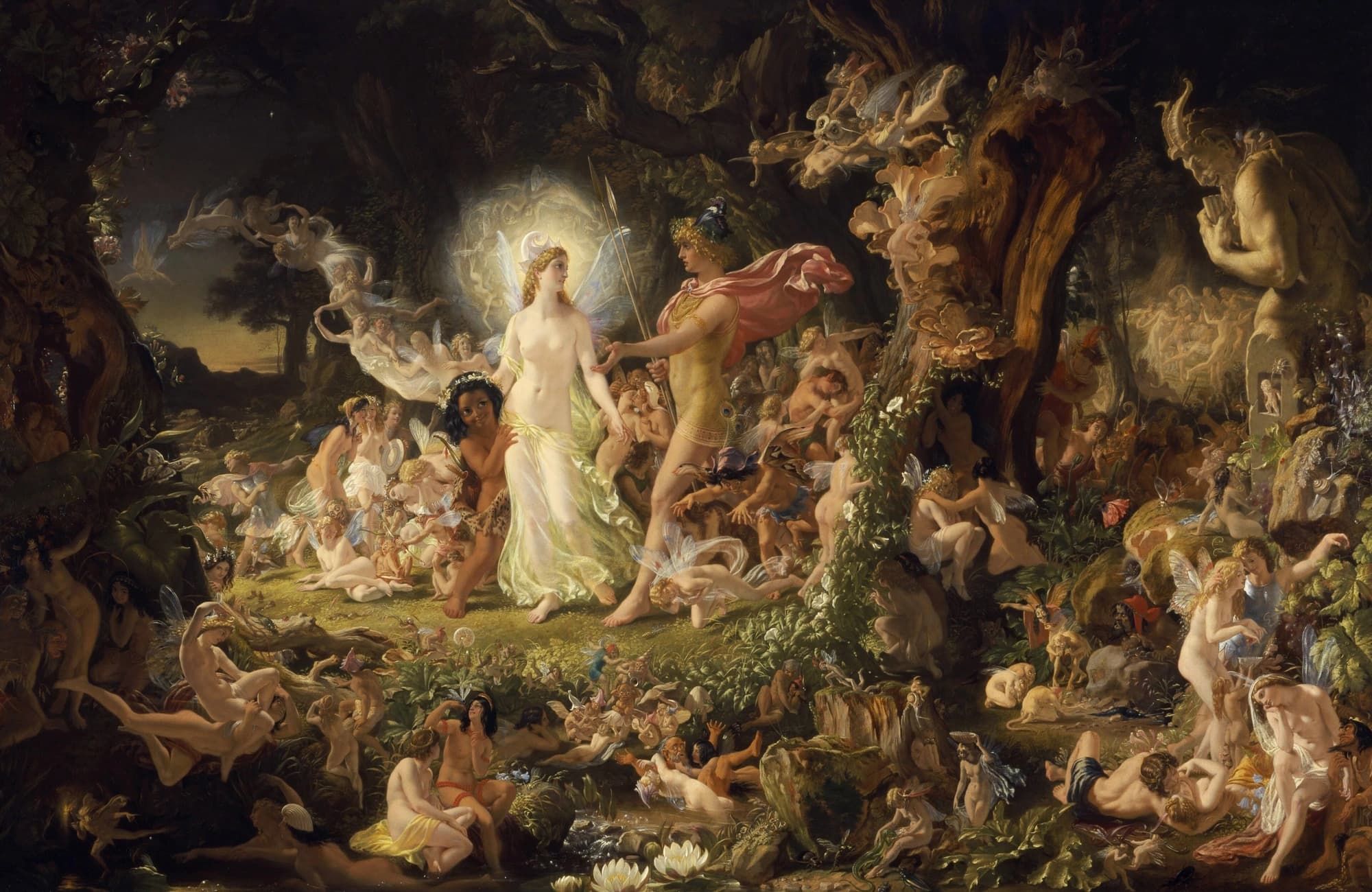
Known as a master of fairy painting, he was an expert in Scottish folklore and Celtic legends. His masterpiece 'The Quarrel of Oberon and Titania' is considered a pinnacle of the Victorian fairy painting craze.1
His series of 'Oberon and Titania' paintings, exhibited in 1847, won prizes at a Westminster Hall competition. These works, now in the National Gallery of Scotland, established his enduring reputation.1
As an antiquary, he had deep knowledge of arms and armor. In 1859, he organized and commanded an artillery volunteer corps of artists; his interest in military history informed the accurate historical details in his paintings.1
With a deep knowledge of literature, he illustrated works like Shakespeare's 'The Tempest' and Coleridge's 'The Rime of the Ancient Mariner'. His literary sensibility as a poet contributed to his narrative painting compositions.1
In 1865, he was appointed Queen's Limner for Scotland and was knighted two years later. Highly trusted by Queen Victoria, he established a prominent public status while producing many religious and historical paintings.1
In his later years, he was a founding member of the Cockburn Association in Edinburgh. Beyond his art, he worked to preserve the city's historical value, serving as vice-president of the conservation group until his death.1