Artist
Ernst Ludwig Kirchner
Works (1)
Timeline
Though known as a painter, Kirchner originally studied architecture in Dresden. This background provided the foundation for the powerful structures and masterful spatial compositions seen in his artworks.1
In 1905, Kirchner founded the avant-garde group 'Die Brücke' (The Bridge). They rejected traditional academic styles, aiming to create a bridge between the past and future through a new Expressionist mode.1
Valuing German heritage, Kirchner revived the technique of woodcut prints. His prints, characterized by sharp lines and bold contrasts, significantly influenced the evolution of 20th-century modern art.1
His studio, a former butcher shop, was a bohemian space defying social norms. By using non-professional models and 15-minute poses, he sought spontaneous, lively expressions of the human form.1
In 1911, he co-founded the private art school 'MIUM' with Max Pechstein. Despite aiming to promote modern painting education, it failed to attract students and closed the following year.1
After moving to Berlin in 1911, he created the 'Street Scenes' series. Using sharp brushwork to depict city dwellers, he established a unique style expressing the loneliness and anxiety of the modern metropolis.1
Struggling with alcohol and drug addiction due to wartime trauma, he was forced into sanatorium life. Even in isolation, he continued to create, using art to examine his mental state.1
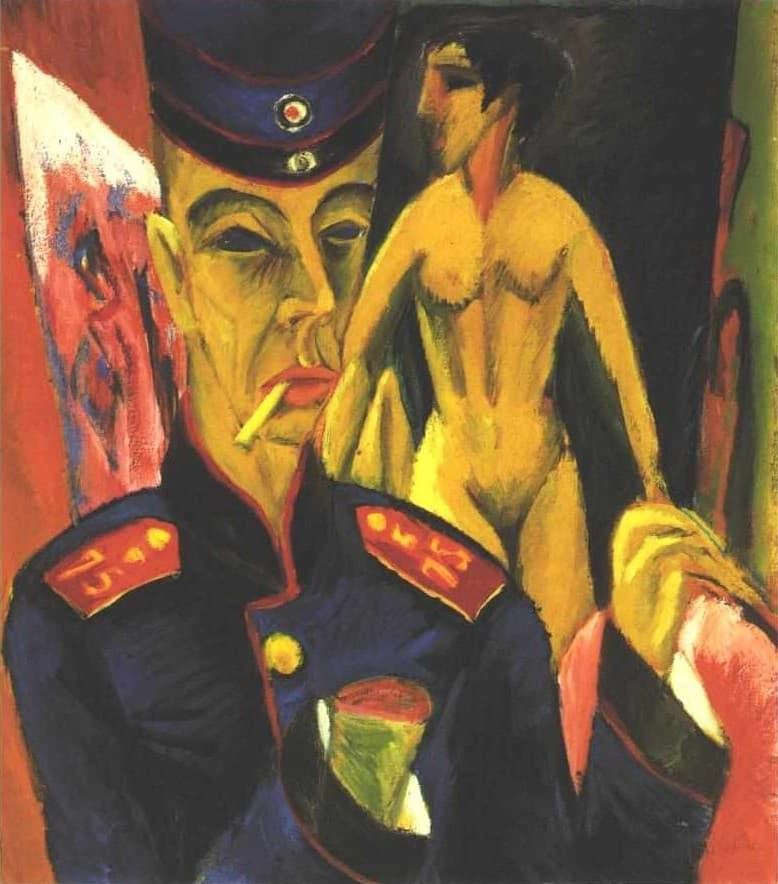
Although he volunteered for WWI, he suffered a mental breakdown and was discharged. His anguish is reflected in masterpieces like 'Self-Portrait as a Soldier,' where he depicted himself with a severed right hand.1

Moving to Davos, Switzerland in 1917, his style changed dramatically. Shifting from Berlin's urban themes, he began depicting majestic Alpine landscapes and rural life with serene, spiritual colors.1
In 1933, the Nazi regime branded his work as 'degenerate.' By 1937, over 600 of his works were confiscated or destroyed, deeply wounding his pride and identity as an artist.1