Artist
Jan Mostaert
Works (1)
Timeline
Born in Haarlem, he studied under Jacob van Haarlem. His early works show the influence of Geertgen tot Sint Jans, characterized by refined compositions and stiff, angular figures.1
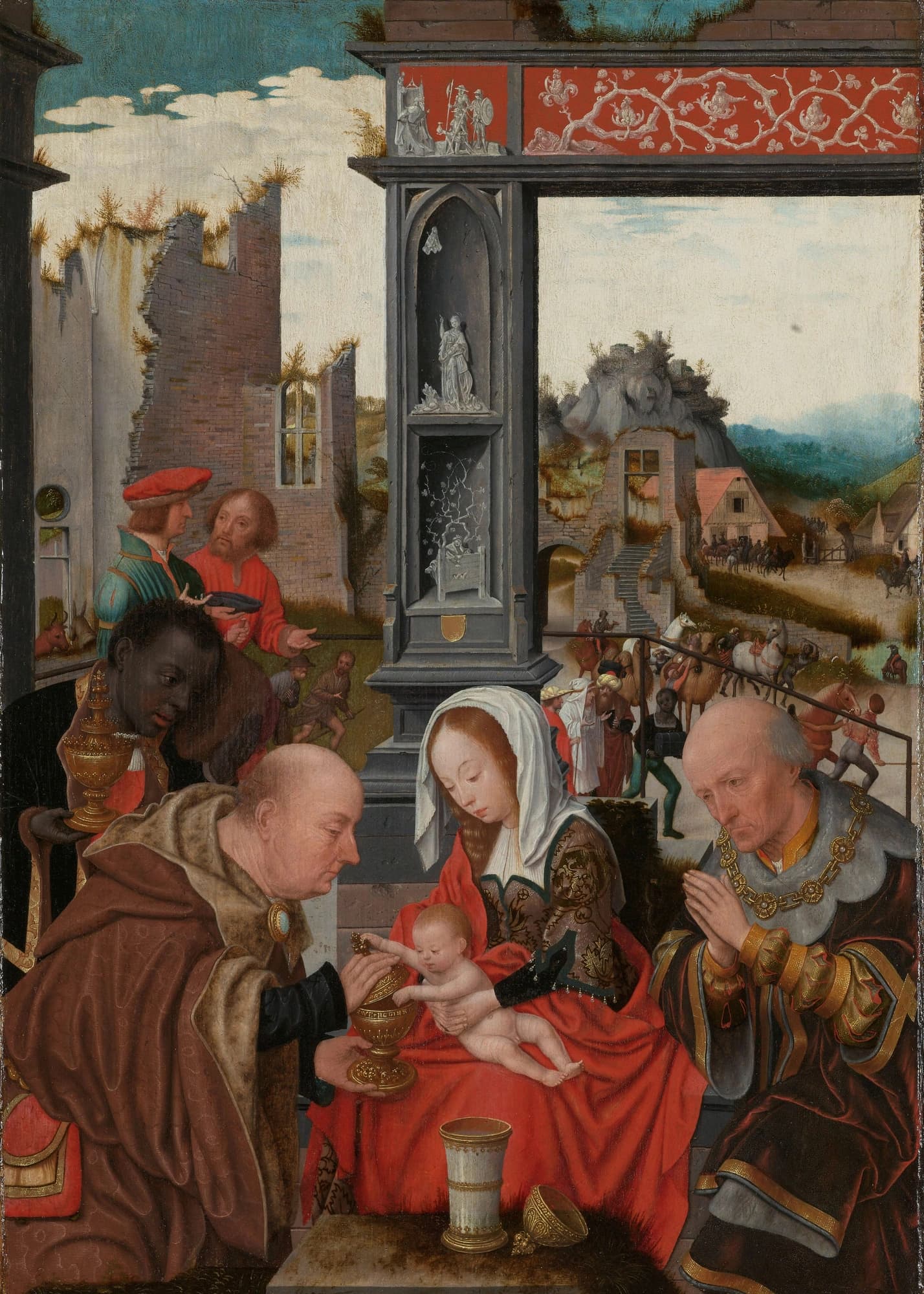
Between 1510 and 1516, he developed a delicate style featuring doll-like figures in bright, blue-skied landscapes, characterized by precise brushwork and religious attention to detail.1
In 1518, he was appointed 'painter with honors' by Margaret of Austria. He painted portraits for her, including a posthumous portrait of her husband, Philibert II, as a New Year's gift.1
In the 1520s, influenced by Joachim Patinir, he adopted romantic landscapes with expansive hills and receding rivers. His landscapes were so accomplished they were once attributed to Patinir.1
Interested in human origins, he blended Christian and pagan interpretations. In 'First Family,' he depicted Adam and Eve's family as primitive people working their land.1
Around 1525, he painted one of the earliest surviving individual portraits of a Black African man, likely a member of Margaret's court or a bodyguard of Charles V, indicated by his rich attire.1

His famous 'West Indies Landscape' is an ambitious, imaginary depiction of the New World. Though he never traveled there, he used Patinir-style cliffs to express his fascination with primitive lands.1
In 1549, he petitioned to move to Hoorn to complete an altarpiece. He spent most of his life in Haarlem, serving as a deacon of the painters' guild and remaining a prominent local artist.1
Many of his works were destroyed in the Great Fire of Haarlem in 1576. Consequently, his surviving oeuvre is limited, and some works have been reattributed to artists like Adriaen Isenbrant.1