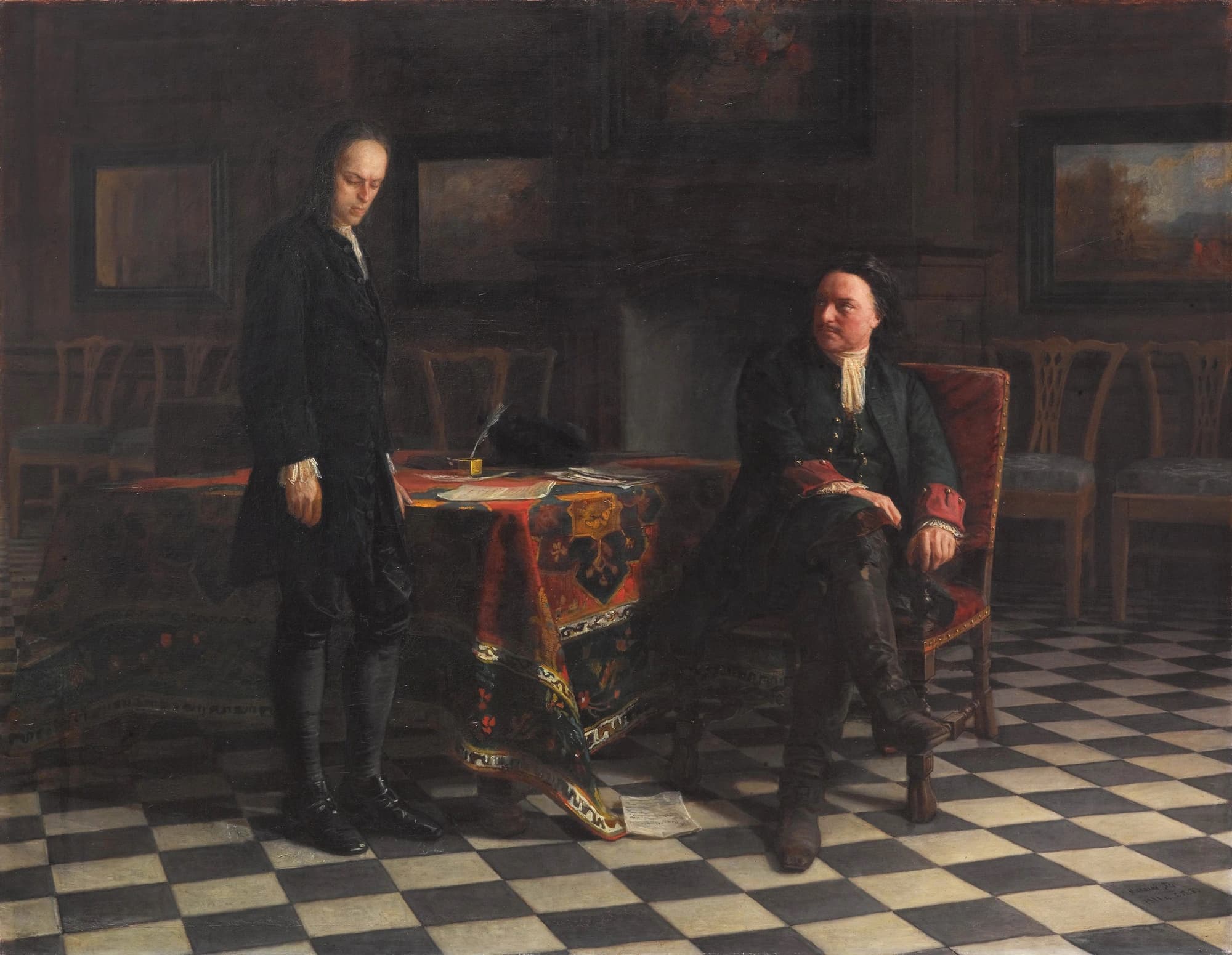
Artist
Nikolai Ge
Works (2)

Timeline
Born into a family of French noble descent in Voronezh, his surname 'Ge' is a Russian transliteration of the original French 'Gay'.1
In 1850, Ge abandoned his career in science to enroll in the Imperial Academy of Arts, studying under Pyotr Basin and being strongly influenced by Karl Briullov.1
During his stay in Italy, Ge met Alexander Andreyevich Ivanov, who became a profound influence on his future works and spiritual exploration in religious painting.1
The Last Supper caused a scandal, with critics hailing it as a 'triumph of materialism and nihilism' for its humanized, non-idealized depiction of Christ.1
In 'The Last Supper' (1863), Ge used a photograph of Alexander Herzen as the model for Christ, marking the first known use of photography for a central figure in a painting.1
In the 1870s, believing art should not be for sale, Ge moved to a farm and became a close friend and follower of Leo Tolstoy's philosophy.1
In his later years, Ge claimed everyone had the right to a portrait and accepted commissions for whatever the subject could afford, including portraits of Tolstoy.1
His later religious works were criticized for illustrating Ernest Renan's rationalist views rather than the New Testament, leading to bans for blasphemy.1
His final work, 'The Crucifixion' (1894), was banned from exhibition by Tsar Alexander III due to its shocking and unconventional depiction.1
Many of Ge's drawings were discovered in Swiss second-hand stores in 1974 and were finally acquired by the Tretyakov Gallery in 2011.1