Artist
Alexander Roslin
Timeline
After training as a naval draughtsman in Sweden, he apprenticed under court painter Georg Engelhard Schröder, where he was strongly influenced by French masters like Rigaud and Largillière.1
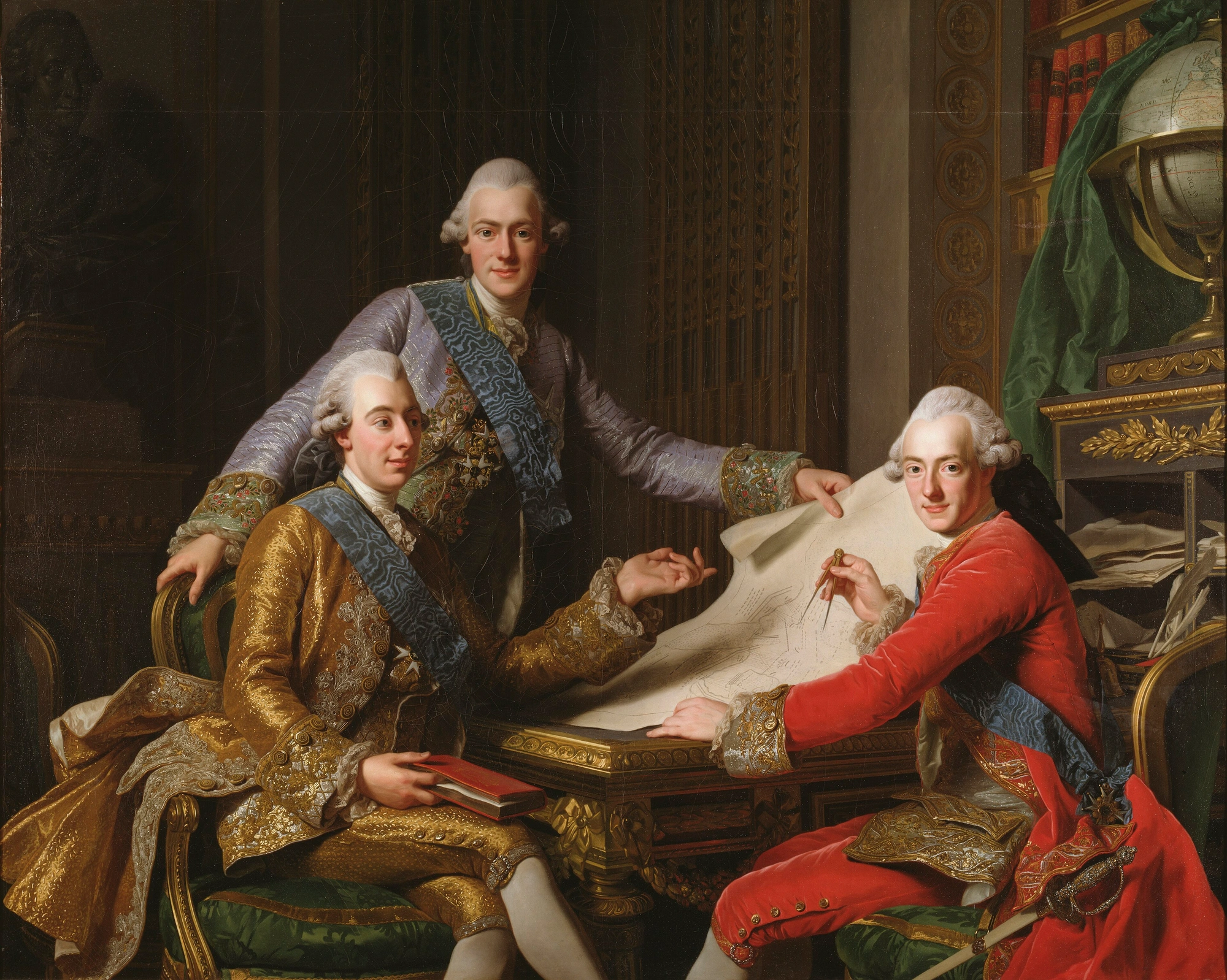
Known for blending Rococo elegance with Classicist tendencies, his masterful rendering of textures like satin and jewels led to the saying, 'Satin, skin? Go to Roslin.'1
Upon moving to Paris in 1752, he became a protégé of François Boucher and rapidly rose to fame, eventually becoming a member of the French Art Academy despite being a foreigner.1
His early work featured bright, cool colors influenced by Nattier and Rigaud, but from the 1760s he adopted bolder coloring, balancing psychological insight with ornate decoration.1
In 1765, he won a competition against Jean-Baptiste Greuze with his portrait of the Duke of La Rochefoucauld and his family, solidifying his reputation among the French aristocracy.1
A double portrait of Roslin and his wife features a gold box from their friend Peill and the inscription 'Loin et près' (Far away yet close), symbolizing their deep friendship.1
His masterpiece 'The Lady with the Veil' depicts his wife, the pastel painter Marie-Suzanne Giroust. Her appearance in Bolognese fashion was highly praised by the philosopher Denis Diderot.1
Often called 'Roslin the Swede,' he received the exceptional honor of a royal pension and a free apartment in the Louvre in 1771, despite his foreign origin.1

During a two-year stay in Russia starting in 1775, he painted Empress Catherine II. Although she tried to persuade him to stay in her service, he declined and returned to Paris.1
Having survived the French Revolution despite losing many patrons, he was considered the wealthiest artist in Paris at the time of his death in 1793.1