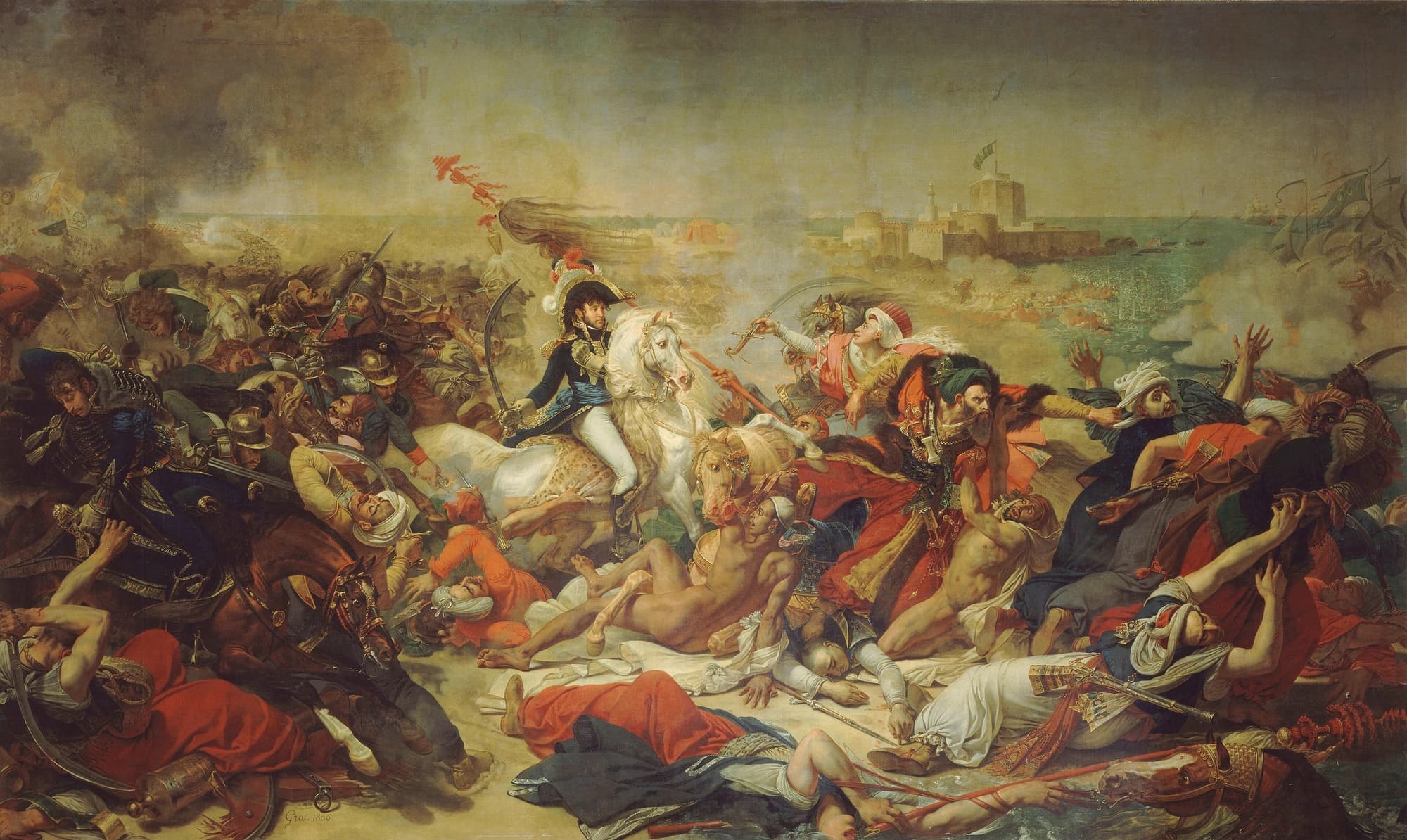
Artist
Antoine-Jean Gros

Timeline
Born into an artistic family in Paris, Gros began drawing at age six under his father, a miniature painter. His precocious talent led him to David's studio at the young age of 14.1
In late 1785, Gros entered the studio of Jacques-Louis David. While training under the Neoclassical master, he began developing a dramatic style that would later influence Romanticism.1
Gros met Josephine in Italy, who introduced him to Napoleon. His 1796 portrait of Napoleon at Arcole brought him fame and secured his position as a favored artist of the future Emperor.1
Appointed as an inspector of reviews, Gros followed Napoleon's army and witnessed battles firsthand. In 1797, he was tasked with selecting art spoils from Italy for the Louvre.1
His 1804 masterpiece 'Napoleon Visiting the Plague-Stricken in Jaffa' was commissioned as propaganda to counter British reports of Napoleon's cruelty, depicting him as a compassionate leader.1

Even after Napoleon's fall, Gros remained prominent and was titled Baron in 1824 by Charles X. He became a professor at the Académie, leading the French school in David's absence.1
In his later years, Gros struggled with the burden of upholding David's Neoclassical traditions while resenting the rise of Romanticism, feeling increasingly alienated from modern tastes.1
Despondent over the harsh criticism of his work 'Hercules and Diomedes' at the 1835 Salon, Gros committed suicide by drowning in the Seine, a tragic end to a career caught between eras.1